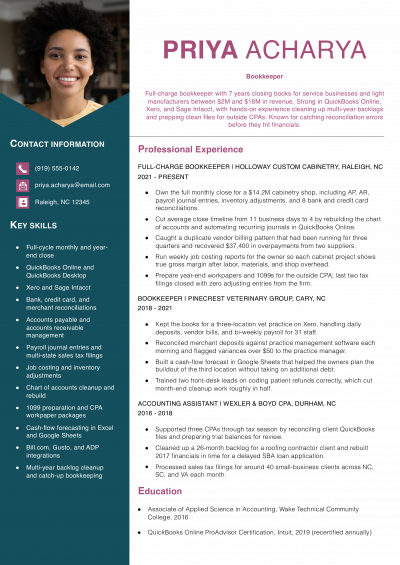
Bank Teller Resume Examples and Templates for 2026



The banking resumes that get callbacks share three things: a credentials block above experience with BSA/AML and licensing status, balancing accuracy stated in specific terms, and referral conversion numbers a branch manager can verify in the first scan.
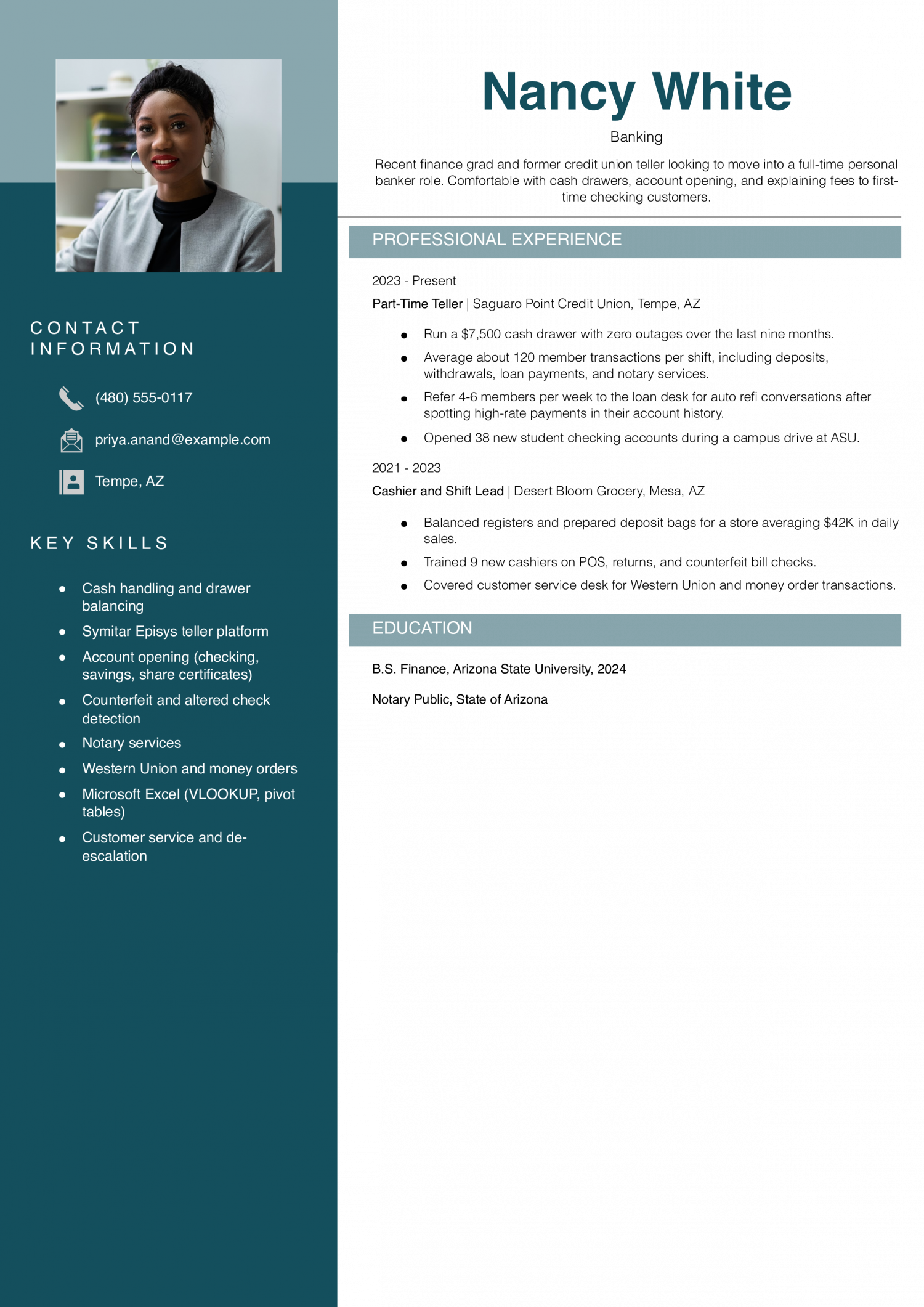
Entry-level applies to new tellers and personal bankers moving from retail or call-center work. The resume needs to prove cash-handling accuracy, customer volume per shift, and any product referrals you closed.
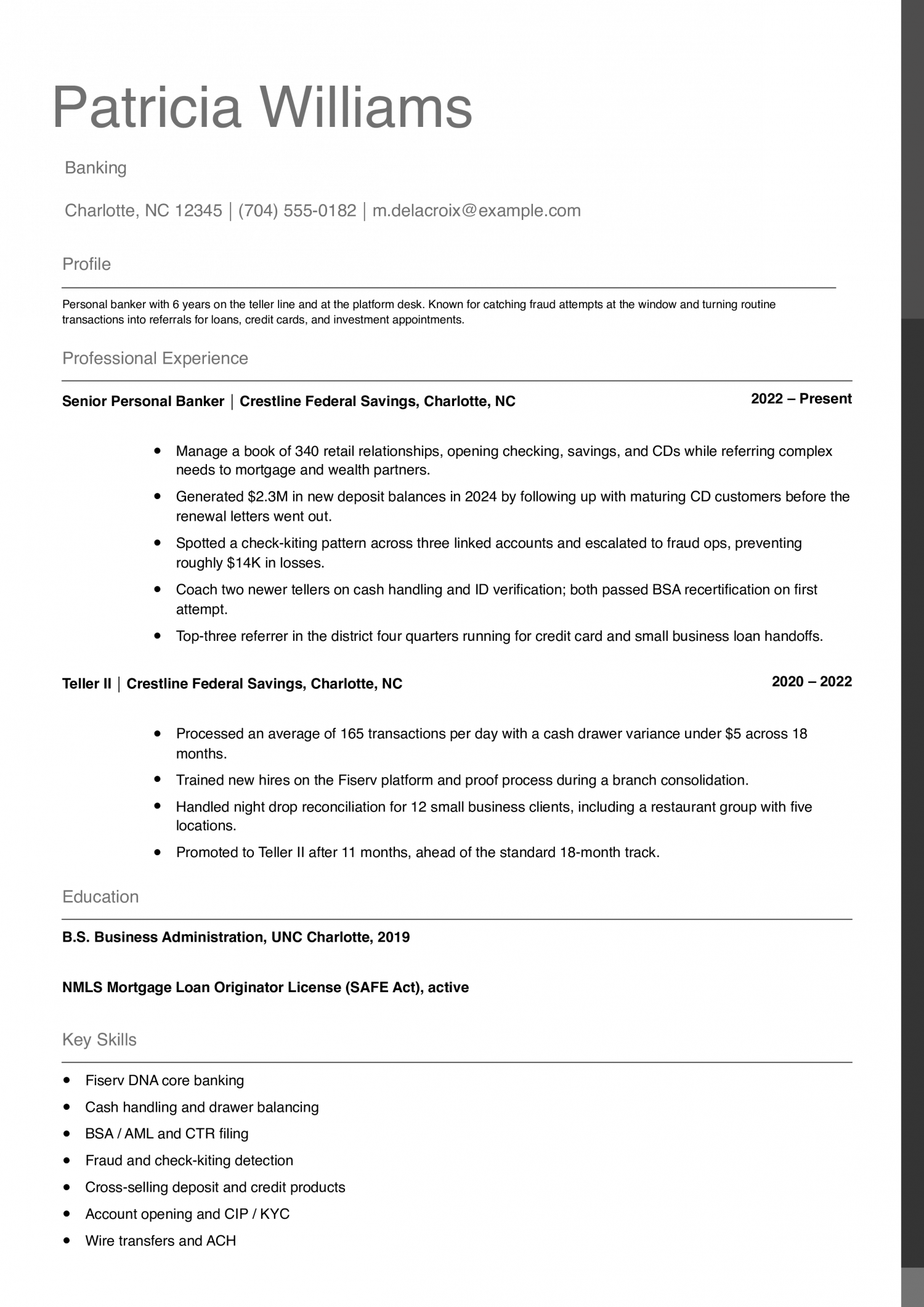
Mid-career covers personal bankers and relationship bankers with two to six years at the window or desk. The resume needs to show a clean balancing record, cross-sell conversion against branch quota, and BSA/AML training.
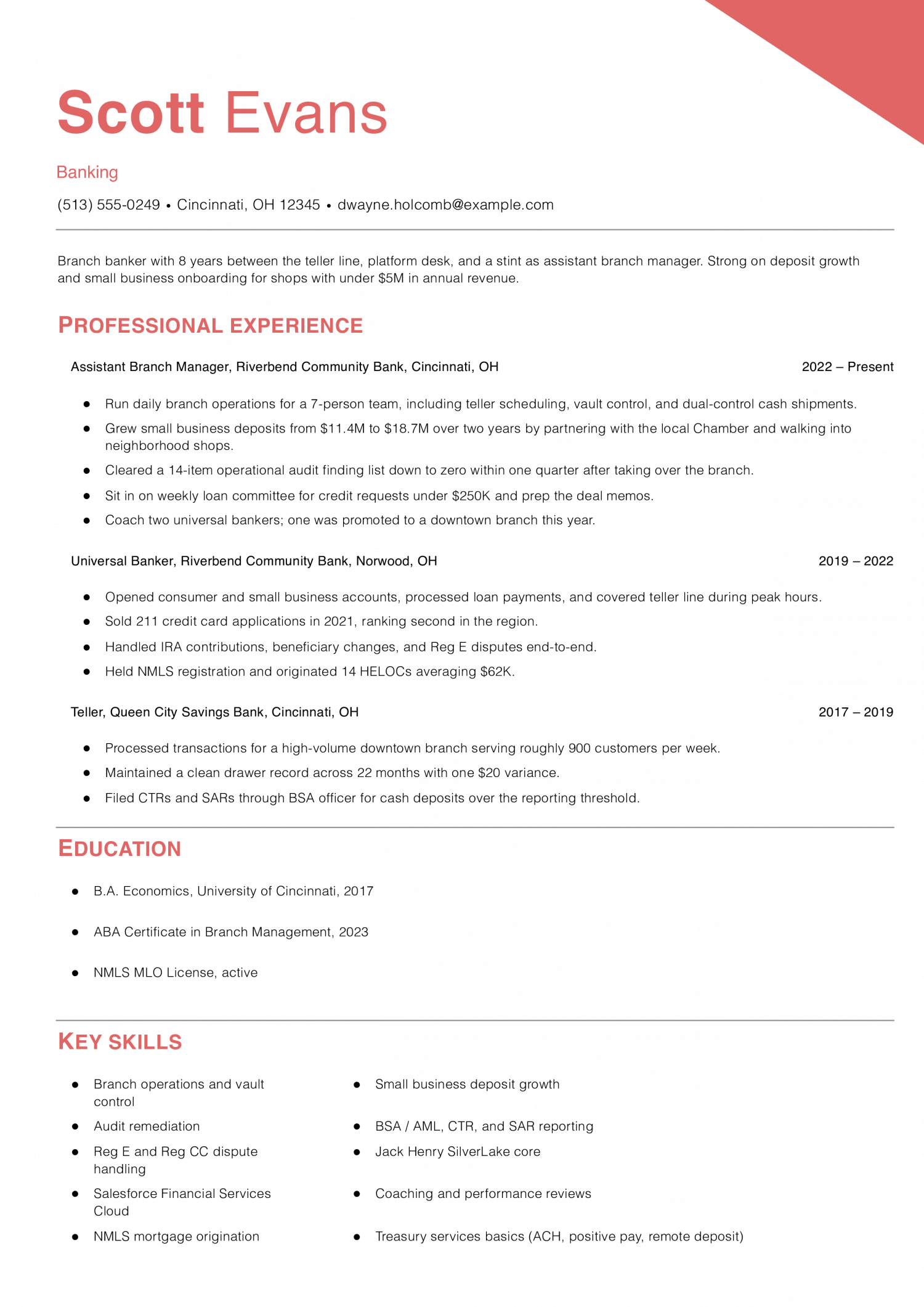
Senior fits relationship managers, branch managers, and private bankers running a book. The resume needs to lead with portfolio size, deposit and loan growth, referral pipeline to wealth or commercial, and audit results.
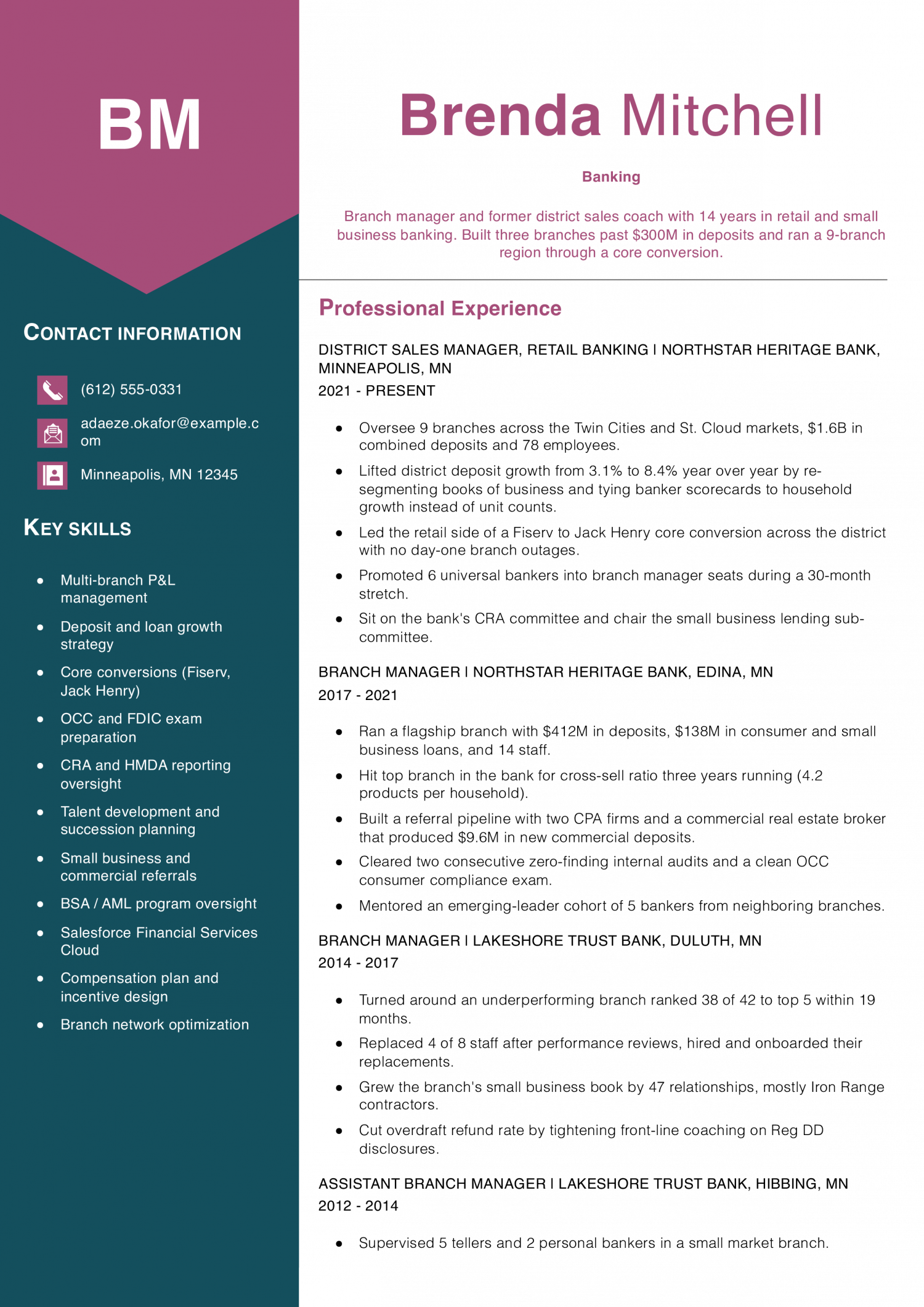
Branch banker with 10 years across teller, personal banker, and assistant branch manager roles in community and regional banks. Strong on deposit growth, fraud detection, and onboarding small business clients in trade and manufacturing neighborhoods.
Your profile should state your years on the line, the bank type you have worked in (national bank, regional, community bank, credit union, private bank), and the products that fill your day.
Name whether you sit at a teller window, a personal banker desk, or a relationship banker book. Add your average daily transaction volume or portfolio size, your licensing status (SIE, Series 6, Series 7, life insurance), and the core platform you run on (FIS, Fiserv, Jack Henry, Salesforce Financial Services Cloud). That scope sentence tells a branch manager in one read whether you fit the opening.
Banking work translates into numbers a branch manager already tracks. Most strong resumes name the daily transaction count, the cash drawer balancing record, the referral conversion rate, and the deposit or loan dollars sourced.
Three metrics tend to carry the most weight: transactions processed per shift, months or quarters at zero shortage, and referrals converted to funded accounts or booked loans. Bullets without a number tend to read as duties. A strong bullet names the product, the count, and the period: 24 credit card referrals converted in Q3, $1.8 million in deposits booked over six months, 14 consecutive months balanced.
Sort your experience into four categories so the scan finds what it needs.
Transactions and cash handling: deposits, withdrawals, treasury checks, foreign currency, vault and ATM balancing. Sales and referrals: deposit account openings, credit card applications, consumer loan referrals, mortgage handoffs, wealth referrals. Compliance and controls: BSA/AML monitoring, CTR and SAR filings, Reg CC hold decisions, KYC reviews, dual control.
Service and resolution: complaint handling, fraud claims, debit card disputes, account research. Each group should hold two or three bullets so the reader can compare you against the job posting line by line.
Banking is a regulated hire, so the credentials block sits on page one above your work history.
List your SIE, Series 6 or 7, state life and health insurance, and NMLS status by state of license in good standing. Do not print the NMLS number on the resume; it goes on the application. Add BSA/AML annual training, OFAC, Reg CC, Reg E, and Reg Z refreshers with the year completed.
Bank hiring managers and financial-services recruiters need to confirm you can sit at the window or open accounts on day one, and the credentials block answers that before they read a single bullet.
Entry and mid-career banking resumes should close with a tight education and systems block.
List your degree or in-progress coursework, plus any bank-sponsored training programs (teller academy, personal banker certification, credit college). Then add a systems line naming the core platform, the CRM, and the office tools: FIS IBS or Fiserv DNA, Salesforce Financial Services Cloud, nCino for loan origination, Encompass for mortgage handoffs, and Excel for daily reporting. That closing section helps a recruiter confirm you can step onto their stack without a four-week ramp.
ATS filters catch more banking resumes than ever in 2026. The skills below come from our user-built banking resumes. Platform names and compliance terms clear the first cut, and client-service language decides whether the resume advances.
Bank hiring managers and financial-services recruiters weigh hard skills first because regulators audit them, then read soft skills as proof your bullets are real. Match the table against the job posting and use soft skills as the language that frames each accomplishment bullet.
| Soft Skills | % of resumes with this skill |
|---|---|
| Customer service | 76% |
| Communication | 59% |
| Attention to detail | 45% |
| Problem solving | 35% |
| Integrity | 31% |
And here are the top hard skills showing up most often.
| Hard Skills | % of resumes with this skill |
|---|---|
| Cash handling | 79% |
| Account management | 50% |
| Regulatory compliance | 41% |
| Financial analysis | 37% |
| Banking software | 28% |
Based on data from thousands of bankers’ resumes built on ResumeTemplates.com, May 2026.
Before a banking resume gets a closer read, hiring teams check for a short list of essentials.
Bank hiring managers and financial-services recruiters expect a niche section that mirrors the posting’s vocabulary. Group keywords by the sub-area of banking you actually work in.
| Niche | Keywords ATS scans for |
|---|---|
| Teller line | cash handling, drawer balancing, vault audit, CTR filing |
| Personal banker | deposit account opening, credit card referrals, consumer loan origination, cross-sell |
| Relationship and private banking | book of business, portfolio growth, wealth referral, high-net-worth client service |
| Compliance and BSA/AML | KYC review, SAR filing, OFAC screening, transaction monitoring |
| Lending and credit | nCino, Encompass, credit memo, underwriting support |
AI use on a banking resume can go three ways: lead with “AI-powered banker” (which recruiters cut), leave it off entirely (which reads as evasive when banks are rolling out Copilot and Salesforce Einstein), or describe the workflow as it actually runs at the branch or desk. The third is what branch managers can validate.
Call-center chatbots now handle balance and routing questions, so window time shifts to product conversations and exception work.
AI-assisted KYC checks pre-fill new account workflows, so bankers spend more time on suitability and cross-sell.
Machine-learning alerts feed the queue, so bankers and compliance staff review flagged transactions instead of scanning logs manually.
Generative tools draft first-pass credit memos and call notes, with the banker editing for accuracy before submission.
Microsoft 365 Copilot: Drafts client emails, summarizes call notes, and pulls account data into Excel for portfolio reviews.
Salesforce Einstein (Financial Services Cloud): Scores next-best-action referrals and surfaces life-event triggers for personal and relationship bankers.
Banking is a multi-track field, and the credential you hold tells a recruiter which lane you belong in. Below is how the major financial credentials read on a banking resume in 2026.
SIE plus Series 6 or 7: required for personal and relationship bankers selling investment products
NMLS registration: required for any banker taking residential mortgage applications, listed by state
CFA Level I, II, or III: signals a credit, corporate banking, or capital-markets path
CPA: useful for credit analysts, audit, and finance roles inside the bank
CAMS: signals a BSA/AML compliance track for bankers moving off the line
Bank hiring managers and financial-services recruiters read this list as a map of where your work is heading. The certifications below tell them which track you have invested in, retail, lending, compliance, or wealth. List the issuing body and the year of completion next to each.
SIE (Securities Industry Essentials): A baseline FINRA exam that signals you can sit for Series 6 or 7 and handle investment referrals.
Series 6 or Series 7 (FINRA): Required for personal bankers and relationship bankers who sell mutual funds, annuities, or full securities.
Certified AML Specialist (CAMS): Issued by ACAMS; signals a compliance or BSA officer track for bankers moving off the line.
Certified Financial Marketing Professional (CFMP): Issued by ABA; useful for relationship bankers building books and branch managers running outreach.
For banking roles, the 10th-percentile floor anchors the new-teller starting point and the top-decile ceiling reflects relationship bankers and branch managers running large books. That spread tells you product mix, licensing, and the bank type you sit inside move you from floor to ceiling more than tenure alone. Geography matters too: metro markets with private banking and commercial concentration pay above the national mean.
Lead the resume with your licensing, the platform you run, and the deposit or loan dollars you have sourced.
| # | State | Avg. Annual |
|---|---|---|
| 1 | Washington | $46,890 |
| 2 | Connecticut | $46,310 |
| 3 | New Jersey | $101,340 |
| 4 | Massachusetts | $45,720 |
| 5 | Alaska | $45,590 |
| 6 | Massachusetts | $45,100 |
| 7 | Oregon | $44,600 |
| 8 | District of Columbia | $44,380 |
| 9 | Colorado | $44,370 |
| 10 | Florida | $44,120 |
| # | State | Workers | Median |
|---|---|---|---|
| 1 | Texas | 26,390 | $37,190 |
| 2 | California | 25,440 | $45,920 |
| 3 | New York | 17,420 | $44,040 |
| 4 | Illinois | 16,490 | $38,490 |
| 5 | Pennsylvania | 15,580 | $38,750 |
Resume Templates offers HR approved resume templates to help you create a professional resume in minutes. Choose from several template options and even pre-populate a resume from your profile.
Yes. Teller work is the foundation banks look for in personal bankers, relationship bankers, and branch managers.
Keep the role on the resume and translate it. Lead the bullets with referrals you sourced, products you opened, and the compliance work you handled, not the cash drawer alone.
If you are applying to a credit analyst or operations role, compress the teller bullets to three lines and weight the rest toward analysis, reconciliation, or systems work.
Lead each bullet with a number a branch manager already tracks.
Use transactions per shift, months at zero shortage, referrals converted, accounts opened, or dollars in new deposits. Then name the product or regulation: credit card referrals, Reg CC hold decisions, CTR filings, vault balancing.
Cut verbs like assisted and helped. Replace them with processed, balanced, referred, opened, and resolved.
Skip the objective. It reads as filler in 2026.
Write a three-line summary that names your years on the line, your licensing (SIE, Series 6, NMLS), your daily transaction volume or book size, and the core platform you run on.
Close the summary with the product you sell best: deposit accounts, consumer loans, credit cards, or wealth referrals.
Treat the internship as a full job entry, not a one-liner.
Name the group (M&A, leveraged finance, equity capital markets), the deal types you supported, the modeling work you did in Excel, and the pitch materials you built in PowerPoint.
Add transaction size where the bank has made it public. For confidential work, use ranges ("supported three middle-market M&A pitches, $50M to $250M range").
For a banker, a professional template is the safest pick, because it signals the polish hiring managers in this field expect. An ATS-friendly template is a solid alternative. Whichever you choose, keep the formatting clean and easy to parse: clear section headings, a standard font, and no graphics a parser can choke on.
Executive Resume Writer and Career Coach
Andrew Stoner is an executive career coach and resume writer with 17 years of experience as a hiring manager and operations leader at two Fortune 500 Financial Services companies, and as the career services director at two major university business schools.
Customize this template in our builder in under 10 minutes.