Electrician Resume Examples and Templates for 2026



Hiring foremen scan the first page for OSHA tickets, the equipment you've run, and the trades you've performed, because that combination tells them whether you can be useful on the crew this week.
Entry-level construction workers are breaking in through a labor pool, a temp agency, or a first non-union crew. The resume needs to prove OSHA 10, reliable transportation, and any hands-on work, paid or unpaid, that shows you can swing a hammer.
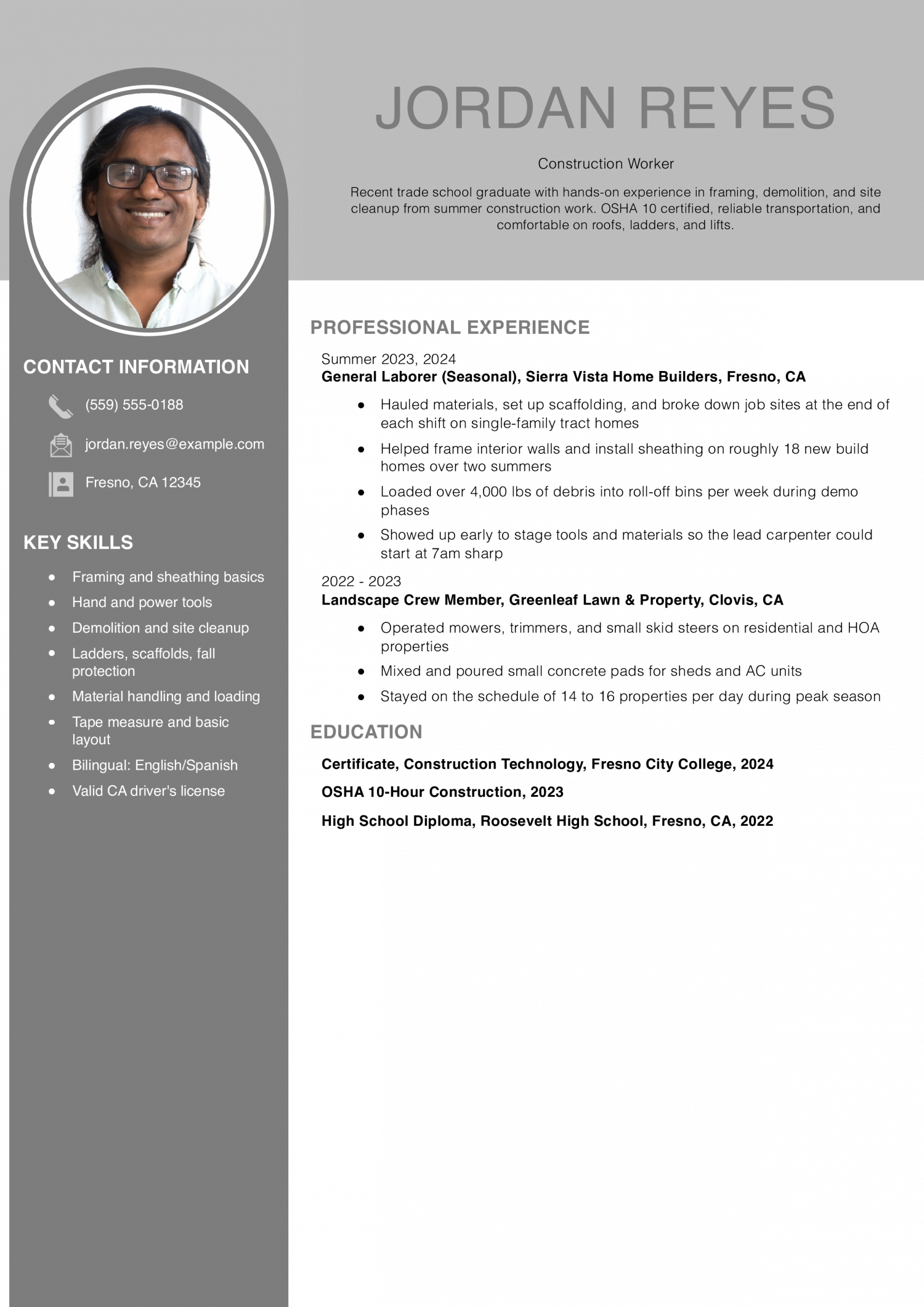
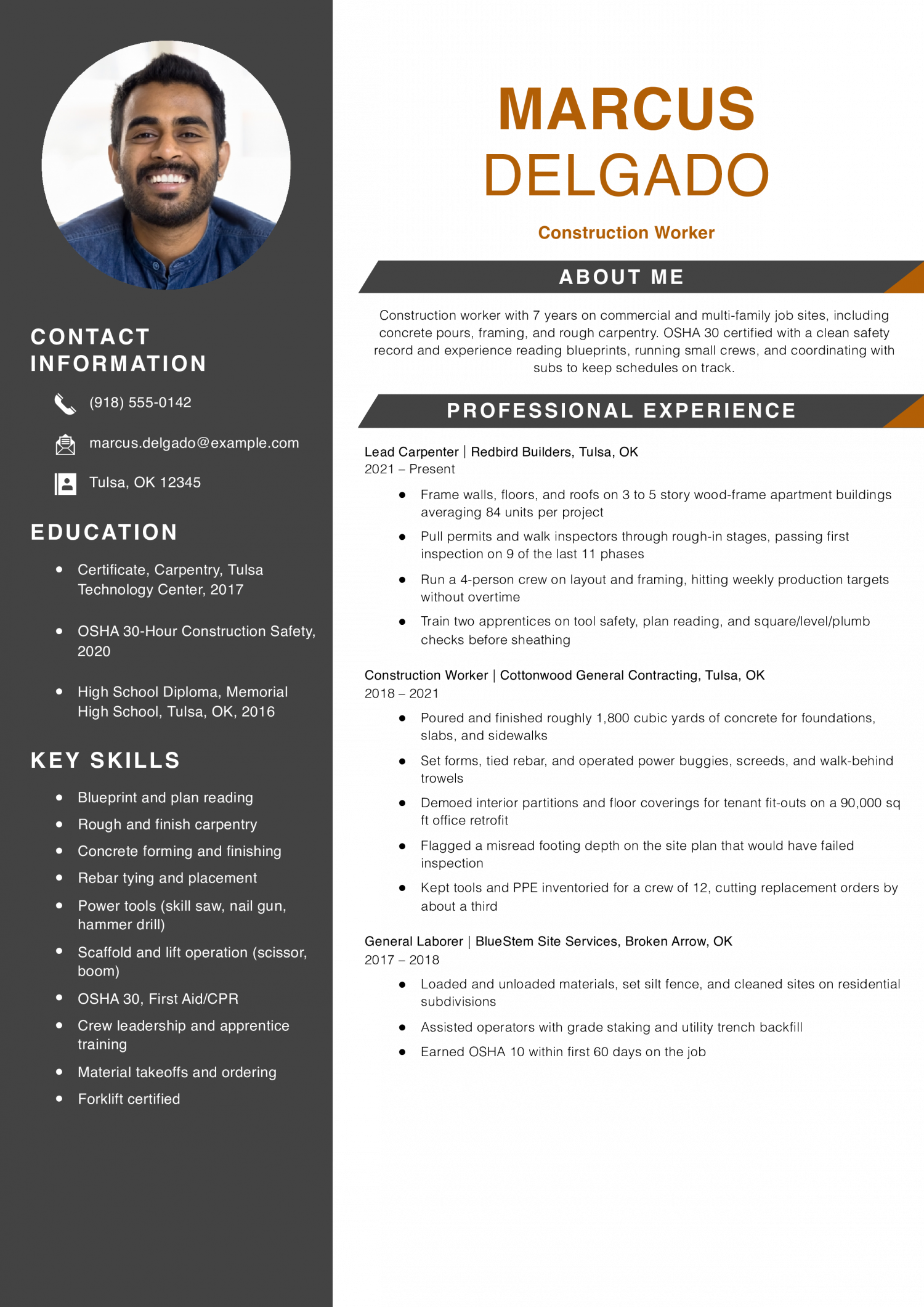
Experienced construction workers have three to seven years on residential or commercial sites and a clear trade specialty. The resume needs to prove the equipment you run, the trades you've performed, and the project types you've completed start to finish.
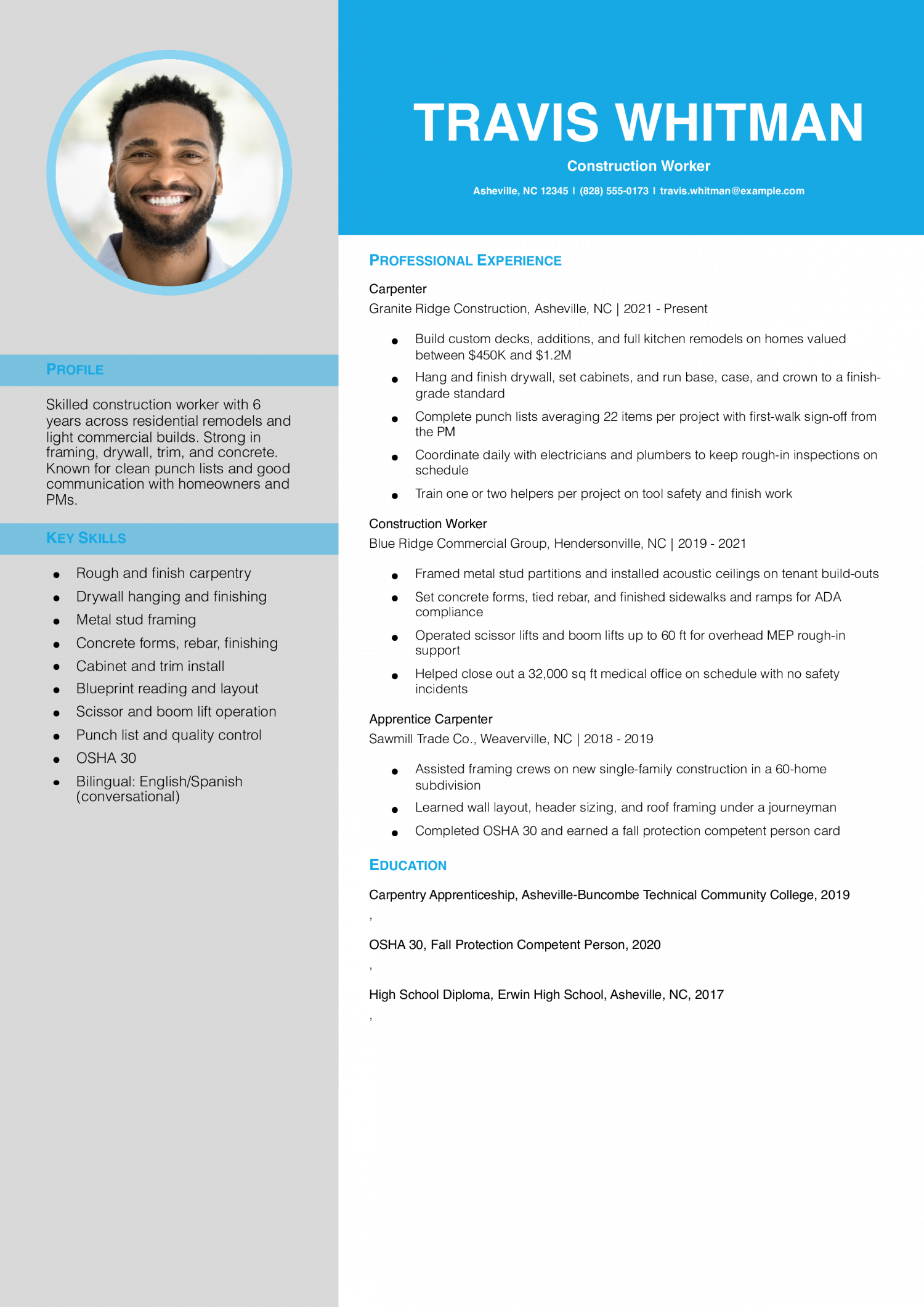
Foremen run crews of four to twenty on active sites and answer to the general contractor. The resume needs to prove crew size led, project value delivered, OSHA 30, and a clean safety record across multiple jobs.

Daniel Pruitt
Boise, ID | (208) 555-0167 | [email protected] | linkedin.com/in/danielpruitt
Construction worker with 10 years across residential, multi-family, and light commercial projects. Skilled in framing, concrete, drywall, and site work. OSHA 30 certified with experience leading small crews, reading plans, and pushing schedules to keep GCs on track.
Working Foreman
Foothill Ridge Construction | Boise, ID | 2022-Present
Carpenter
Snake River Builders | Nampa, ID | 2019-2022
Concrete Finisher
Cascade Pour Co. | Meridian, ID | 2017-2019
Framer
Owyhee Frame & Truss | Caldwell, ID | 2015-2017
General Laborer
Treasure Valley Site Works | Boise, ID | 2014-2015
Your profile should state your years on active job sites and the trades you work in. Name framing, concrete, drywall, demolition, roofing, or whichever combination you actually perform.
Add the project type (residential, commercial, industrial, civil) and the equipment you’re cleared to operate. Close with your OSHA card and any specialty tickets a foreman would care about.
Trades work rarely fits neat percentages, so lean on volume and scope. Name square footage framed, linear feet of concrete poured, units finished, or crew size you’ve worked alongside.
Strong bullets read like “framed 14 single-family units over an 18-month build” rather than “responsible for framing.” Numbers without a story still beat duties without numbers.
Bundle bullets under three or four trade buckets so a foreman can scan them in seconds. Common groupings are framing and rough carpentry, concrete and formwork, demolition and site prep, and finish work.
Under each bucket, name the tools and equipment used: skid steer, jackhammer, nail gun, miter saw, laser level, scaffolding. Specific tools beat the generic phrase “power tools.”
Foremen and shop managers need to see OSHA 10 or OSHA 30, forklift or aerial lift certs, scaffold user training, and any CDL or flagger card without scrolling. Put them in a credentials block under your profile.
Add first aid and CPR if current. List the issuing body and the year, and note any union affiliation in the same block so the desk reading the resume sees scope and clearance together.
Education is short: high school, GED, or trade school with the year. Add any apprenticeship hours logged toward a journeyman card, since hours on the books are real currency on a construction worker resume.
End with a one-line note on reliable transportation, willingness to travel between sites, and clean driving record if you’ve got one. These read as proof you’ll show up on time, every day.
The construction worker resumes that get callbacks share a specific skill mix. The lists below come from our user-built construction worker resumes. Foremen and site supervisors scan for these patterns first, not generic phrases like “hard worker” or “team player.” Hard skills name the trades and equipment; soft skills back up the bullets that show you stay on the crew.
Match these lists against the trades named in your target posting, and treat the soft skills as evidence behind your work history, not a separate paragraph.
| Soft Skills | % of resumes with this skill |
|---|---|
| Teamwork | 65% |
| Physical stamina | 53% |
| Reliability | 43% |
| Communication | 38% |
| Time management | 32% |
And here are the top hard skills showing up most often.
| Hard Skills | % of resumes with this skill |
|---|---|
| Power tool operation | 69% |
| OSHA safety compliance | 50% |
| Blueprint reading | 41% |
| Heavy equipment operation | 38% |
| Concrete and framing | 28% |
Based on data from thousands of construction workers’ resumes built on ResumeTemplates.com, May 2026.
Before a construction worker resume gets a closer read, hiring teams check for a short list of essentials.
OSHA cards are the first thing a foreman looks for, and they belong in a credentials block on page one. List the card type, the issuing trainer or authorized provider, and the year you completed it.
Foremen read your tool list as a shortcut to your trade scope. Name the actual tools and equipment you’ve operated rather than writing “various power tools.”
Name the local number and the trade: Carpenters Local 157, Laborers Local 79, IBEW Local 3, or whichever applies. Include your book status (Book 1, journeyman, apprentice) and the year you joined.
If you’re working through an apprenticeship, list the hours logged toward your journeyman card. Hours on the books are a real number a hiring hall recognizes.
Foremen and site supervisors read your certifications as a map of where your work is heading. The list below tells them which track, ground labor, equipment operation, or finish trade, you’ve invested in beyond OSHA basics. List the issuing body and the year of completion next to each one.
Construction laborers are one of the larger occupations in the BLS data, which means the median pulls in a long tail of general labor roles alongside skilled trade workers. The spread between the tenth and ninetieth percentiles is wide, and it tracks closely with union membership, equipment tickets, and metro cost of living.
To position above the median, lead your resume with the trades you’ve performed, the equipment you’re cleared to run, and OSHA 30 rather than a generic “hard worker” summary.
| # | State | Avg. Annual |
|---|---|---|
| 1 | Hawaii | $66,100 |
| 2 | Illinois | $64,890 |
| 3 | New Jersey | $63,190 |
| 4 | Massachusetts | $62,430 |
| 5 | California | $60,540 |
| 6 | Minnesota | $58,720 |
| 7 | Rhode Island | $58,290 |
| 8 | Alaska | $57,970 |
| 9 | New York | $57,680 |
| 10 | Washington | $57,240 |
| # | State | Workers | Median |
|---|---|---|---|
| 1 | Texas | 117,580 | $38,180 |
| 2 | California | 85,370 | $60,540 |
| 3 | Florida | 75,770 | $40,820 |
| 4 | New York | 49,890 | $57,680 |
| 5 | North Carolina | 38,530 | $42,250 |
Resume Templates offers HR approved resume templates to help you create a professional resume in minutes. Choose from several template options and even pre-populate a resume from your profile.
Lead with your OSHA card, the trades you perform, and the equipment you can operate. Foremen scan for those three things before reading anything else.
Follow with three to five years of recent work history, naming the contractor, the project type, and what you built. Close with high school or trade school, apprenticeship hours, and a one-line note on reliable transportation.
Open each bullet with a trade verb: framed, poured, hung, demolished, installed. Name what you built and the volume or square footage when you can.
Avoid vague phrases like "assisted with construction tasks." Foremen want to know which trade you owned and which tools were in your hand.
Yes, if the work was real and you can describe it specifically. List the project and the trades you performed rather than naming a family member as the employer.
Use a label like "Independent Residential Projects" or the legal name of the family business if one exists. Treat it the same as any other job: dates, scope, trades performed.
Volunteer builds with Habitat for Humanity, disaster relief crews, or church builds count as real trade experience. Create a section titled "Volunteer Construction Experience" and list the organization, the project type, and the trades you performed.
Name the hours logged if you tracked them and any OSHA briefings the site required. Foremen care about the work, not the paycheck behind it.
For a construction worker, an ATS-friendly template is the safest pick, because it puts your certifications and experience where a hiring manager scans first. A basic template is a solid alternative. Whichever you choose, keep the formatting clean and easy to parse: clear section headings, a standard font, and no graphics a parser can choke on.
Executive Resume Writer and Career Coach
Andrew Stoner is an executive career coach and resume writer with 17 years of experience as a hiring manager and operations leader at two Fortune 500 Financial Services companies, and as the career services director at two major university business schools.
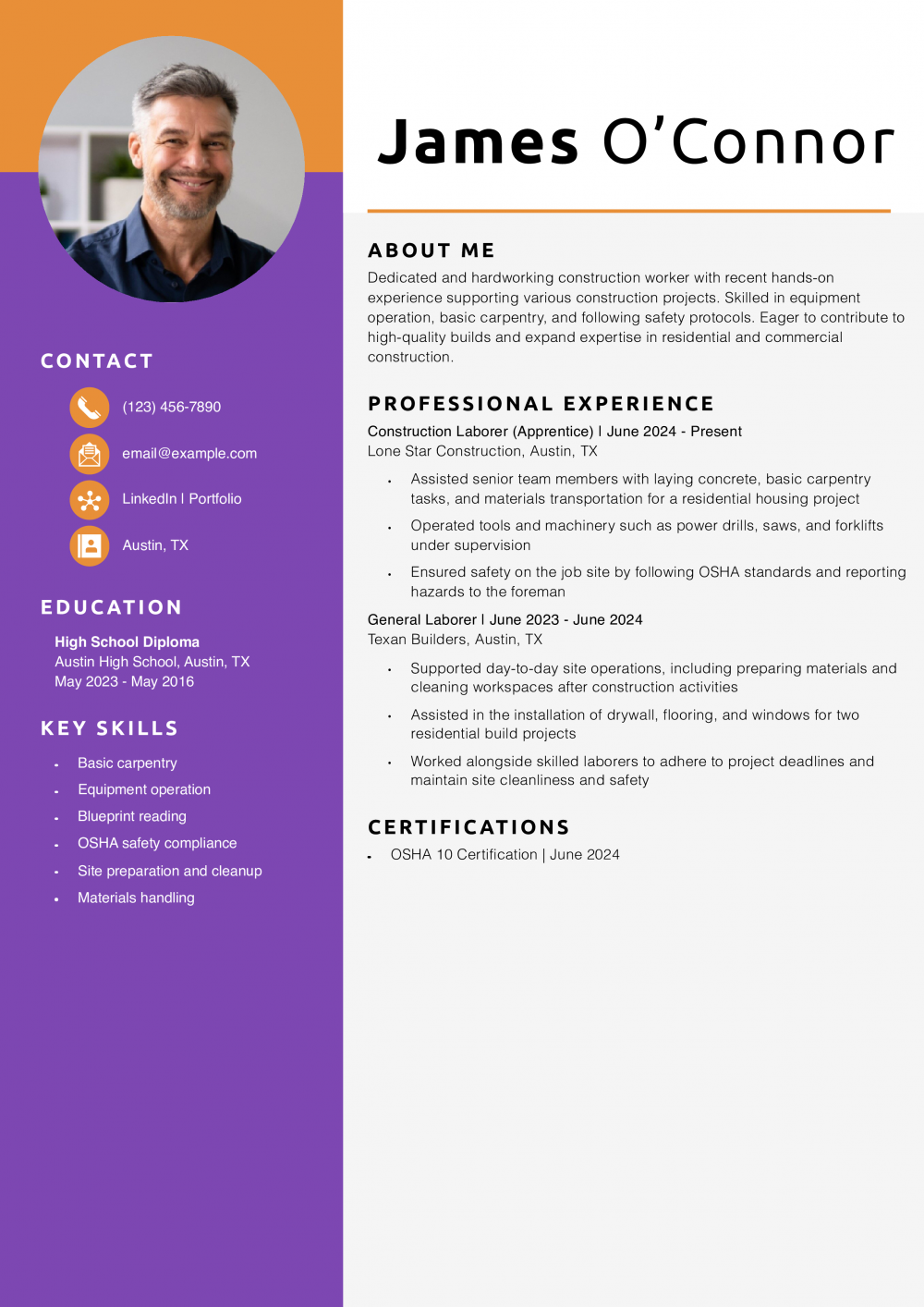
Customize this template in our builder in under 10 minutes.