Tip !

The electrical engineer resumes that advance past the first technical screen share three things: a credentials line with PE or EIT status near the top, project bullets that name voltage and load, and tool fluency in the codes the posting cites.

Andrew Stoner , Executive Resume Writer and Career Coach

Why this resume works

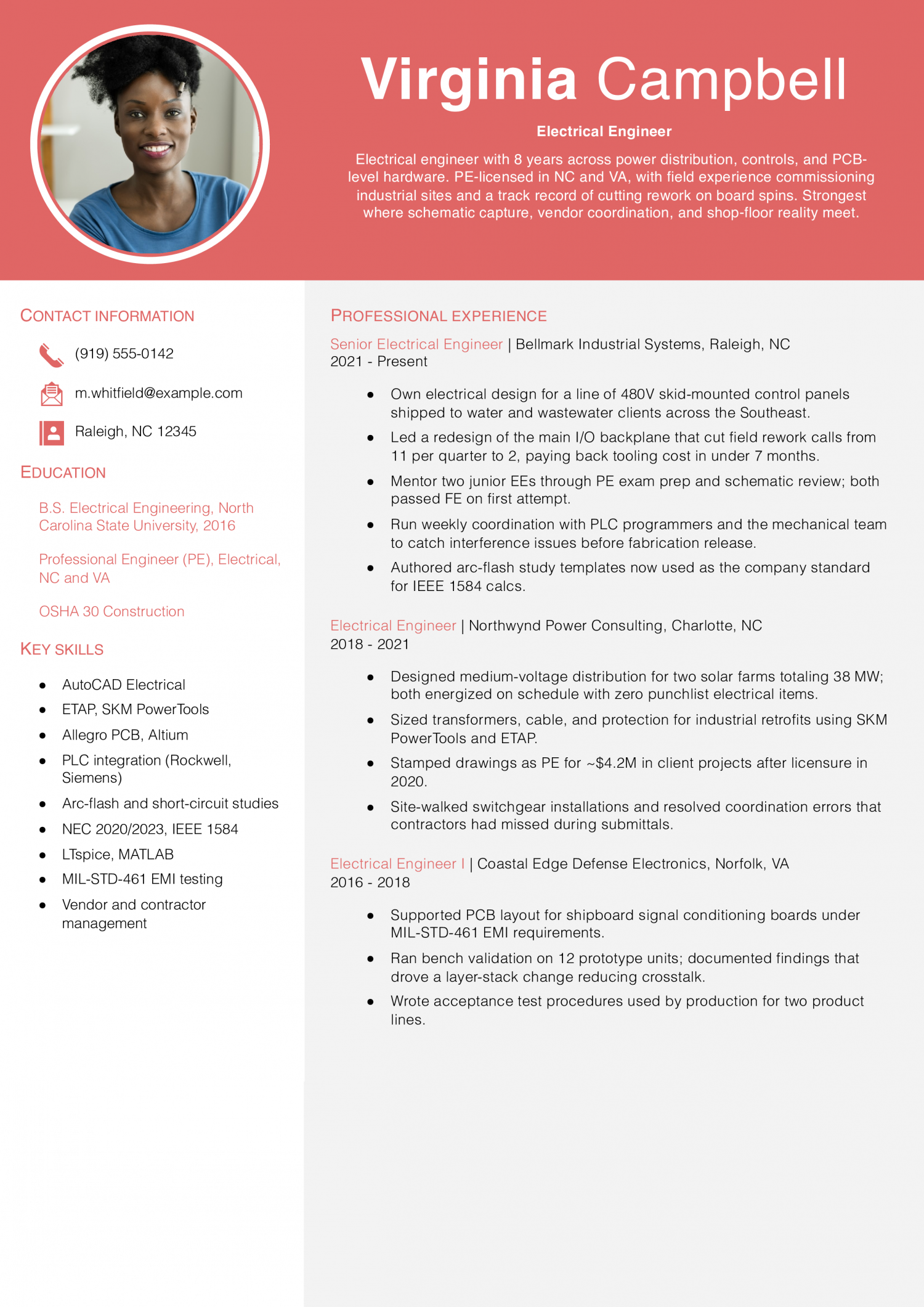
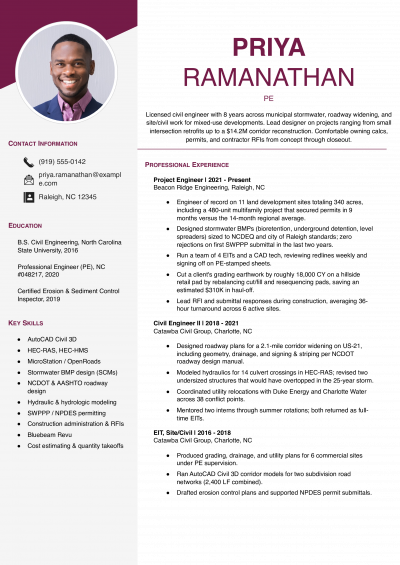
  • Shows real money behind the license: Tying the PE stamp to roughly $4.2M in stamped projects turns a credential into business impact a hiring manager can weigh.
  • One bullet does the heavy metric work: The rework-call reduction (11 down to 2 per quarter, 7-month payback) is the anchor number, so the other bullets can stay qualitative without feeling thin.
  • Mixes design, field, and mentoring: Reviewers see schematic work, site commissioning, and team development, which is what a senior IC role actually asks for.

Junior EE Example

Early-career electrical engineers with one to three years post-graduation, usually EIT-certified and working under a PE. The resume needs to prove coursework translated into delivered calcs, drawings, and field support on real projects.

Why this resume works

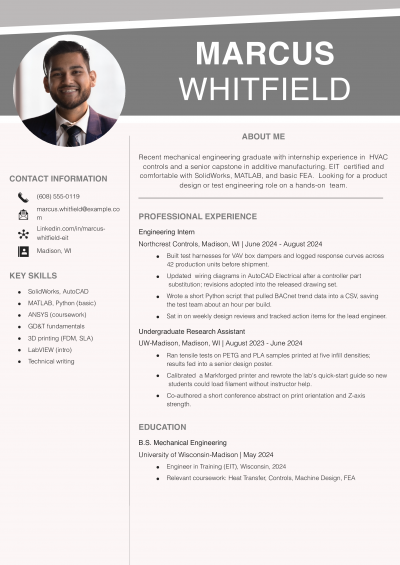
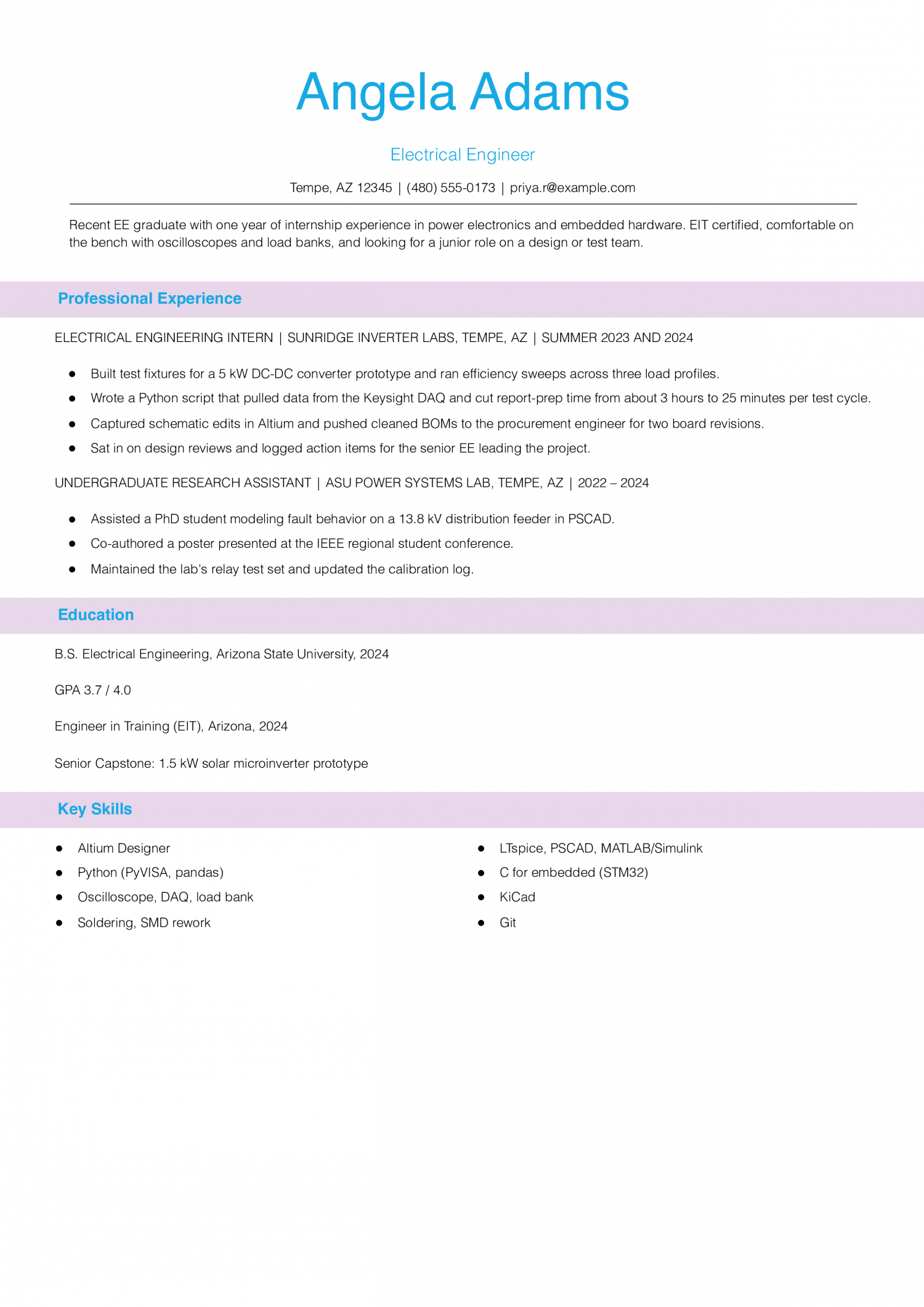
  • Internship work reads like real engineering: Building test fixtures and writing a Python automation script shows the candidate did more than shadow, which is what new-grad reviewers want to see.
  • One clear time-saved number: Going from 3 hours to 25 minutes per test cycle gives the resume a single concrete metric without forcing fake numbers onto every bullet.
  • Credentials sit where they help: EIT, GPA, and capstone all live in EDUCATION, keeping EXPERIENCE focused on work output instead of school details.

Senior EE Example

Engineers with five to ten years owning designs from schematic through commissioning, often pursuing or holding a PE. The resume needs to prove project scope in voltage, load, and budget, plus the codes and tools you ran.

Why this resume works

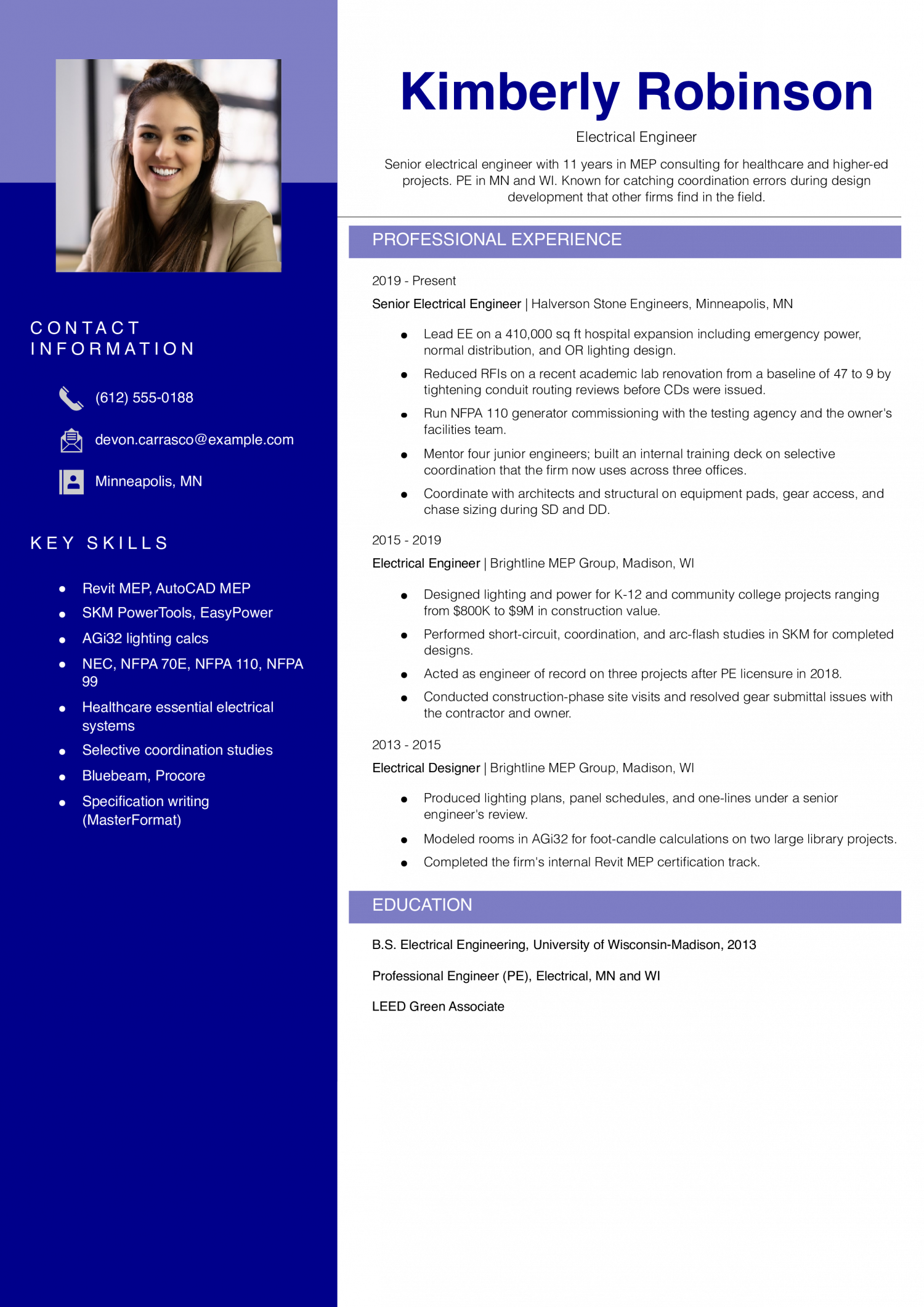
  • Picks a metric reviewers respect: RFIs dropping from 47 to 9 on a renovation is a number every MEP firm tracks, so it lands without needing extra explanation.
  • Codes and standards are named, not implied: Listing NFPA 110, NFPA 99, and selective coordination tells healthcare hiring managers the candidate already speaks their language.
  • Career path tells a clean story: Designer to EE to Senior EE at related firms shows steady growth in stamp authority and project size.

Lead Example

Lead or staff engineers who set design standards, mentor EITs, and sign or stamp drawings. The resume needs to prove discipline ownership, multi-project budgets, code-committee or client-facing work, and measurable design wins.

Why this resume works

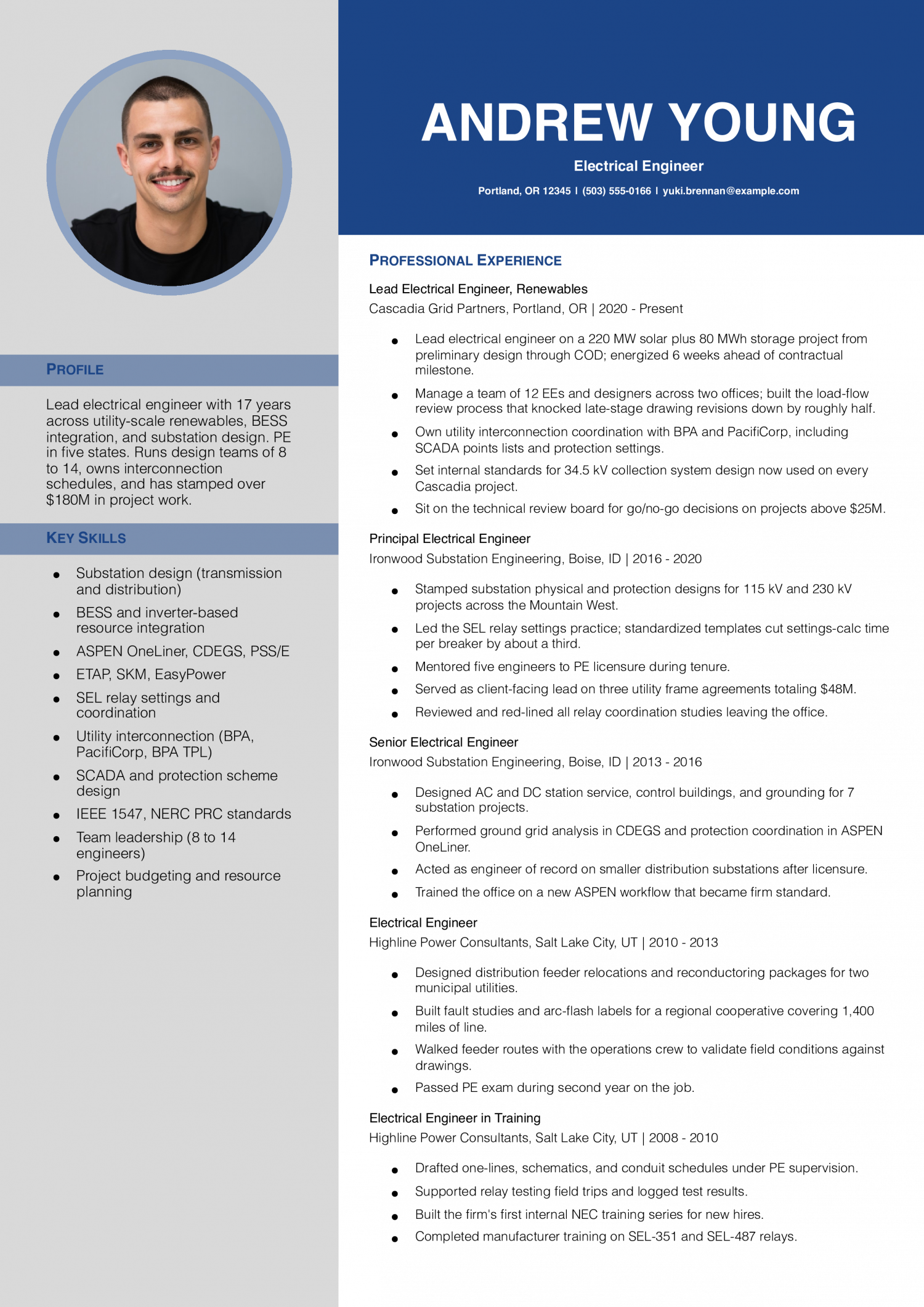
  • Scope matches a Lead title: A 220 MW plus 80 MWh project, $180M stamped, and team sizes of 8 to 14 are the right scale signals for senior leadership.
  • Mentor count is concrete: Five engineers brought to PE under their watch shows the candidate actually builds bench strength, not just delivers projects.
  • Long history stays scannable: Five jobs across 17 years are summarized with 4 to 5 tight bullets each, so the resume reads its full arc without bloating to four pages.

How to Write an Electrical Engineer Resume

01 Open with what a license lookup won't show

Lead with the one signal an engineering director cannot pull from a state PE lookup. That might be a specific design portfolio, a code-committee seat, or fluency in a stack the posting names.

Concrete openers carry weight: 480V switchgear coordination studies in ETAP, arc-flash analysis to IEEE 1584, PLC programming on Allen-Bradley ControlLogix, or PCB layout in Altium for FCC Class B. Pair it with your PE state or EIT status. The reviewer reads one line and knows whether your scope matches the opening.

02 Quantify scope on every project bullet

Most strong electrical engineer bullets carry a number. Reviewers scan for voltage class, load size, schedule, and budget before reading the verb.

Aim for two or three metrics per bullet: voltage level (480V, 13.8kV, 138kV), connected load (MW or kVA), project budget, and either a schedule beat or a calc result. Bullets without a number tend to read as duties. A line like “designed 2.5MW solar PV interconnection at 34.5kV, commissioned six weeks ahead of schedule” advances further than “designed solar PV system.”

03 Group work by design discipline

Engineering managers read by discipline, not by employer. Cluster bullets under four buckets: power systems studies, controls and instrumentation, hardware or PCB design, and field commissioning.

Under power systems, list short circuit, coordination, arc flash, and load flow studies with the software (ETAP, SKM, EasyPower). Under controls, name the PLC platform, HMI, and SCADA stack. Under PCB or analog, list schematic capture, layout tool, and any compliance testing (FCC, CE, UL).

Under field work, name commissioning, FAT and SAT, and relay testing.

04 Place licensure and codes high on page one

Put a credentials block under your summary, above experience. List PE state and discipline (Electrical), EIT or FE status, and NCEES record if you hold one. Do not include the license number on the resume.

Add a codes and standards line: NEC (NFPA 70), NFPA 70E, IEEE 1584, IEC 61850, UL 508A, or whatever you actually applied. Engineering directors and project leads need this visible in the first scan because it gates billable work, stamping authority, and client-facing assignments on regulated projects.

05 Cut coursework and rebalance for senior roles

Once you pass the five-year mark, cut university coursework, GPA, and the senior design project unless it directly mirrors the role. Trim early internships to a single line.

Reclaim that space for staff-level signals: design standards you authored, EITs you mentored, multi-discipline coordination with mechanical or civil teams, and client or AHJ interactions. If you sign or stamp drawings, say so and name the disciplines. Lead-engineer bullets should show budget ownership, scope across multiple sites, and the technical decisions that held up in construction.

ATS filters catch more electrical engineer resumes than ever in 2026. The skills below come from our user-built electrical engineer resumes. Tool and code names clear the first cut, and cross-discipline coordination decides whether the resume advances.

Engineering directors and project leads weight hard skills first on the parse, then read soft skills as evidence behind your project bullets. Match the tables against the posting and treat soft skills as claims your bullets must back with examples.

Soft Skills % of resumes with this skill
Problem-solving 70%
Communication 57%
Attention to detail 42%
Analytical thinking 37%
Teamwork 28%

And here are the top hard skills showing up most often.

Hard Skills % of resumes with this skill
Circuit design and analysis 69%
AutoCAD and CAD drafting 59%
Electrical code compliance 45%
PLC programming 37%
MATLAB simulation 32%

Based on data from thousands of electrical engineers’ resumes built on ResumeTemplates.com, May 2026.

Must Have on an Electrical Engineer Resume

The items below are what separate an electrical engineer resume from one that gets put back in the pile.

Niche Keywords for ATS Checkers

Engineering directors and project leads expect the niche terms below to appear in the exact form the posting uses. Group them by sub-discipline so the parser tags your resume against the right opening.

Niche Keywords ATS scans for
Power systems and utility ETAP, SKM PowerTools, arc flash analysis, short circuit coordination, IEEE 1584
Controls and automation Allen-Bradley ControlLogix, Studio 5000, PLC programming, SCADA, IEC 61131-3
PCB and hardware design Altium Designer, schematic capture, PCB layout, signal integrity, FCC compliance
Building and MEP AutoCAD Electrical, Revit MEP, NEC, lighting design, panel schedules
Renewables and power electronics PVsyst, solar PV interconnection, inverter design, IEEE 1547, battery energy storage

AI Skills to Add

Engineering employers are split between teams piloting artificial intelligence for design assist and code-checking, and teams that restrict it on IP-sensitive or ITAR projects. Name the tools you use, describe the workflow honestly, and avoid claims you “design with AI” when your actual practice is generating boilerplate and verifying calcs by hand.

What AI is actually changing for this role
Code and standards lookup

Assistants speed up cross-referencing NEC, IEEE, and IEC clauses, but stamped designs still require engineer verification against the printed code.

Schematic and BOM generation

Tools draft starting points for control schematics and parts lists, with engineers refining symbols, ratings, and procurement constraints.

Calc review and sanity checks

Engineers run independent calc methods through assistants to cross-check ETAP or SKM results before sign-off on coordination studies.

Technical writing

Design basis documents, FAT procedures, and submittal narratives draft faster with AI, while engineers own technical accuracy and client tone.

AI tools to name
  • GitHub Copilot: Used in embedded firmware and PLC structured text work for boilerplate, comments, and unit test scaffolding.
  • ChatGPT or Claude (enterprise tier): Used for code-reference lookup, design basis drafting, and review of calc logic on non-IP-sensitive work.
How to phrase AI on your resume
Do
  • Used GitHub Copilot to scaffold IEC 61131-3 structured text for ControlLogix routines, cutting boilerplate time 30% while hand-verifying interlock logic.
  • Drafted design basis documents and FAT procedures with enterprise ChatGPT, with PE review of technical content before client submittal.
Skip
  • AI-powered electrical designer revolutionizing power systems engineering
  • Leveraged generative AI to deliver next-generation circuit design solutions

Portfolio Strategy

Electrical engineering portfolios carry weight for controls, PCB, and firmware roles, and matter less for power systems consulting where stamped designs and references do the work. Tailor the format to the discipline you target.

Best for PCB and hardware GitHub Pages or personal site

Host schematics, layout screenshots, BOMs, and bring-up notes on a static site you control.

Best for firmware and embedded GitHub

Public repos with READMEs explaining the hardware target, peripherals used, and test methodology.

Best for power and controls PDF case study deck

Two to four page PDFs per project with one-line diagrams, calc summaries, and outcome metrics.

Best for visibility LinkedIn featured section

Pin two or three project write-ups so recruiters see them in the first scroll.

Pull anything covered by NDA, ITAR, or client confidentiality. Redact part numbers, vendor names, and proprietary schematics before posting. When in doubt, ask the former employer in writing.

For each project, include the design brief, the constraints, the tools you used, and the measured result. A 1.5MW solar interconnect case study with a one-line diagram and a coordination plot says more than ten lines of prose.

If you stamp drawings as a PE, do not post stamped sheets publicly. Use redacted excerpts or describe the project at a level that respects the seal.

Professional Engineering License on Your Resume

The PE license gates stamping authority, billable design work, and most senior electrical engineer titles. Engineering directors look for it on page one, in a dedicated credentials block.

How to list PE status without exposing the license number

List PE status under your summary, above the experience section. The format engineering directors expect: credential, discipline, state, and standing. Add NCEES Record holder if you carry one for multi-state mobility.

Do not publish the license number on the resume. State boards advise against it because the number plus your name enables impersonation on permit filings. Provide the number on the employer’s application form when requested.

  • Professional Engineer (PE), Electrical, Texas, in good standing
  • Engineer in Training (EIT), California, FE Electrical and Computer passed 2023
  • NCEES Record holder for multi-state comity applications
  • States of practice: TX, OK, NM (active); LA (in process)

Electrical Engineering Credentials That Get You the Job

Beyond your PE or EIT, the certifications below tell engineering directors which design domains and safety standards you can lead on without supervision. List the certifying body and the year earned for each, and keep the block on page one near your licensure line.

  • Professional Engineer (PE), Electrical: Required for stamping drawings and leading designs on regulated projects. List the state and discipline; do not include the license number.
  • Engineer in Training (EIT) or FE Passed: Standard signal for early-career hires. Shows you cleared the Fundamentals of Engineering exam and are tracked toward PE.
  • Certified Energy Manager (CEM): Strong for engineers in utility, facilities, or sustainability roles. Signals load analysis and energy modeling beyond pure design work.
  • NFPA Certified Electrical Safety Compliance Professional (CESCP): Useful for arc-flash and 70E work, especially in industrial and utility settings where safety studies drive scope.

Latest BLS Statistics for Electrical Engineers

For electrical engineers, the 10th-percentile floor reflects early-career EITs working under a PE on narrow scope, and the top decile reflects PE-licensed engineers running power studies, signing drawings, or leading multi-discipline projects in high-cost metros.

That spread tells you licensure, project scope, and industry (semiconductor, utility, defense) move you toward the ceiling more than tenure alone. Lead your resume with PE status, the voltage and load classes you own, and the codes you stamp under.

$111,910 National median annual
$120,980 National mean annual
$74,670 Entry-tier floor (10th percentile)
$175,460 Top-decile ceiling (90th percentile)
188,790 Electrical Engineers in the U.S.
Where you stand

Entry tier

$74,670 to $111,910 At the entry tier, lead with your EIT or FE pass, the software stack, and the calcs you ran during internships.

Mid band

$111,910 to $175,460 At the mid band, your resume needs to show PE progress, voltage and load scope per project, and the codes you applied independently.

Top decile

$175,460+ At the top decile, lead with PE stamp authority, multi-project budgets, design standards authored, and the EITs you mentored to licensure.

Top-paying states

# State Avg. Annual
1 New Mexico $143,850
2 California $140,360
3 District of Columbia $138,860
4 New Hampshire $131,790
5 Washington $130,730
6 Idaho $128,960
7 Massachusetts $126,010
8 New Jersey $125,120
9 Maryland $124,450
10 Virginia $122,320

Highest-employment states

# State Workers Median
1 California 23,650 $140,360
2 Texas 15,470 $105,560
3 Michigan 10,840 $102,990
4 Washington 10,010 $130,730
5 New York 7,720 $112,550
Source: U.S. Bureau of Labor Statistics, OEWS 2024 release (SOC 17-2071).
Written by professional resume writers and loved by hiring managers

Resume Templates offers HR approved resume templates to help you create a professional resume in minutes. Choose from several template options and even pre-populate a resume from your profile.

Frequently Asked Questions

What keywords should an electrical engineer resume include?

Mirror the posting first, then layer in standard ATS anchors: AutoCAD Electrical, ETAP, MATLAB, Allen-Bradley, Altium, NEC, IEEE 1584, PLC, and SCADA.

Use both the acronym and the spelled-out form once so the parser indexes both. List PE state and EIT status in your credentials line.

If the posting names a discipline like power systems or controls, repeat that phrase in your summary and your most recent role.

How do I list my PE license without exposing the license number?

List the credential as "Professional Engineer (PE), Electrical, [State], in good standing" in a credentials block under your summary.

State boards advise against publishing the license number on resumes posted online. Provide the number on the application form when the employer requests it.

If you hold an NCEES record for multi-state mobility, add "NCEES Record holder" on the same line.

What projects should an electrical engineering fresher put on a resume?

Lead with the senior design or capstone project, then one or two coursework projects that map to the target role.

Name the deliverable, the tools, and the result. A power systems capstone might read: designed 480V switchgear lineup for a 1.5MW manufacturing load using ETAP.

Add any IEEE student branch, Formula SAE electrical, or robotics work that involved real hardware, schematics, or firmware.

Should I use a one-page resume or a CV format?

For most U.S. industry roles, use a one or two-page resume. Cap at one page through five years of experience and two pages beyond that.

CV format is standard for academic, research, and some international engineering roles where publications, patents, and conference papers matter.

If the posting asks for a CV, add a publications section, patents granted, and grants or funded research below experience.

Which resume template works best for an electrical engineer?

For an electrical engineer, a tech template is the safest pick, because it keeps your stack, tools, and impact easy to scan. An ATS-friendly template is a solid alternative. Whichever you choose, keep the formatting clean and easy to parse: clear section headings, a standard font, and no graphics a parser can choke on.

Rate this article

Electrical Engineer Resume

Average Rating

4.9/5 stars with 141 reviews

You have given 0 Star(s)
4.9/5 stars with 141 reviews
Andrew Stoner

Executive Resume Writer and Career Coach

Andrew Stoner is an executive career coach and resume writer with 17 years of experience as a hiring manager and operations leader at two Fortune 500 Financial Services companies, and as the career services director at two major university business schools.