Certified Nursing Assistant Resume Examples and Templates

A state registry lookup confirms you are a CNA in good standing. It does not show the setting you worked in or the patients you carried. Put that on line one. Name the population, the…
The ER nurse resumes that get scheduled for interviews within a week share three things: a credentials block above experience, acuity and patient-load numbers per shift, and trauma certifications with current expiration dates.
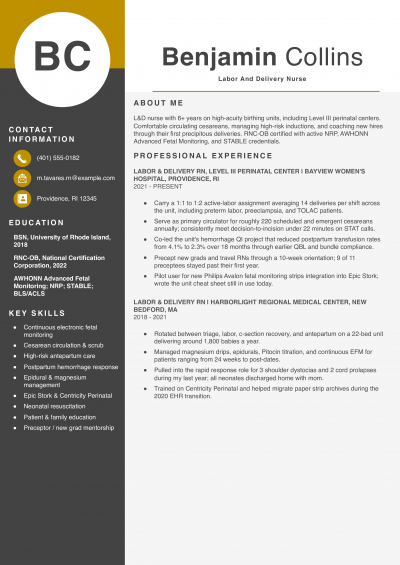
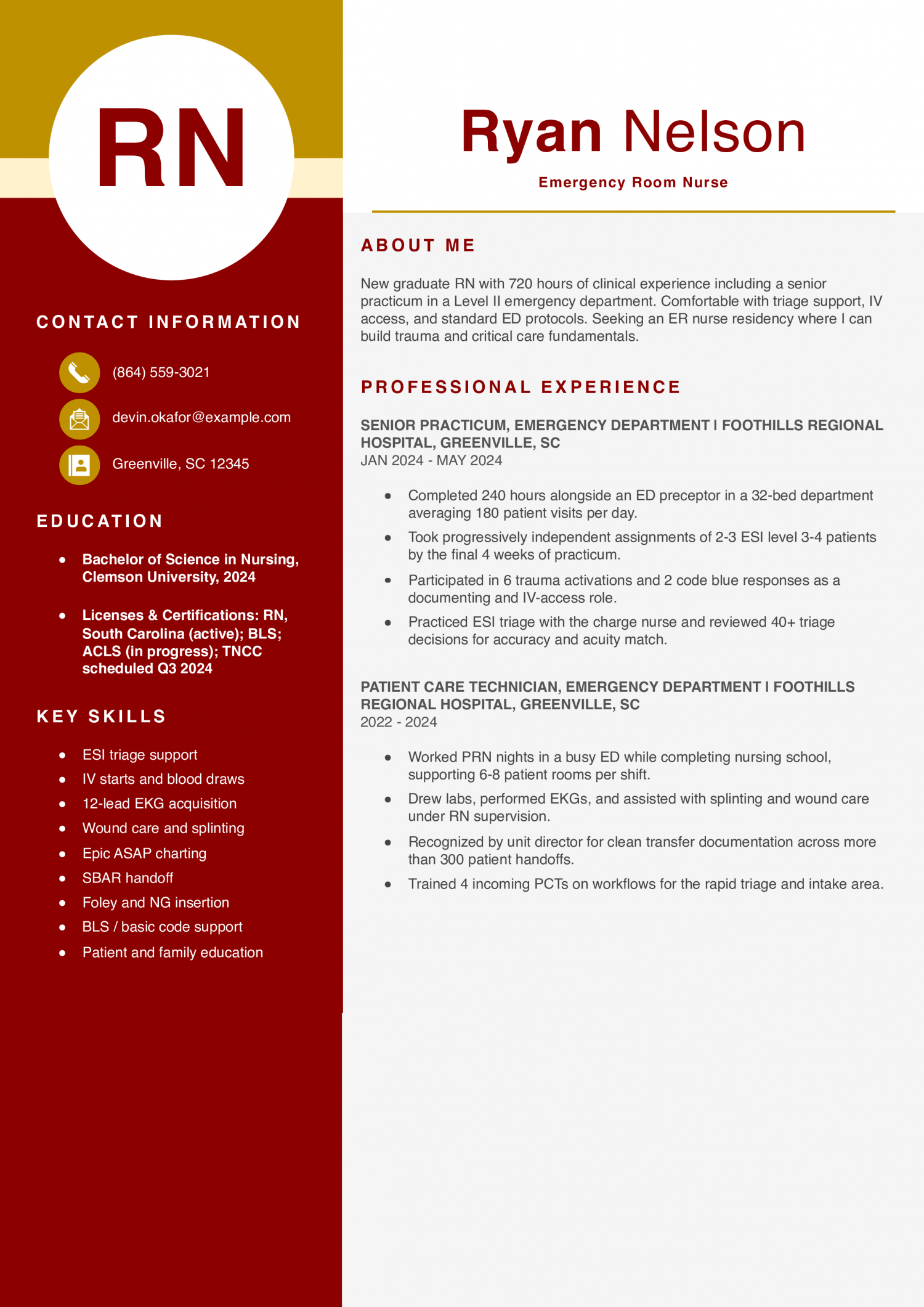
The new grad RN tab fits nurses inside their first 12 months who completed an ER preceptorship or capstone. Your resume needs to prove your license is active and your clinical hours map to ER acuity.
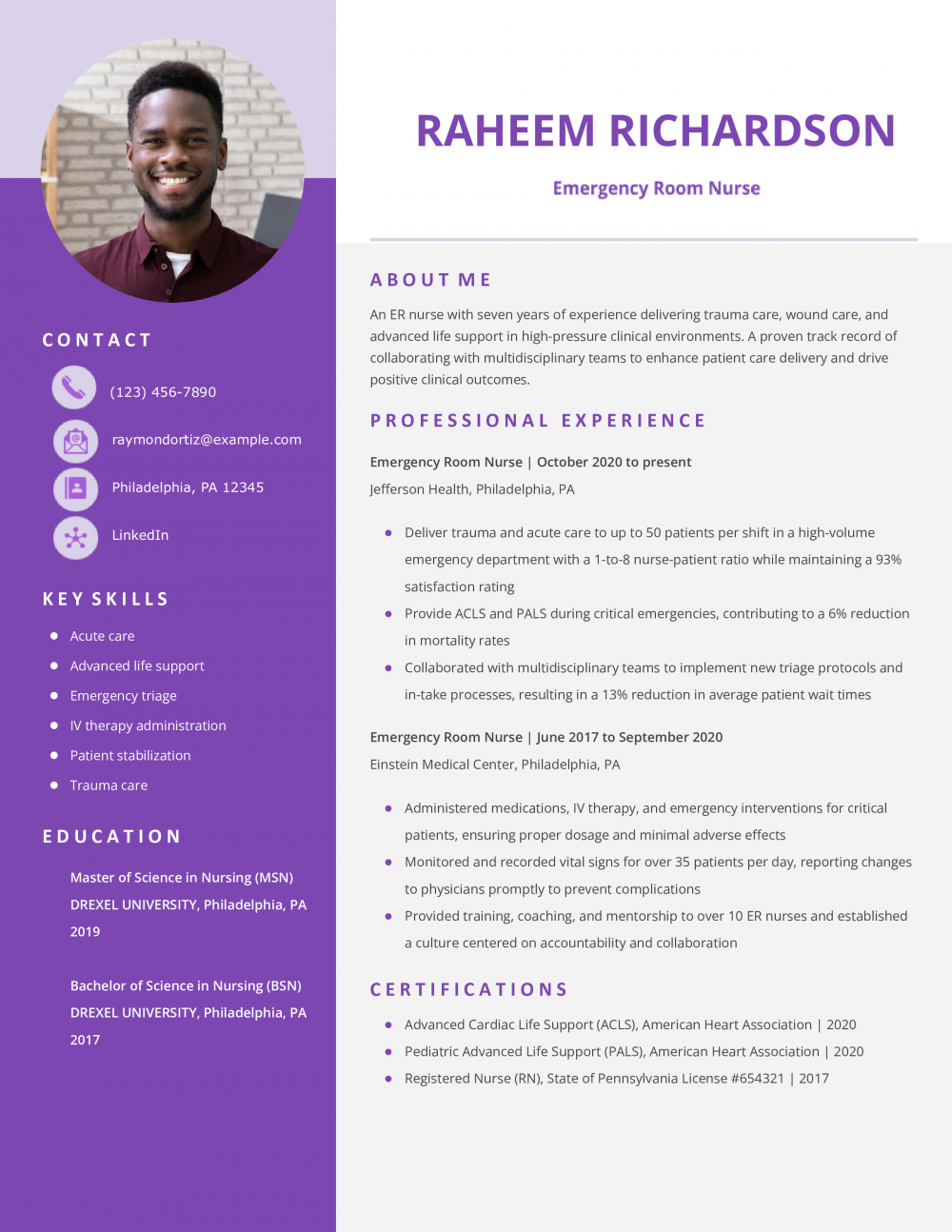
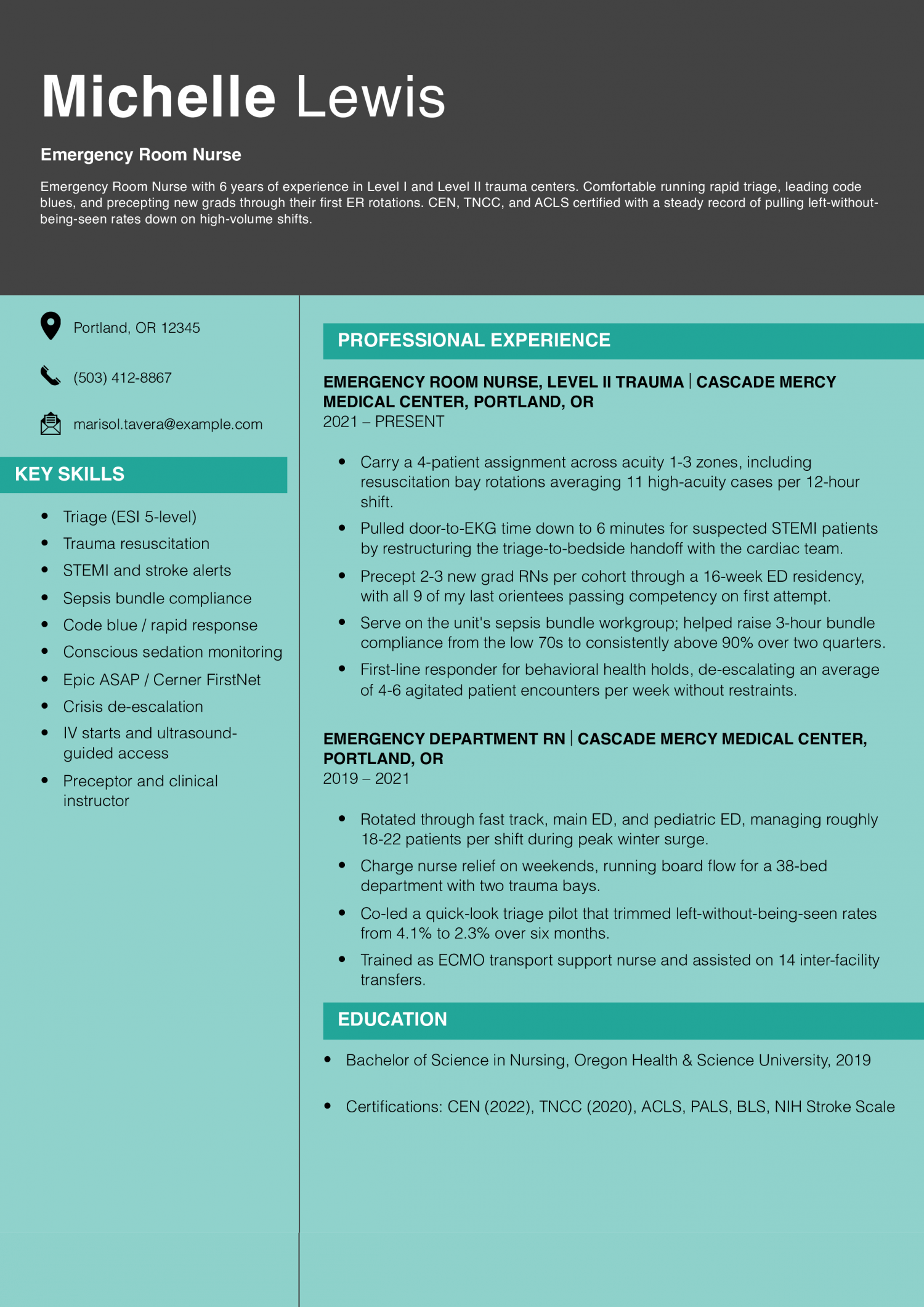
The staff nurse tab fits RNs with two to seven years on the floor working across ESI levels and trauma activations. Your resume needs to prove your patient load, acuity mix, and the procedures you own without supervision.
The charge nurse tab fits RNs running shift assignments, triage flow, and code response across a department. Your resume needs to prove staffing decisions, throughput metrics, and the certifications you hold beyond the staff floor.
Amaya Pendleton, BSN, RN, CEN
Louisville, KY | (502) 318-9462 | [email protected] | linkedin.com/in/amayapendleton
Emergency Room Nurse with 8 years of bedside ED experience across community and academic Level II trauma centers. Strong in triage, stroke and STEMI response, and clinical preceptorship. CEN and TNCC certified, currently completing an MSN in nursing leadership.
Senior Emergency Room Nurse and Relief Charge
Ohio River Medical Center | Louisville, KY | 2021-Present
Emergency Room Nurse
Bluegrass Baptist Hospital | Lexington, KY | 2018-2021
Emergency Room Nurse
Bluegrass Baptist Hospital | Lexington, KY | 2016-2018
Patient Care Technician, Emergency Department
Bluegrass Baptist Hospital | Lexington, KY | 2014-2016
Your profile should state your years as an RN, the ED setting you’ve worked in, and the acuity range you handle.
Name the trauma designation (Level I, II, III), average daily census, and the ESI levels you triage. Add the patient population if it narrows your fit, such as adult, pediatric, or mixed. ER nurse managers and hospital recruiters scan this block for setting match before reading bullets.
Close with one line on the certifications you carry beyond BLS, since trauma and pediatric credentials shift you out of the general RN pool.
Bullets without a number tend to read as duties. Recruiters scan for three figures: patients per shift, acuity mix, and a throughput or outcome metric.
Name your average patient load (for example, four to six patients per 12-hour shift), the share of high-acuity (ESI 1 and 2) cases you carried, and door-to-provider or door-to-EKG times you helped move.
If you precepted, name the number of new hires you trained. A strong bullet pairs the action with the volume and the acuity, not the action alone.
Cluster your skills into categories ER nurse managers recognize at a glance. Four groupings work for most resumes.
Triage and assessment (ESI leveling, primary and secondary surveys, focused neuro and cardiac exams). Resuscitation and codes (ACLS algorithms, defibrillation, intubation assist, compressions, rapid response).
Procedures and access (IV starts, central line assist, NG and Foley placement, splinting, wound closure assist, 12-lead EKG). Documentation and handoff (Epic ED module, SBAR, charge nurse reports, EMTALA-compliant transfers).
Build a credentials block directly under your profile with your RN license state and status, plus BLS, ACLS, PALS, and TNCC with expiration months.
Do not print your license number on the resume. List the state and “license in good standing,” then supply the number on the application form when requested.
ER nurse managers and hospital recruiters need this visible early because staffing decisions and trauma assignments depend on which cards you carry. CEN, CPEN, TCRN, and SANE belong here too if you hold them.
List your BSN or ADN, the school, and graduation month. If you’re a new grad or within two years of NCLEX, add your ER preceptorship or capstone with hours and the facility.
Name the clinical instructor or charge RN only if you have permission. Pin any ED externship or tech experience here too, since recruiters count those hours toward acuity exposure.
Skip high school. Skip GPA after your first nursing role.
Five years ago, an ER nurse resume read like a task list of IV starts and vital signs. The skills below come from the resumes our users built in 2026. The mix has shifted toward acuity metrics, Epic ED module proficiency, and trauma certifications named by acronym.
ER nurse managers weigh hard skills like ACLS and triage as gates. Soft skills like rapid decision-making back up specific bullets, not stand-alone claims. Match the hard-skill list against the job posting, then use soft skills as the evidence layer inside your bullets.
| Soft Skills | % of resumes with this skill |
|---|---|
| Critical thinking | 69% |
| Composure under pressure | 63% |
| Communication | 41% |
| Teamwork | 39% |
| Empathy | 27% |
And here are the top hard skills showing up most often.
| Hard Skills | % of resumes with this skill |
|---|---|
| Patient triage | 73% |
| Advanced cardiac life support | 59% |
| Trauma and emergency care | 48% |
| IV therapy and medication administration | 37% |
| EKG interpretation | 33% |
Based on data from thousands of emergency room nurses’ resumes built on ResumeTemplates.com, May 2026.
The items below are what separate an emergency room nurse resume from one that gets put back in the pile.
Every ED hire starts with license verification. Put your license block on page one, above your experience.
List your active RN license by state, status, and expiration month. If you hold a multistate license under the Nurse Licensure Compact, write “multistate RN license” next to your home state.
Do not print the license number on the resume itself. Recruiters verify the number through the state board’s Nursys lookup or the employer’s onboarding form.
State boards set CE clock-hour requirements on a renewal cycle that varies by state. Track your hours and the topic categories, since EDs prefer trauma and pediatric CE over general nursing topics.
List CE only when it sharpens your fit for the target role. Pediatric CE for a children’s hospital, trauma CE for a Level I bid, sepsis CE for a sepsis coordinator track.
Name the provider, the topic, the contact hours, and the year. Skip CE older than three years unless it’s a major specialty course.
EDs run on a small set of charting platforms, and ER nurse managers filter for the one their facility uses. Name the system and the specific ED module you charted in.
Your resume should prove you handle PHI correctly without printing any of it. ER nurse managers read carelessness with patient details as a hiring risk.
Never name a patient, a room number, or a case identifier in a bullet. Aggregate the work: “managed four to six patients per shift across ESI 1-3” reads clean.
If a bullet describes a specific case (a mass casualty event, a high-profile code), keep it to the clinical action and the outcome at the population level.
Beyond your active RN license and BLS, the certifications below tell ER nurse managers which patient populations you can take without backup and how ready you are for trauma activations. List the certifying body and current expiration month for each.
Registered nursing is one of the larger occupations tracked by BLS, which means the published median pulls in a long tail of med-surg, clinic, and lower-acuity roles. ER pay sits above that median in most metros because of acuity, shift differentials, and trauma designation.
To position above the median on paper, lead your resume with trauma level, acuity mix, and specialty certifications, not the generic “registered nurse” title.
| # | State | Avg. Annual |
|---|---|---|
| 1 | California | $140,330 |
| 2 | Hawaii | $136,320 |
| 3 | Oregon | $123,990 |
| 4 | Washington | $112,180 |
| 5 | Alaska | $110,690 |
| 6 | New York | $105,600 |
| 7 | District of Columbia | $104,550 |
| 8 | New Jersey | $102,730 |
| 9 | Nevada | $101,990 |
| 10 | Massachusetts | $101,970 |
| # | State | Workers | Median |
|---|---|---|---|
| 1 | California | 326,720 | $140,330 |
| 2 | Texas | 261,050 | $90,010 |
| 3 | Florida | 218,100 | $82,850 |
| 4 | New York | 204,120 | $105,600 |
| 5 | Pennsylvania | 146,840 | $87,610 |
Resume Templates offers HR approved resume templates to help you create a professional resume in minutes. Choose from several template options and even pre-populate a resume from your profile.
One page for new grads and nurses with under five years on the floor. Two pages once you've added charge experience, preceptor work, or committee roles.
Recruiters skim the credentials block and the most recent role first. A clean two-page resume beats a cramped one-page resume if you have the content.
No. List the state and "RN, license in good standing" with the expiration month.
State boards advise against printing license numbers on documents you email or post online. Provide the number on the employer's application form when it asks.
Lead with your ER preceptorship, capstone, or externship hours and the facility's trauma level.
Pull any med-surg, tele, or ICU acuity into bullets that map to ED skills: rapid assessment, code response, IV access, and high patient load. Add TNCC or ENPC before applying if you can.
Name the compact state license you hold and the state you've applied in, with "endorsement pending" and the month filed.
Recruiters need the timeline to pace the start date. If you're using the Nurse Licensure Compact, write "multistate RN license" next to your home state.
For an emergency room nurse, an ATS-friendly template is the safest pick, because it puts your certifications and experience where a hiring manager scans first. A basic template is a solid alternative. Whichever you choose, keep the formatting clean and easy to parse: clear section headings, a standard font, and no graphics a parser can choke on.