Finance Manager Resume Examples and Templates for 2026



The entry level financial analyst resumes that get scheduled share three things: a named modeling output above the experience block, Excel and SQL functions called out by name, and a CFA Level I or Bloomberg BMC line that finance recruiters can verify in seconds.
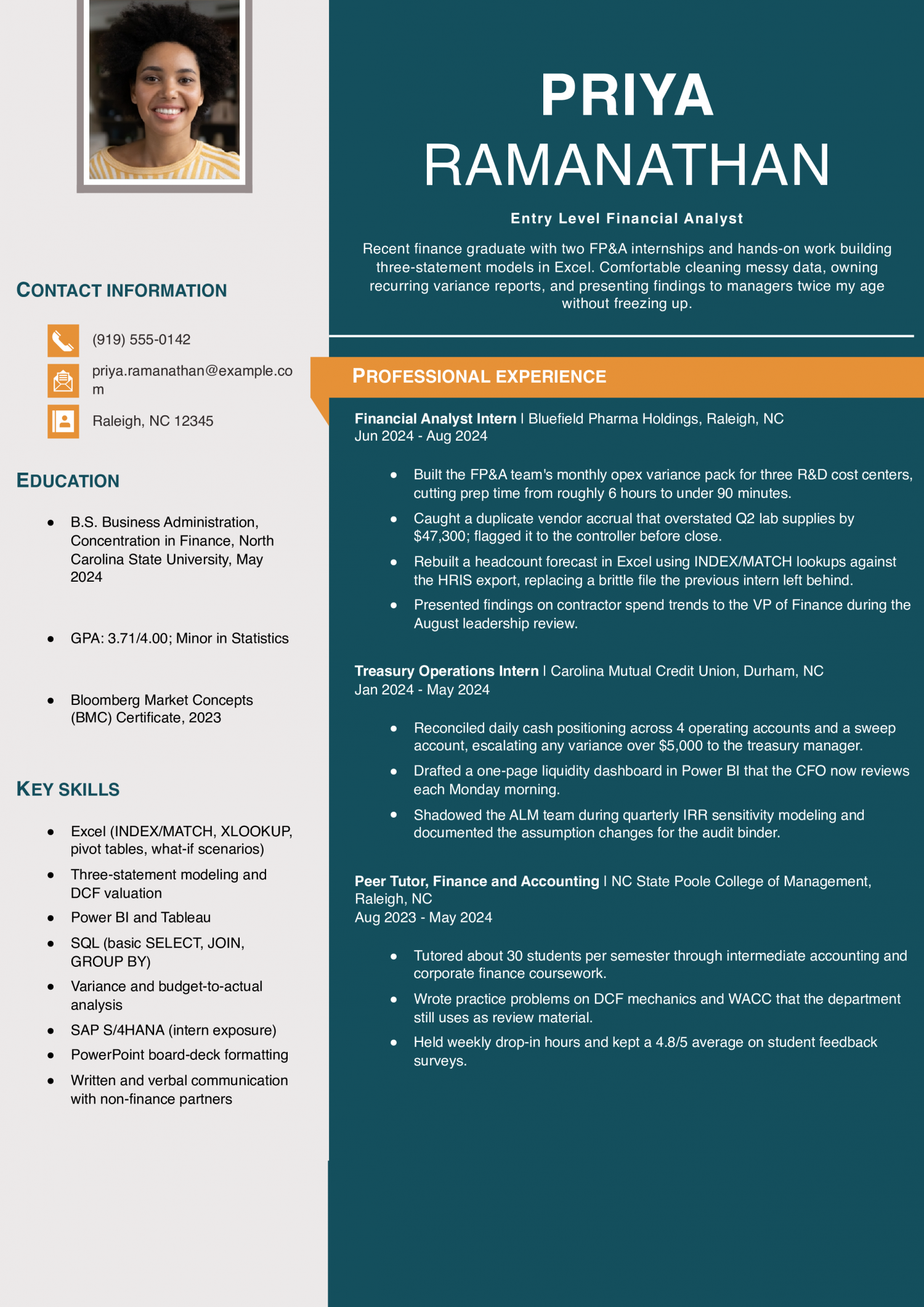
You sit somewhere between a finance internship and your first full year on a corporate FP&A or banking desk. This resume needs to prove you can build a model, pull clean data, and present a finding without a senior analyst rewriting your slide.
Elena Sokolova
Minneapolis, MN | (612) 555-0173 | [email protected] | linkedin.com/in/elenasokolova
Finance and economics double major graduating May 2025 with two analyst internships, a corporate banking rotation, and a capstone project building a 5-year operating model for a regional grocery chain. Comfortable in Excel, Power BI, and SQL; known by classmates and managers for clean, well-labeled models that anyone can pick up and run.
Corporate Finance Intern
Harborline Logistics Group | Minneapolis, MN | Jun 2024 – Aug 2024
Credit Analyst Intern
Northshore Community Bank | Duluth, MN | Jan 2024 – May 2024
Research Assistant, Department of Applied Economics
University of Minnesota | Minneapolis, MN | Sep 2023 – May 2024
Treasurer, Carlson Finance Club
University of Minnesota Carlson School | Minneapolis, MN | Aug 2023 – May 2024
Barista and Shift Lead
Stonemill Coffee Roasters | Minneapolis, MN | Sep 2022 – Aug 2023
Your profile should state your degree (finance, accounting, economics), the modeling work you did in school or an internship, and the tools you used to do it.
Name the model types you built (DCF, three-statement, LBO, variance analysis) and the data scale you handled. A finance manager scanning the top third of page one wants to know if you’ve built a model end-to-end or only edited inputs.
If you have CFA Level I, Bloomberg BMC, or a relevant minor, put it in the profile line. This is the scope statement: experience level, tool stack, and one or two output types.
A bullet that says ‘built financial models’ reads as a duty. A bullet that says ‘built a five-year DCF on a $400M consumer staples target, sensitized WACC and terminal growth across nine scenarios’ reads as work.
Name three numbers most strong bullets carry: the dataset size, the model output, and the decision it informed. Variance analysis on a $12M operating budget, a forecast that flagged a 6 percent revenue miss, a reconciliation across 14 cost centers.
Bullets without a number tend to read as classroom work. Pull figures from internships, case competitions, capstone projects, and student-managed fund roles.
Cluster bullets into three buckets a finance manager scans for: financial modeling, data analysis, and reporting or presentation.
Under modeling, name the model type and the assumptions you owned (DCF, comparable company, accretion/dilution, budget build). Under analysis, name the data source and the function (SQL pulls from a data warehouse, Excel pivot tables on transaction-level data, variance bridges).
Under reporting, name the audience and the format (board deck, weekly flash report, monthly close package). This structure mirrors how FP&A and investment banking teams describe analyst work in postings.
Recruiters parse for Excel, SQL, Bloomberg, Power BI, Tableau, FactSet, and Capital IQ in the first ATS pass. Build a Skills block on page one that names each tool plus the function you used (Excel: INDEX MATCH, SUMIFS, XLOOKUP, pivot tables; SQL: joins, window functions).
Add a Certifications line with CFA Level I (or candidate status with exam date), Bloomberg Market Concepts, and any Wall Street Prep or Corporate Finance Institute completions. List the issuing body, not the registration number.
If your GPA is 3.5 or higher, include it. Relevant coursework belongs in the education block when your internship history is thin.
End with education (degree, school, graduation date, GPA if 3.5+), then a Projects or Leadership block.
Projects carry the resume when your internship history is one line. List two or three with the same structure as work bullets: the model or analysis you built, the data, the tools, and the finding. A capstone DCF on a public company, a student-managed fund pitch, a case competition placement.
Leadership in a finance club, investment society, or analyst program signals you ran toward finance work outside the classroom, which finance managers and senior analysts read as commitment to the track.
The entry level financial analyst resumes that get callbacks share a specific skill mix. The lists below come from our user-built entry level financial analyst resumes. Finance managers and senior analysts scan for these patterns first, not generic ‘detail-oriented team player’ language.
Hard skills carry the first ATS pass: Excel functions, SQL, modeling types, and named data terminals. Soft skills only count when paired with a bullet showing the behavior in action. Match the hard-skills list against your target job posting and use the soft-skills list as evidence prompts for your experience bullets.
| Soft Skills | % of resumes with this skill |
|---|---|
| Communication | 66% |
| Analytical thinking | 53% |
| Attention to detail | 49% |
| Problem solving | 39% |
| Teamwork | 31% |
And here are the top hard skills showing up most often.
| Hard Skills | % of resumes with this skill |
|---|---|
| Financial modeling | 65% |
| Microsoft Excel | 54% |
| Financial analysis | 45% |
| Data analysis | 39% |
| Forecasting and budgeting | 27% |
Based on data from thousands of entry-level financial analysts’ resumes built on ResumeTemplates.com, May 2026.
These are the must-haves hiring teams look for when scanning an entry level financial analyst resume.
Finance managers and senior analysts expect to see the sub-niche language of the seat they’re hiring for, not a generic ‘financial analysis’ tag. Match the cluster below to the posting you’re targeting.
| Niche | Keywords ATS scans for |
|---|---|
| Corporate FP&A | financial planning and analysis, budget vs actual, variance analysis, monthly close |
| Investment banking and research | financial modeling, DCF, comparable company analysis, LBO model |
| Internship and new graduate | financial analyst intern, junior financial analyst, entry level analyst, financial analyst with no experience |
| Data and reporting | financial data analyst, SQL, Power BI dashboard, financial reporting |
| Tools and terminals | Bloomberg Terminal, FactSet, Capital IQ, advanced Excel |
Finance teams are split between groups piloting Copilot in Excel for model checks and groups that block generative tools over data-handling and audit concerns. Name the tools you’ve used, describe the workflow honestly, and don’t claim you ‘build models with AI’ if your real practice is using AI to spot-check formulas or draft commentary.
Copilot in Excel and ChatGPT are used to flag broken references, circular logic, and inconsistent units before a senior analyst reviews.
Variance commentary and earnings summaries get a first draft from an LLM, then a human pass for tone and accuracy.
Analysts use ChatGPT and Copilot to draft and debug SQL pulls against data warehouses, then verify outputs against known totals.
Equity research and corporate development teams use AI to surface key drivers from filings, with mandatory source verification.
Finance recruiters read your credential stack as a signal of which track you’re committing to. The CFA points toward investment-side work, the CPA toward accounting and corporate finance, and modeling certificates toward banking and corporate development.
Finance managers and senior analysts read this list as a map of where your work is heading. The certifications below tell them which track you’ve invested in (CFA, FP&A, modeling, or data). List the issuing body and the year of completion or expected sitting date for in-progress exams.
The 90th-percentile financial analyst out-earns the median by a wide margin, and the spread shows the market rewards the industry you land in (investment banking, asset management, tech FP&A) more than your years on the job. Entry-tier analysts at a regional bank and entry-tier analysts at a top tech FP&A group share a title and almost nothing else.
Lead the resume with the industry tag and modeling output the top of the band actually pays for, not generic ‘financial analysis’ phrasing.
| # | State | Avg. Annual |
|---|---|---|
| 1 | Wyoming | $213,940 |
| 2 | New York | $126,580 |
| 3 | California | $111,100 |
| 4 | New Jersey | $109,380 |
| 5 | Oregon | $107,680 |
| 6 | Massachusetts | $107,610 |
| 7 | District of Columbia | $106,840 |
| 8 | Connecticut | $106,250 |
| 9 | Virginia | $104,030 |
| 10 | Minnesota | $102,800 |
| # | State | Workers | Median |
|---|---|---|---|
| 1 | New York | 47,130 | $126,580 |
| 2 | California | 40,570 | $111,100 |
| 3 | Texas | 26,940 | $92,370 |
| 4 | Florida | 21,690 | $83,560 |
| 5 | Massachusetts | 18,020 | $107,610 |
Resume Templates offers HR approved resume templates to help you create a professional resume in minutes. Choose from several template options and even pre-populate a resume from your profile.
Lead with a Projects or Coursework block that mirrors real analyst work.
Pick two or three substantial pieces (a capstone DCF, a student-managed fund pitch, a case competition) and write them as experience bullets with the model type, dataset, tools used, and the finding.
Add internships, teaching assistant work, and finance club leadership as supporting evidence.
Write a summary, not an objective.
A three-line summary names your degree, your modeling and tool stack, and the type of role you target (FP&A, investment banking, equity research).
Objectives that say 'seeking a role to grow my skills' read as filler and waste the top of page one.
Put it in two places: the summary line and the Certifications block.
Write 'CFA Level I candidate, sitting February 2026' so recruiters know you're on the track and can verify the exam window.
If you've already passed Level I, write 'CFA Level I passed (2025)' in both spots.
One page.
Finance recruiters screen analyst resumes at volume and expect a single page through your first three to five years.
Use the space for a tight summary, a skills block with named tools, internships or full-time work in dated bullets, education with GPA if 3.5 or higher, and a projects or leadership block.
For an entry-level financial analyst, a professional template is the safest pick, because it signals the polish hiring managers in this field expect. An ATS-friendly template is a solid alternative. Whichever you choose, keep the formatting clean and easy to parse: clear section headings, a standard font, and no graphics a parser can choke on.
Executive Resume Writer and Career Coach
Andrew Stoner is an executive career coach and resume writer with 17 years of experience as a hiring manager and operations leader at two Fortune 500 Financial Services companies, and as the career services director at two major university business schools.
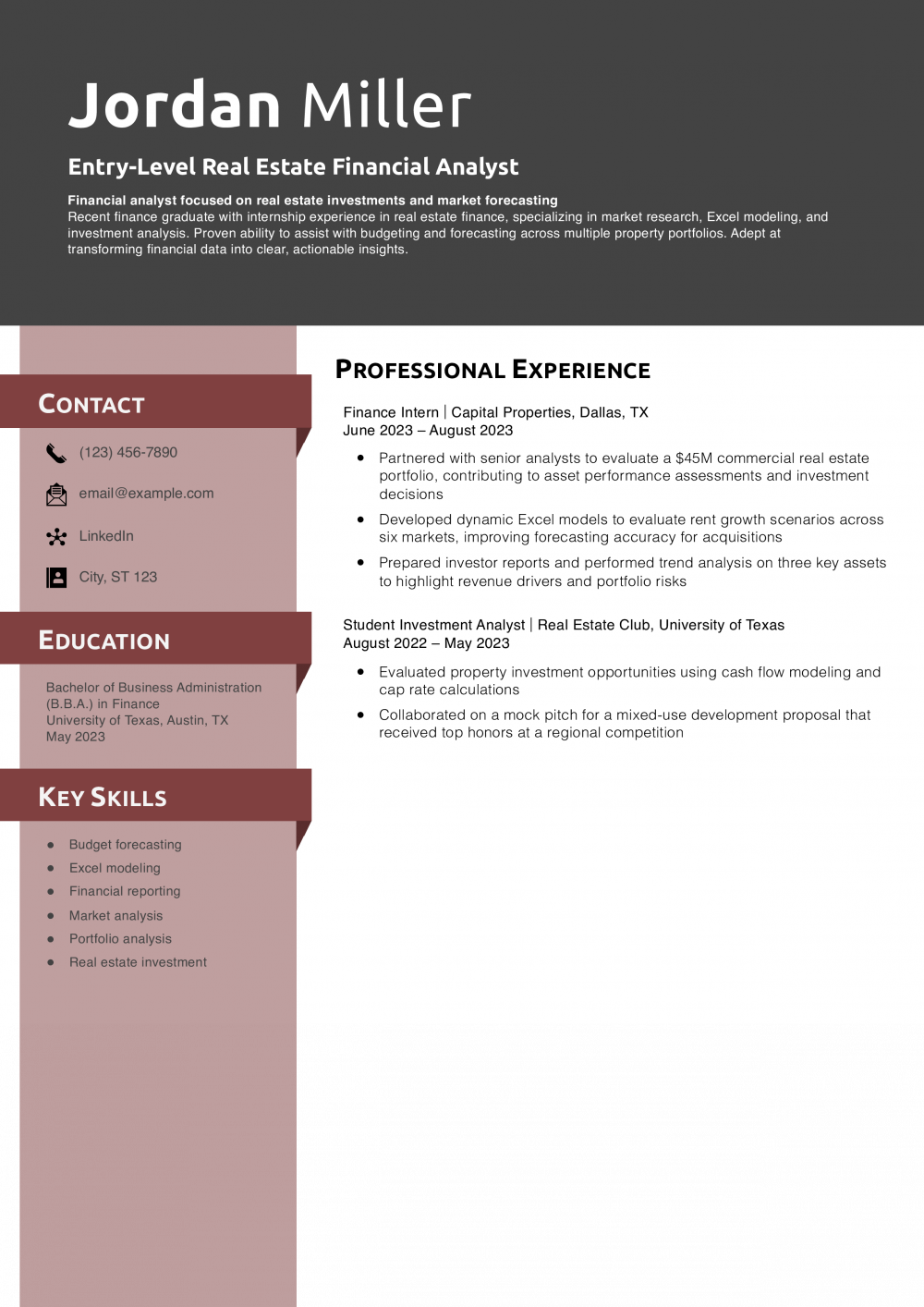
Customize this template in our builder in under 10 minutes.