Android Developer Resume Examples and Templates for 2026



A tight stack header with versions is what gets full stack resumes past the recruiter keyword parse; named scale numbers on shipped features are what make them readable enough to reach the technical screen.
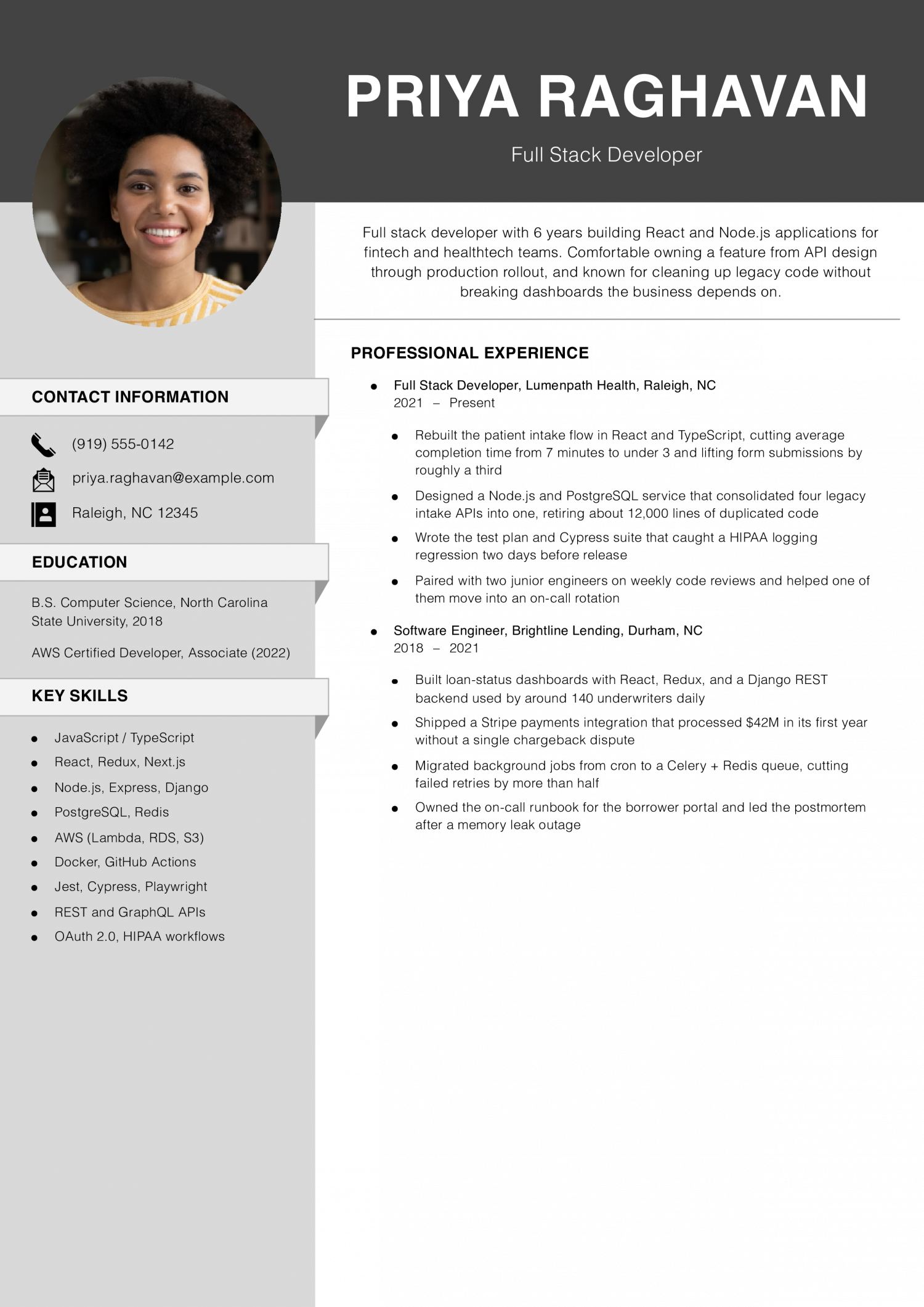
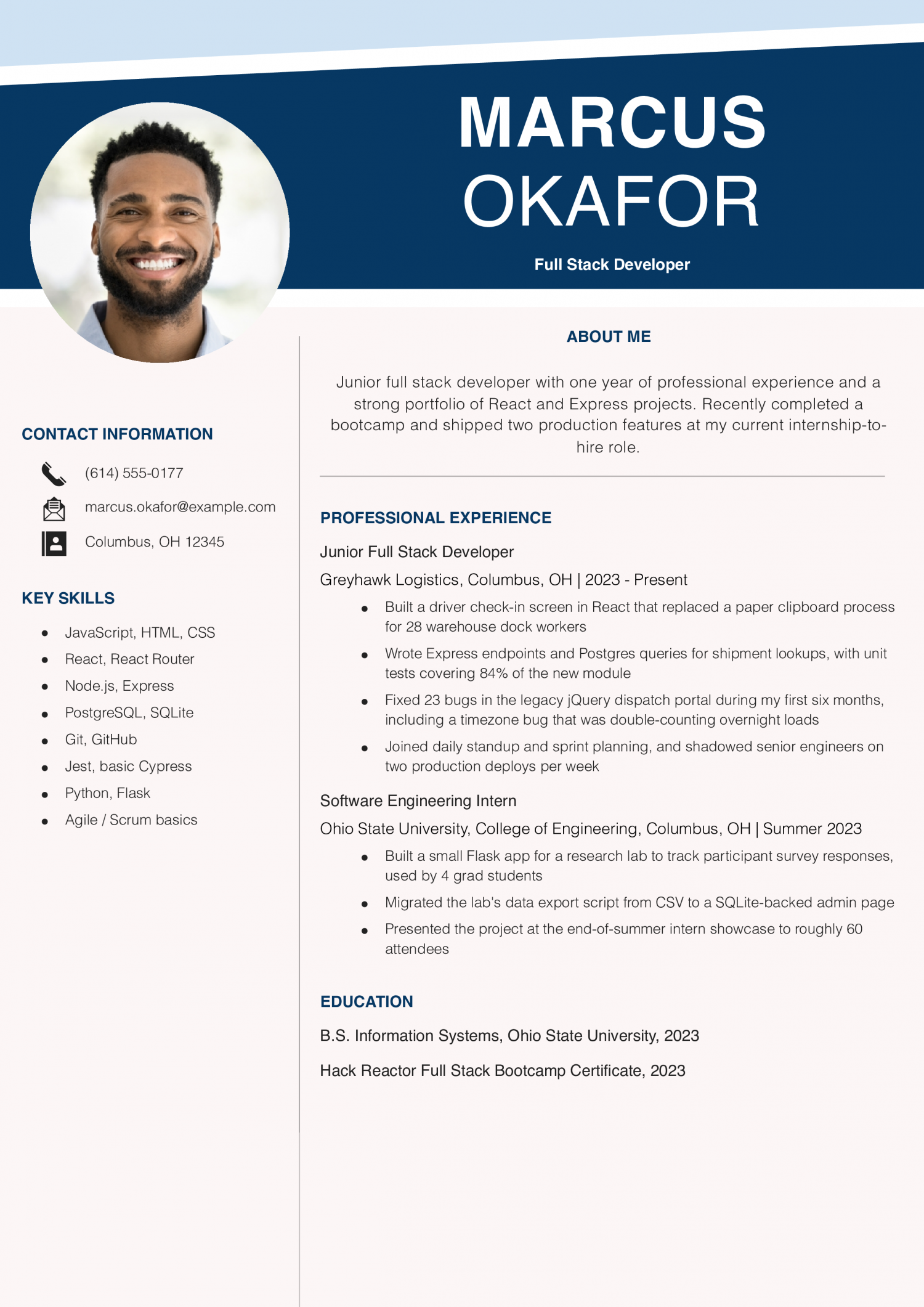
Junior full stack developers are zero-to-two years in, often coming from a bootcamp, CS degree, or self-taught path. The resume needs to prove shipped projects in production, the stack you can work in unsupervised, and any open-source or internship contributions.
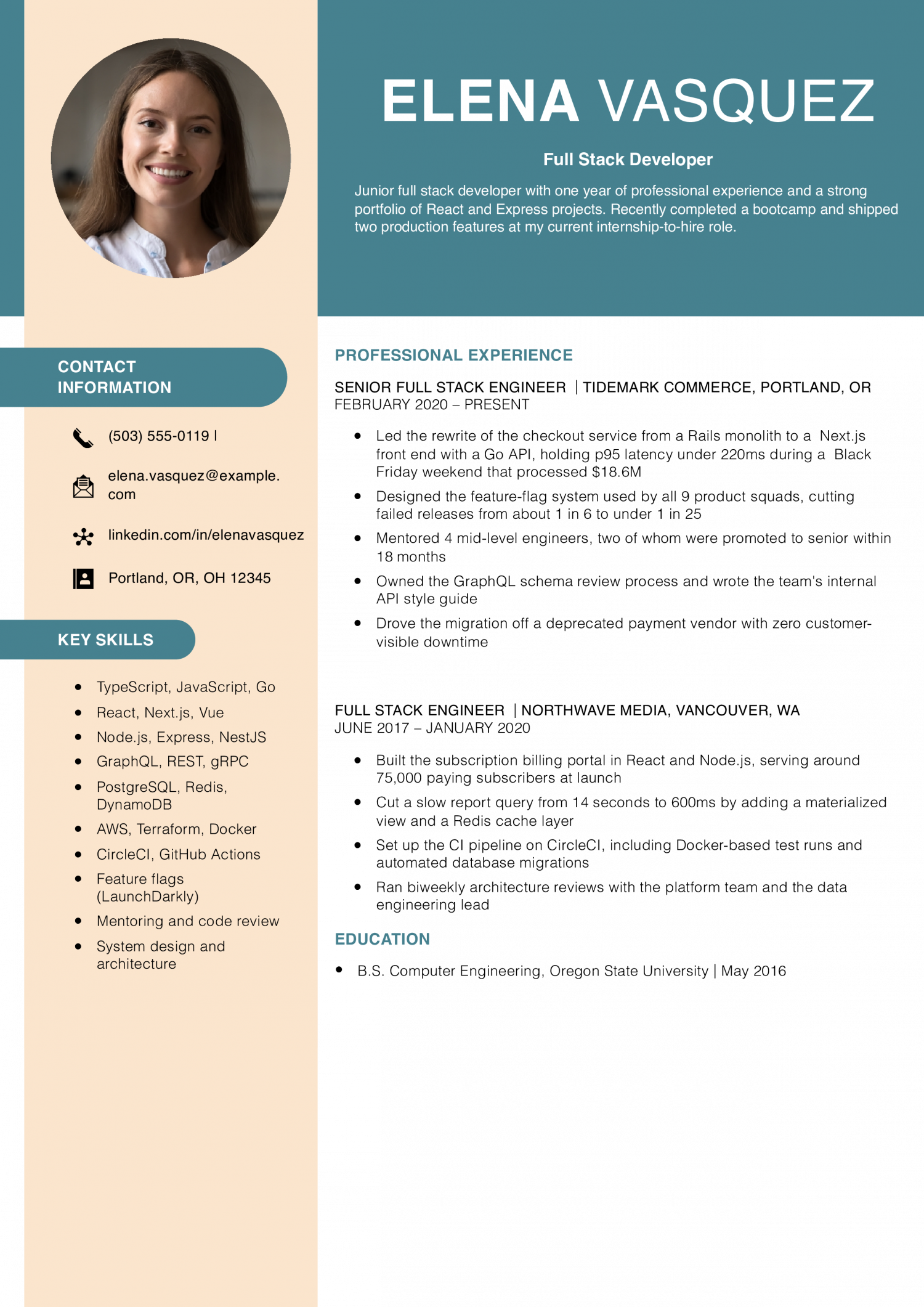
Senior full stack developers own features end-to-end across frontend and backend, with three-to-six years of production work. The resume needs to show systems you've shipped at scale, on-call rotations you carry, and the specific performance numbers you moved.
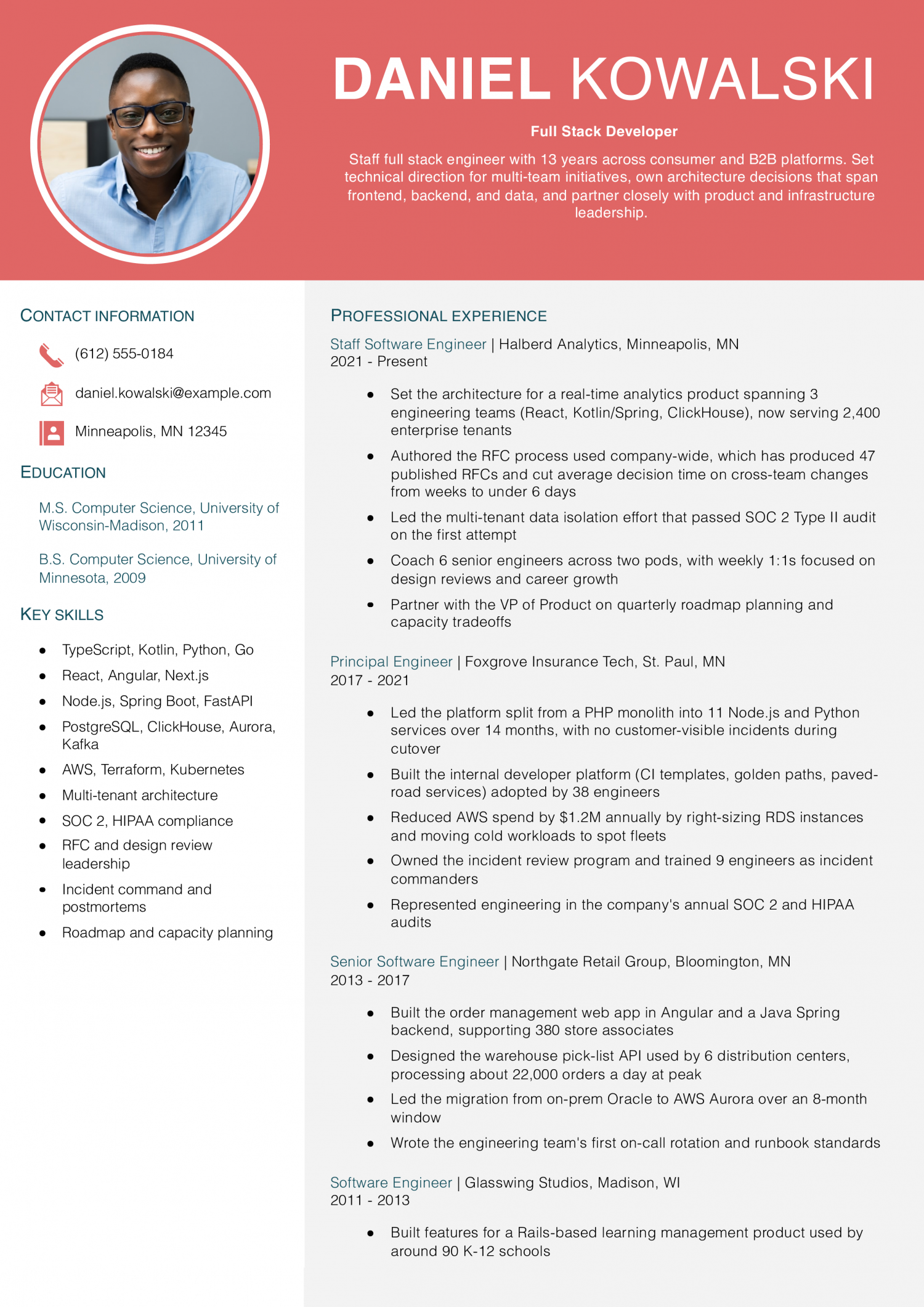
Staff full stack developers set technical direction across multiple teams and architect platforms others build on. The resume needs to show the systems you designed, the engineers you've mentored or hired, and cross-team initiatives you led to delivery.
Sofia Marchetti
Nashville, TN | (615) 555-0163 | [email protected] | linkedin.com/in/sofiamarchetti
Full stack developer with 7 years building React, Node.js, and Python applications for healthcare, edtech, and logistics teams. I take features from design through deployment, write the tests that keep them honest, and have a habit of replacing fragile services without slowing the roadmap.
Senior Full Stack Developer
Cobalt Pine Health | Nashville, TN | 2022-Present
Full Stack Engineer
Riverbend Learning | Chattanooga, TN | 2019-2022
Software Engineer
Kestrel Freight Systems | Memphis, TN | 2017-2019
Junior Software Developer
Maplewood Digital Agency | Knoxville, TN | 2016-2017
The first line of your summary should name the scale of what you’ve shipped, not your years coding. Lead with users served, latency cut, or build-time reduced on a named stack.
Engineering managers read that opener as your readiness to own production. A line like “Full stack developer who shipped a React and Node checkout serving 40K daily users” beats “passionate developer with five years of experience” every time.
Bullets without a number tend to read as duties. Strong full stack bullets name the metric the system moved: p95 latency, conversion lift, build time, error rate, or active users.
Pick two or three metrics per role and stay honest. “Cut p95 API latency from 800ms to 180ms” and “reduced CI run from 14 to 4 minutes” land harder than vague impact claims.
Cluster your bullets so a reader sees the breadth fast. Three buckets usually work: frontend features, backend services and APIs, and deployment or data layer work.
Name the real artifacts. React components and state management, REST or GraphQL endpoints, Postgres schemas, Redis caches, and the CI/CD pipeline you wired up in GitHub Actions or CircleCI.
Tech leads scan the stack block before reading any bullet. Place it under your summary with primary languages, frameworks, databases, and cloud, ideally with versions where it matters.
If you hold AWS, GCP, or Azure certifications, list them in the same block. They signal you can own the deploy side, not just the application code, which widens the roles you’ll clear.
Lines like “wrote clean code” or “collaborated with cross-functional teams” use space without proving anything. Strip them.
Replace with specifics: the migration you led, the on-call incident you resolved, the feature flag rollout you ran, or the junior engineer you onboarded. Concrete beats generic on every review pass.
Full stack hiring is tight in 2026. Engineering teams are running leaner and the bar to clear a screen is higher. The hard skills below come from our user-built full stack developer resumes and reflect what recruiters parse for, from React and Node to Postgres and GitHub Actions.
Match the hard-skills list against the target job posting verbatim, then use soft skills as evidence backing your bullets, not as standalone claims.
| Soft Skills | % of resumes with this skill |
|---|---|
| Communication | 71% |
| Problem solving | 66% |
| Cross-functional collaboration | 43% |
| Adaptability | 37% |
| Time management | 31% |
And here are the top hard skills showing up most often.
| Hard Skills | % of resumes with this skill |
|---|---|
| JavaScript and TypeScript | 73% |
| Front-end frameworks (React, Angular) | 52% |
| Back-end development (Node.js, Python) | 42% |
| REST API design | 39% |
| SQL and NoSQL databases | 33% |
Based on data from thousands of full-stack developers’ resumes built on ResumeTemplates.com, May 2026.
Before a full stack developer resume gets a closer read, hiring teams check for a short list of essentials.
Engineering managers expect your niche keywords to match the stack pairing in the posting, not a generic skills wall. Group your keywords by sub-specialty so a parser scores a clean match on the first pass.
| Niche | Keywords ATS scans for |
|---|---|
| JavaScript full stack (React + Node) | react full stack developer, node full stack developer, mern stack developer, full stack javascript engineer |
| Java full stack | java full stack developer, spring boot full stack, java angular full stack, java react developer |
| Python full stack | python full stack developer, django full stack, fastapi full stack, python react developer |
| Next.js and modern web | next.js full stack developer, full stack web developer, typescript full stack, vercel deployment |
| Senior and staff titles | senior full stack engineer, staff full stack engineer, full stack software engineer, lead full stack developer |
AI use on a full stack developer resume can go three ways: lead with “AI-powered engineer” (which tech leads screen out), leave it off entirely (which reads as evasive in 2026), or describe the workflow as it actually runs. The third is what engineering managers can validate in a code review.
Cursor and Copilot now generate boilerplate components, route handlers, and tests, so the value moves to design and review.
Reviewers now check for AI-generated patterns that compile but miss edge cases, security holes, and team conventions.
Pasting stack traces into Claude or ChatGPT for root-cause hypotheses is standard; what matters is verifying before merging.
Take-homes increasingly ask candidates to use AI tools transparently, then explain what they kept, changed, or rejected.
Full stack developers get hired on shipped work, so your portfolio should let a tech lead read code and see a running app inside two minutes. Link directly from your resume header.
Pin three to five repos with clean READMEs, real commit history, and live demos linked at the top.
Host your frontend projects with a custom subdomain so reviewers click once and see the app.
Spin up your Node, Python, or Java services with a public URL and a Postman collection in the repo.
A simple personal site that links projects, writeups, and your resume PDF outperforms a long LinkedIn About.
Pin the right repos. Reviewers look at the three pinned repos on your GitHub profile first. Make sure each one has a real README with a screenshot, the stack, setup steps, and a deployed link. Drive-by viewers should understand the project in under a minute.
Show full stack scope. One project should clearly demonstrate ownership across frontend, backend, database, and deploy. A todo app does not count. Build something with auth, an external API, persistent data, and a deployed URL that runs without you wiring up localhost.
A dedicated tech stack block under your summary is the first thing engineering managers read. Keep it in plain text, grouped by layer, with versions where they signal recency.
A working portfolio and shipped commits keep you eligible. The certifications below are what move a full stack developer resume from the qualified-but-typical stack into an engineering manager’s shortlist. List the issuing body, level, and year earned next to each name.
Top-paying states for full stack developers cluster around dense product and platform markets, but the highest employment counts often sit in states with large enterprise IT footprints, not only the obvious coastal tech hubs. The spread between the 10th and 90th percentile is wide because the title covers everything from CRUD shops to platform teams.
If you’re geographically flexible, lead the resume with the stack and scale numbers; let the recruiter map them to their band.
| # | State | Avg. Annual |
|---|---|---|
| 1 | California | $170,910 |
| 2 | Washington | $166,910 |
| 3 | Virgin Islands | $162,820 |
| 4 | New York | $161,260 |
| 5 | Massachusetts | $150,520 |
| 6 | Maryland | $137,890 |
| 7 | District of Columbia | $136,040 |
| 8 | Oregon | $135,260 |
| 9 | Delaware | $135,160 |
| 10 | Colorado | $134,540 |
| # | State | Workers | Median |
|---|---|---|---|
| 1 | California | 292,630 | $170,910 |
| 2 | Texas | 151,460 | $130,500 |
| 3 | New York | 104,130 | $161,260 |
| 4 | Washington | 91,470 | $166,910 |
| 5 | Virginia | 83,290 | $134,470 |
Resume Templates offers HR approved resume templates to help you create a professional resume in minutes. Choose from several template options and even pre-populate a resume from your profile.
Frame each role by the systems you owned and the scale you ran them at. Name the stack, the scope, and the metric that moved.
A strong line reads: "Owned the React and Node order service handling 12K daily checkouts; cut p95 latency 60 percent." That tells a tech lead what you can repeat.
No. Listing 20 technologies signals shallow exposure and dilutes ATS matching against the target posting.
Group your stack into primary (used in production for a year or more), secondary (working knowledge), and tools. Cut anything you couldn't pair-program in tomorrow.
Be honest about the split and lead with the side you ship in. A 70/30 frontend-leaning developer can still land full stack roles if the backend bullets prove ownership.
In the summary, name the split: "Full stack developer, frontend-leaning, with three years shipping Node APIs alongside React work." That preempts the question in the screen.
Inside bullets, tied to outcomes, not as a standalone "AI skills" line. Tech leads want to see what you shipped, not what you prompted.
A clean line: "Used Cursor and Claude Code to scaffold a Next.js admin panel; cut feature delivery time from three sprints to one." That reads as workflow, not hype.
For a full-stack developer, a tech template is the safest pick, because it keeps your stack, tools, and impact easy to scan. An ATS-friendly template is a solid alternative. Whichever you choose, keep the formatting clean and easy to parse: clear section headings, a standard font, and no graphics a parser can choke on.
Executive Resume Writer and Career Coach
Andrew Stoner is an executive career coach and resume writer with 17 years of experience as a hiring manager and operations leader at two Fortune 500 Financial Services companies, and as the career services director at two major university business schools.

Customize this template in our builder in under 10 minutes.