Nursing Resume Examples and Templates for 2026

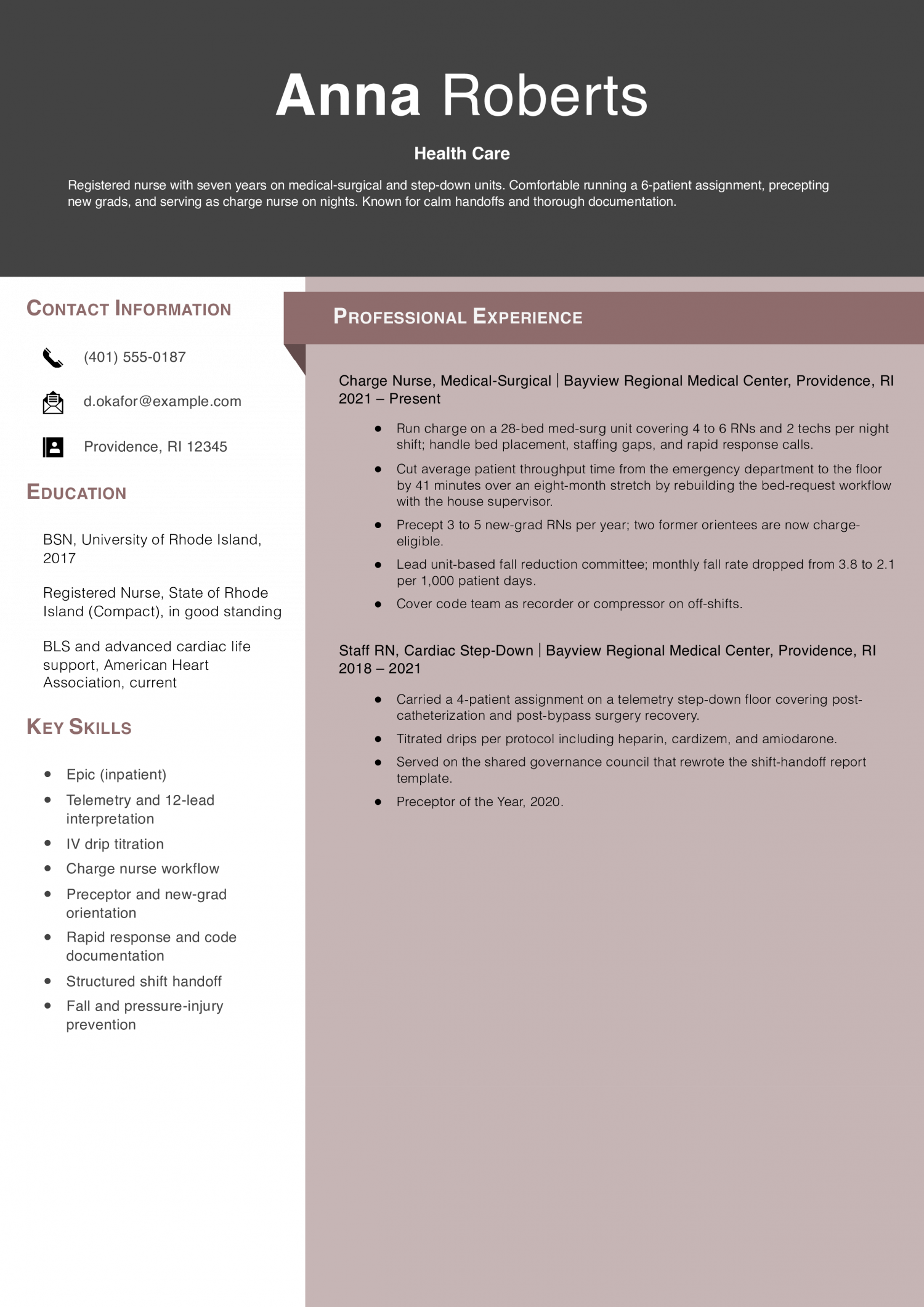
Lead the summary with patient ratio, acuity, and unit type, not years at the bedside. Nurse managers read that line to predict whether you can hold a full assignment on their floor. Name the ratio…
Every resume example is written and reviewed by our team of Certified Professional Resume Writers to ensure top-quality content and formatting.
Health care hiring runs on proof of patient impact, not job titles. Your resume should lead with the settings you worked in, the populations you served, and the systems you charted in, whether that is Epic, Cerner, or Meditech. Name your license, your state, and your years at the bedside or in the clinic up top.
Healthcare hiring managers and clinical directors scan for safety, throughput, and compliance in the same pass. Show patient satisfaction scores you moved, wait times you cut, or infection rates you helped lower. Add HIPAA fluency, shift census, and any charge nurse or preceptor work.
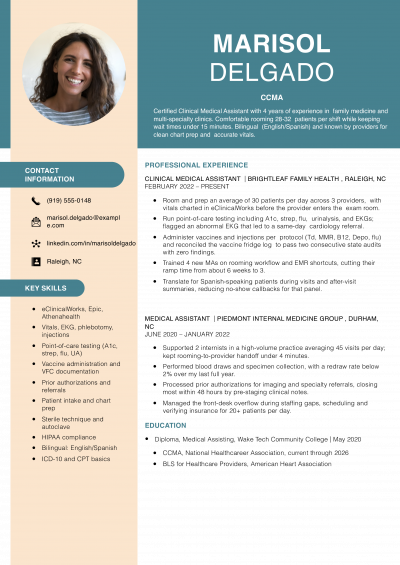
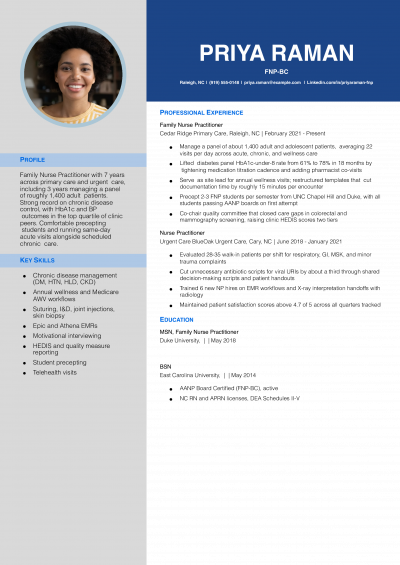
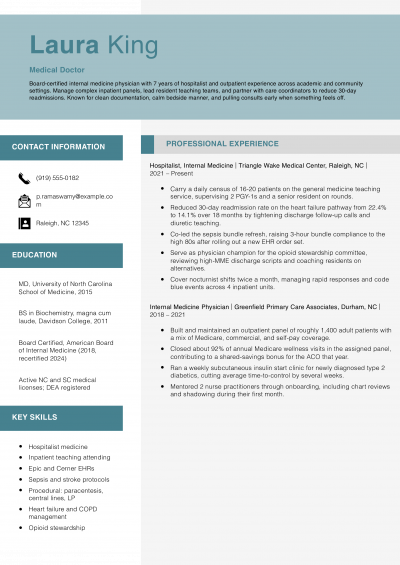
The examples below show how to frame that across roles, from RN and MA to allied health and administration. Use them to shape your own bullets.
A licensure line placed above the experience section, patient volume figures that stay consistent across settings, and EHR systems named by vendor are what separate the Health Care resumes clinical directors advance from the rest.
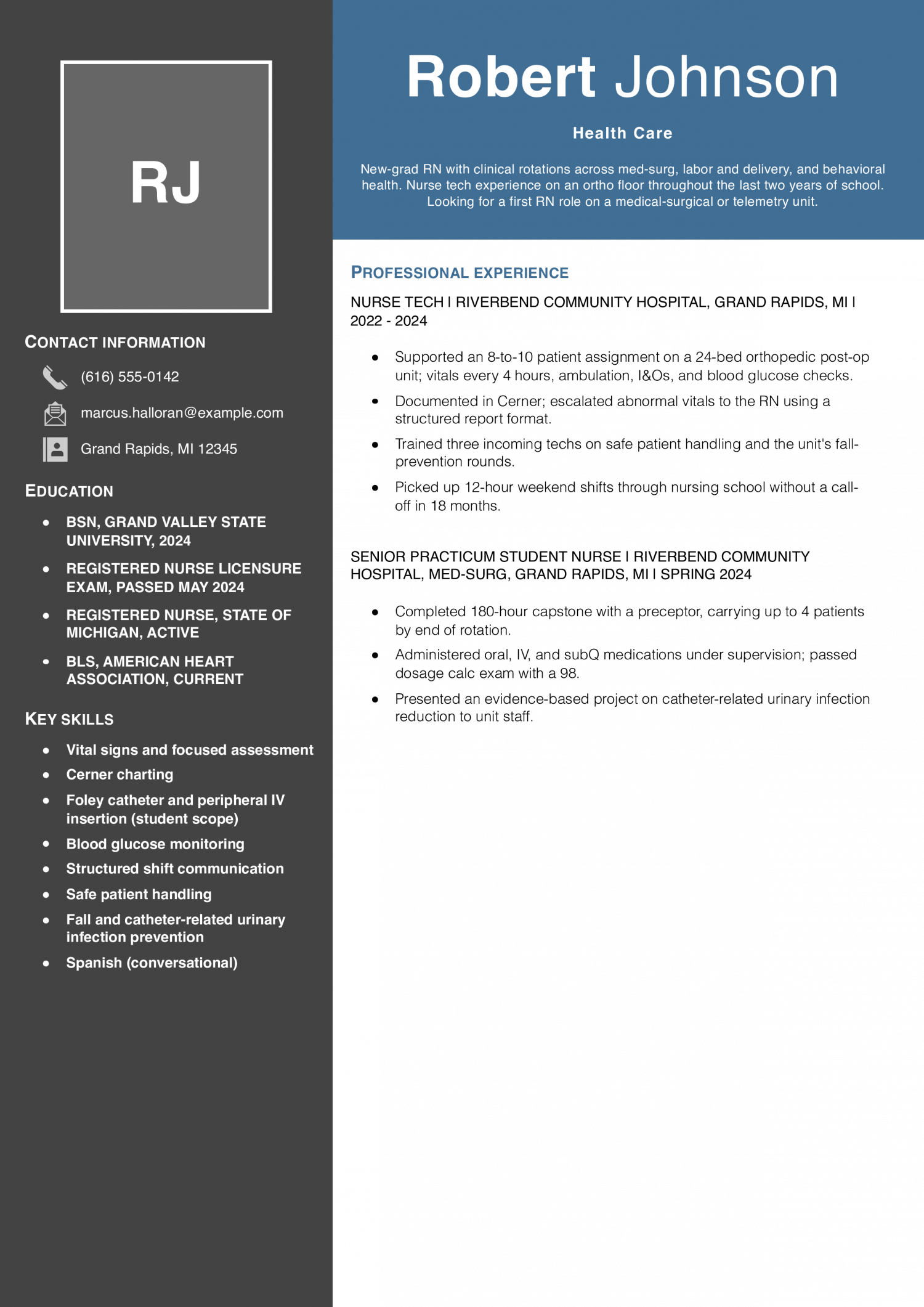
You are a new grad or recent hire stepping into your first patient-facing role. This resume has to show clinical training, hands-on rotations, and comfort with the pace of a care setting.
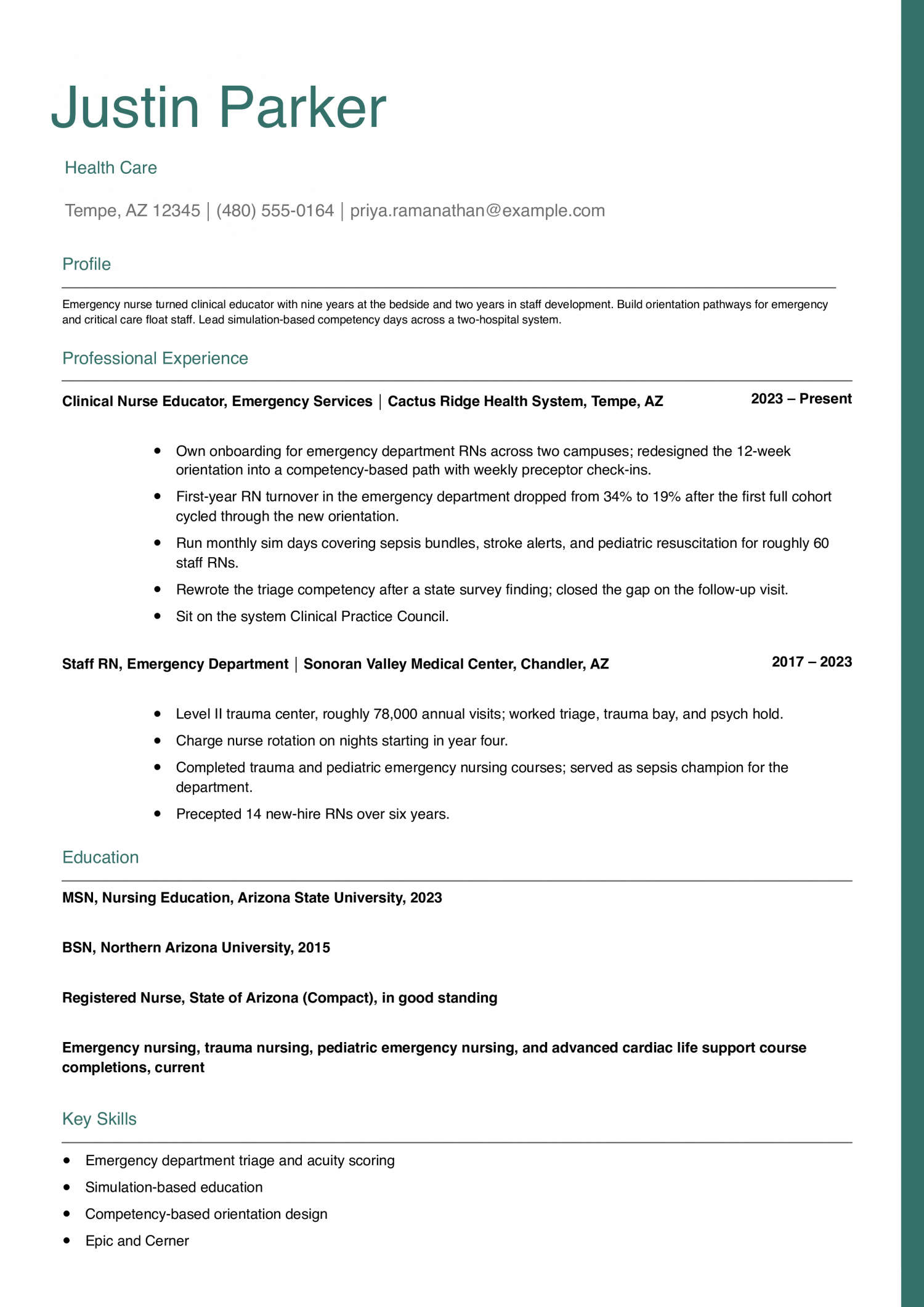
You have three to seven years of practice and now handle a full patient load without daily oversight. This resume has to show steady clinical judgment, chart accuracy, and solid teamwork across shifts.
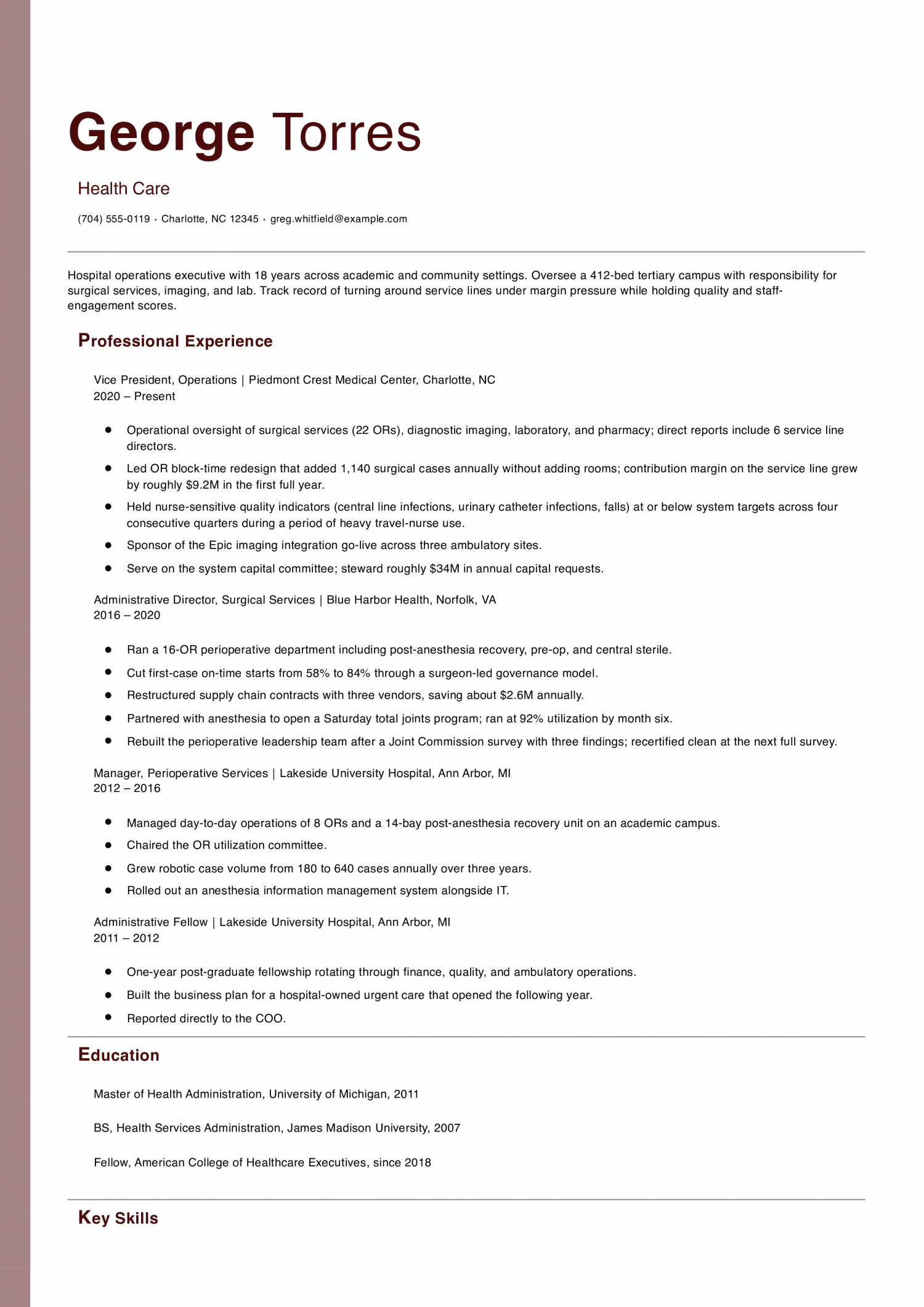
You lead a unit or clinic and answer for staffing, quality scores, and budget. This resume has to show people leadership, clear gains in patient care, and solid work with doctors and executives.
Alicia Bergstrom, RN, BSN
Minneapolis, MN | (612) 555-0173 | [email protected] | linkedin.com/in/alicia-bergstrom-rn
Critical care RN with 11 years across cardiothoracic critical care, medical critical care, and rapid response. Charge-nurse experience and active preceptor for new-grad residents. Comfortable running fresh post-op hearts, continuous dialysis, extracorporeal life support circuits with perfusion, and complex family meetings. Looking to move into a critical care clinical coordinator or assistant nurse manager role.
Charge Nurse, Cardiothoracic Critical Care Unit
Northern Lakes University Medical Center | Minneapolis, MN | 2021-Present
Rapid Response Nurse (per diem, concurrent)
Northern Lakes University Medical Center | Minneapolis, MN | 2022-Present
Staff RN, Medical Critical Care Unit
Cedar Point Medical Center | Saint Paul, MN | 2016-2021
Staff RN, Medical-Surgical / Telemetry
Cedar Point Medical Center | Saint Paul, MN | 2013-2016
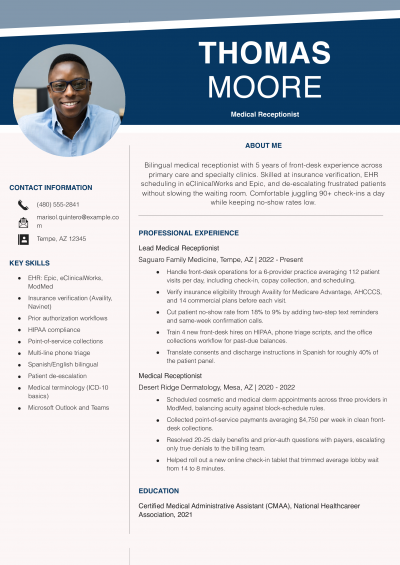
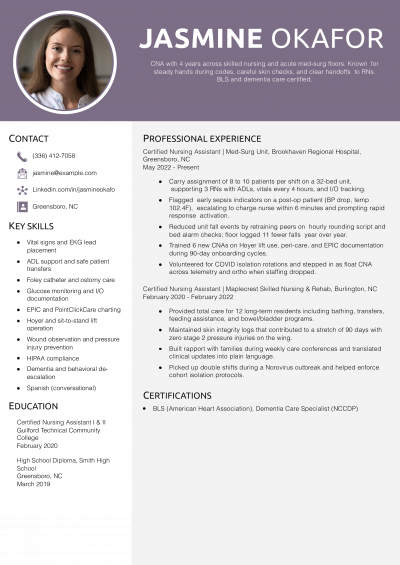
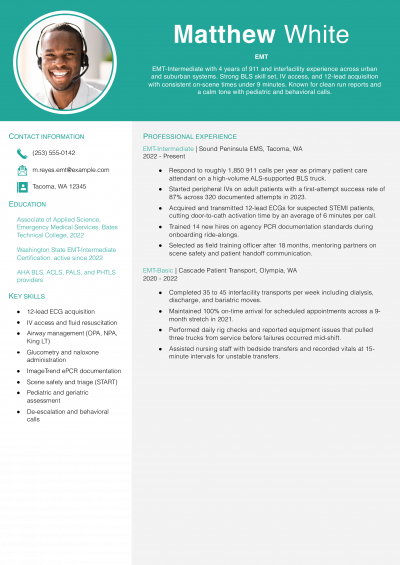
The first line of your summary should name a number a charge nurse tracks, and lead with patient load per shift, unit type, and years at that acuity. A cardiac step-down nurse might open with 6 patients per shift on a 32-bed telemetry unit across 4 years. A medical assistant might open with 25 to 30 patients rooming per day in a busy family practice.
Hiring managers read this line as your fit for their staff ratio. A scope sentence with no number reads as a job description. Put the number in the first eight words of the summary.
Recruiters scan for census and quality scores. Then they read the action verb.
A cath lab tech can write cases per day and door-to-balloon times. A revenue cycle specialist can write claims worked per day and clean-claim rate.
When a metric is protected or you never saw the dashboard, use volume and scope language: high-acuity ICU, level I trauma center, 400-bed teaching hospital. Anchor the reader in the size of the work.
Break each role into three to five buckets. A reader can scan it in seconds. Direct patient care is one bucket: assessments, medication administration, wound care, patient education.
Documentation and compliance is another: charting in the EHR, care plans, incident reports, HIPAA handling. Procedures and technical skills form a third: IV starts, EKGs, phlebotomy, sterile field setup, specimen handling. Care coordination is a fourth: handoffs, discharge plans, team rounds, family talks.
Leadership or precepting can be a fifth for charge nurses and senior techs. Lead each bullet with the verb, not the tool. Write started peripheral IVs on difficult-access oncology patients, not responsible for IV access.
The category order signals what you want the next role to look like.
Hiring managers screen for licensure and EHR skills before they read a bullet. Put a credentials block near the top, under the summary, with state, license type, and status. Write RN, California, license in good standing, and add BLS, ACLS, or PALS with expiration month and year.
Never publish the license number itself. Add a short systems line for Epic, Cerner, Meditech, or athenahealth, and name the modules you actually used. A coder should name ICD-10-CM, CPT, and the encoder.
A rev cycle analyst should name the clearinghouse. Rules vary by state and employer. Mirror the exact credentials the job asks for.
Missing credentials on page one send the resume to a second pile. If you work in coding and billing, see our medical billing and coding resume examples for ways to present your systems.
The bottom third of the resume should confirm your clinical foundation. List your degree, school, and graduation year, and add your clinical rotations if you are within three years of graduation. New grads should name rotation sites, hours, and patient populations: 180 hours med-surg at a 250-bed community hospital.
Add a continuing education line for courses like telemetry interpretation, chemotherapy administration, or trauma nursing core course. Name any preceptorship or residency program by hospital and track. Volunteer clinical hours belong here for career changers moving into health care from another field.
Keep this section tight, four to six lines total. The reader has already decided by the time they reach it. Use it to remove doubt about your training.
Health care resumes face stricter ATS screening in 2026 than in past years. The posting decides which of these skills matter, so read it before you build your list. Clinical terms clear the first cut.
Patient-care language decides whether the resume advances to a human reader. Healthcare hiring managers and clinical directors weigh hard skills first to confirm you can do the work. Soft skills like patient rapport then show you can hold a team and a floor.
Read both lists as a starting menu, not a script to copy in full. Pull the exact terms from the job ad and mirror them in your skills block. Back each soft skill with a bullet that shows it in action on a shift.
Swap in the software, unit type or patient population the posting names. Keep the block scannable at six to ten items so the parser reads every line.
| Soft Skills | AI-estimated % |
|---|---|
| Communication | 68% |
| Empathy | 63% |
| Attention to detail | 46% |
| Teamwork and collaboration | 35% |
| Problem-solving | 29% |
And here are the top hard skills showing up most often.
| Hard Skills | AI-estimated % |
|---|---|
| Electronic Health Records (EHR) | 67% |
| CPR and first aid | 53% |
| Medical terminology | 43% |
| Patient care | 39% |
| Medication administration | 30% |
Skill names and rankings come from an AI model grounded in U.S. Department of Labor occupation data for healthcare workers, not from a count of healthcare workers’ resumes built on ResumeTemplates.com.
Hiring teams check for these first when they scan a health care resume.
HIPAA fluency is a baseline expectation on health care resumes. Healthcare hiring managers and clinical directors screen for it fast. Show it in plain language tied to real work.
Name the systems and workflows you used, not vague claims. Point to training, audits, and how you handled protected health information. Keep the wording specific to your role and setting.
Resume Templates offers HR approved resume templates to help you create a professional resume in minutes. Choose from several template options and even pre-populate a resume from your profile.
Reverse chronological is the standard format most clinical directors expect to see. It puts your current unit, facility, and title at the top where a reviewer scans first.
Use a functional format only if you are returning after a long gap, and pair it with a clear dates section.
Write a three-line summary, not an objective, and name the setting and years upfront. Say what you do, where you do it, and one measurable result a director cares about.
For example, name your patient load, your unit type, and a quality metric you moved.
Mirror the words the posting itself uses, since most systems screen for exact matches on skill terms. Common ones include patient intake, insurance verification, scheduling, EHR, and HIPAA compliance.
Name the specific software you used, such as Epic or Cerner, rather than writing "EHR systems" alone.
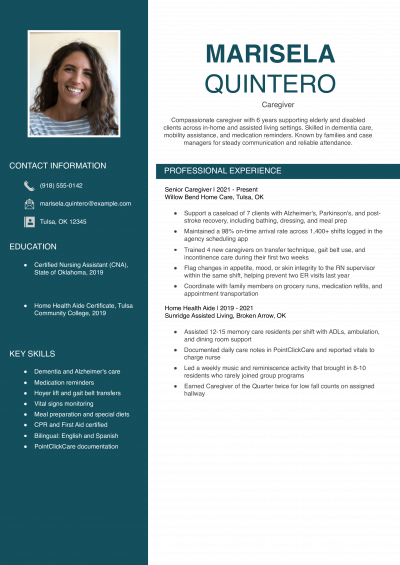
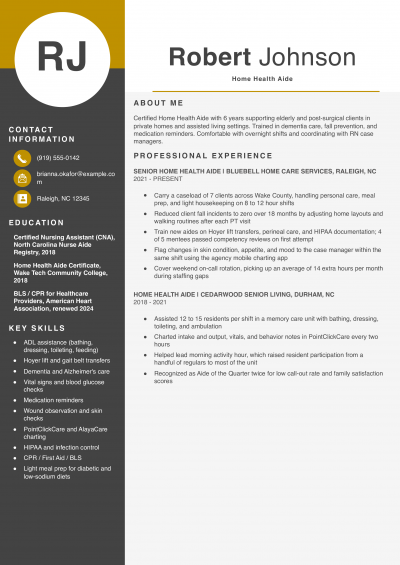
List the agency as the employer, your title, and the client population you served, such as adult, pediatric, or hospice. Under bullets, name the tasks a hiring reviewer needs to verify: vitals, medication reminders, transfers, and personal care.
Add caseload size and any outcomes you tracked, such as reduced hospital readmissions.
Put it under a section called Volunteer Experience, right below paid work, with the same bullet style. Name the clinic or organization, your role, the hours per week, and the dates you served.
Treat the bullets like paid work: describe the patient contact, the supervising clinician, and any skills you built.
Group your bullets by transferable skill rather than by unit, so a reviewer sees the pattern first. Lead each bullet with the clinical action, then name the setting where you did it.
Add a short line in your summary that states the specialty you are moving toward and why.
Yes, if you have five or more years of clinical work, or a mix of certifications, procedures, and preceptor roles. Keep page one for your summary, current role, credentials, and top skills, since that is what gets scanned.
Push older roles, continuing education, and committee work to page two.
Put your license and the number of patients you cared for in an ATS-friendly template. A basic template is also worth a look.
Health Care Resume
4.8/5 stars with 211 reviews

Executive Resume Writer and Career Coach
Andrew Stoner is an executive career coach and resume writer with 17 years of experience as a hiring manager and operations leader at two Fortune 500 Financial Services companies, and as the career services director at two major university business schools.
© 2026 Resumetemplates.com All rights reserved.