Why this resume works

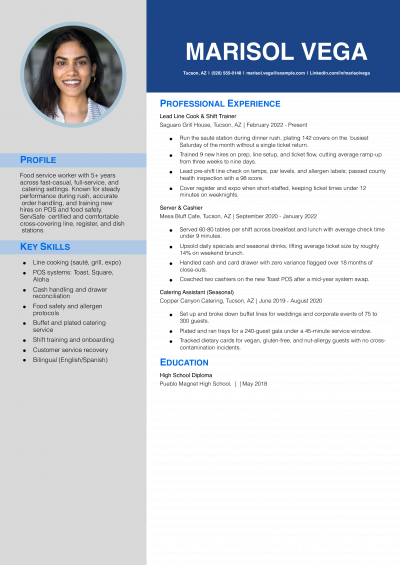
  • Covers per night tied to a real number: Saying 210 covers with 14-minute ticket times tells a chef exactly what speed this cook can hold.
  • Shows growth from prep to station lead: Three jobs walk from prep cook to sauté and grill, which matches how kitchens actually promote.
  • Names the stations a chef will ask about: Sauté, grill, fry, and pantry are called out by name, so a hiring chef can match the cook to an open station.

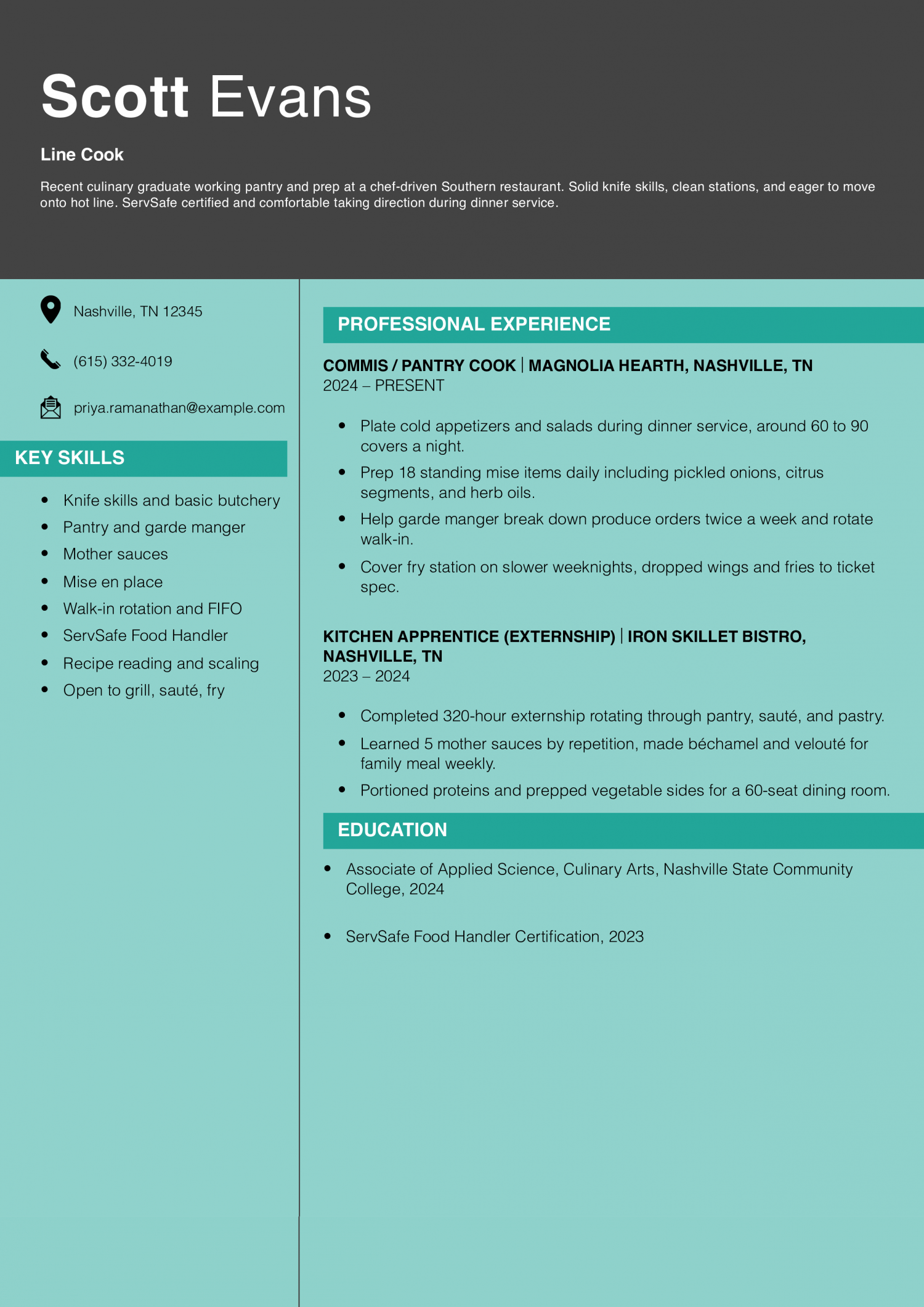
Commis Example

Commis cooks are early-career cooks with one to two years on the line, often coming from culinary school or prep cook roles. This resume needs to prove station versatility, ServSafe certification, and willingness to work any shift the schedule needs.

Why this resume works

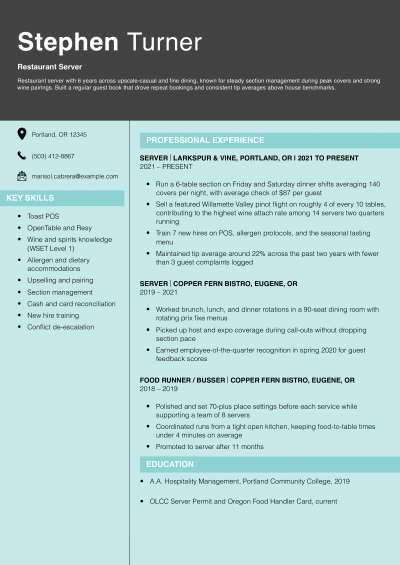
  • Cover count is honest for the level: 60 to 90 covers a night is a realistic number for a commis, not an inflated one a chef will see through.
  • Externship counted as real experience: Listing 320 hours and the stations rotated through shows actual kitchen time, not just classroom hours.
  • Says what stations they want next: Ending the skills list with grill, sauté, and fry tells the chef this cook wants to move onto the hot line.

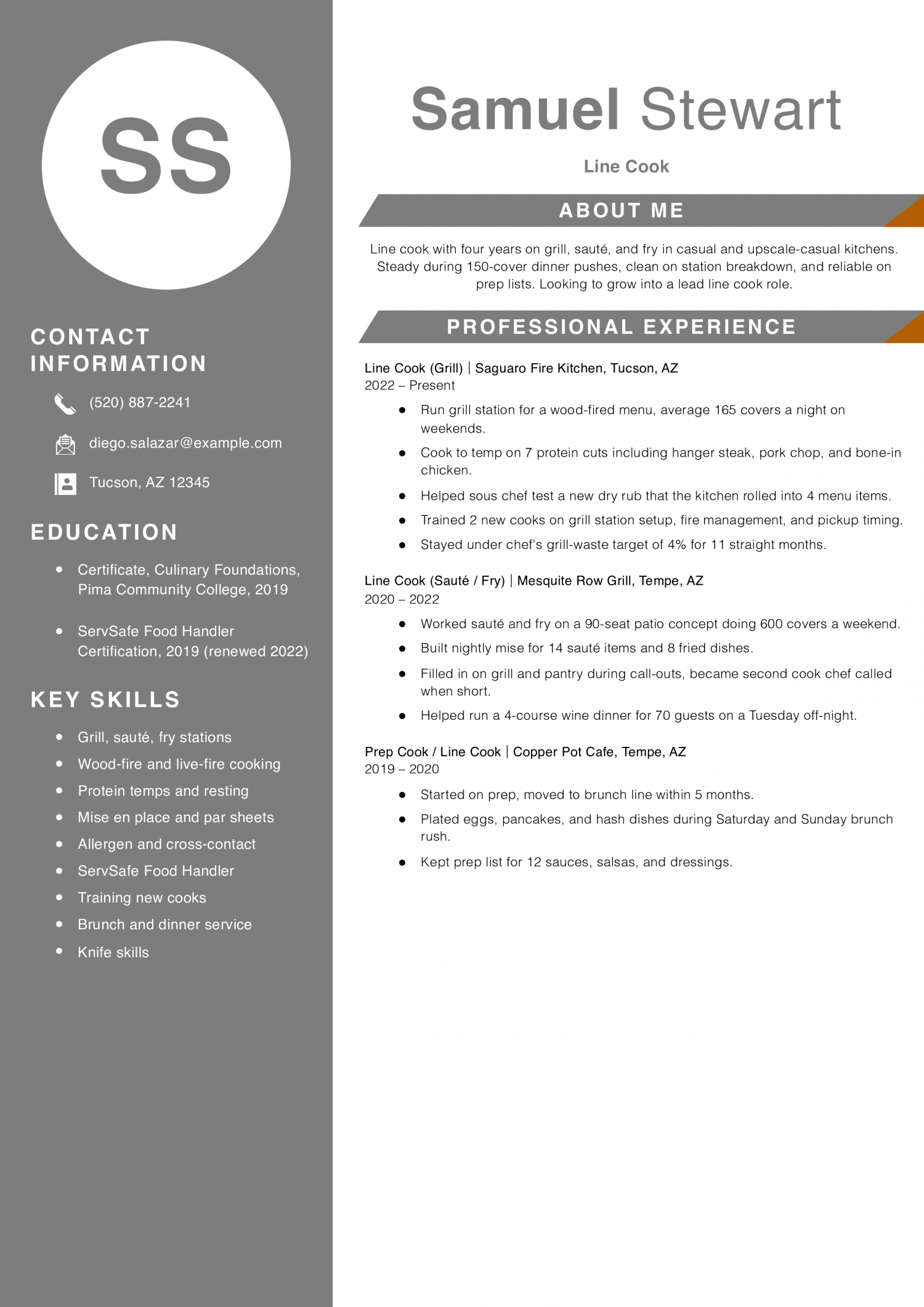
Line Cook Example

Line cooks own two to three stations at a steady volume kitchen and run their own mise en place each shift. This resume needs to prove ticket speed under pressure, recipe consistency, and clean HACCP execution across grill, sauté, and fry.

Why this resume works

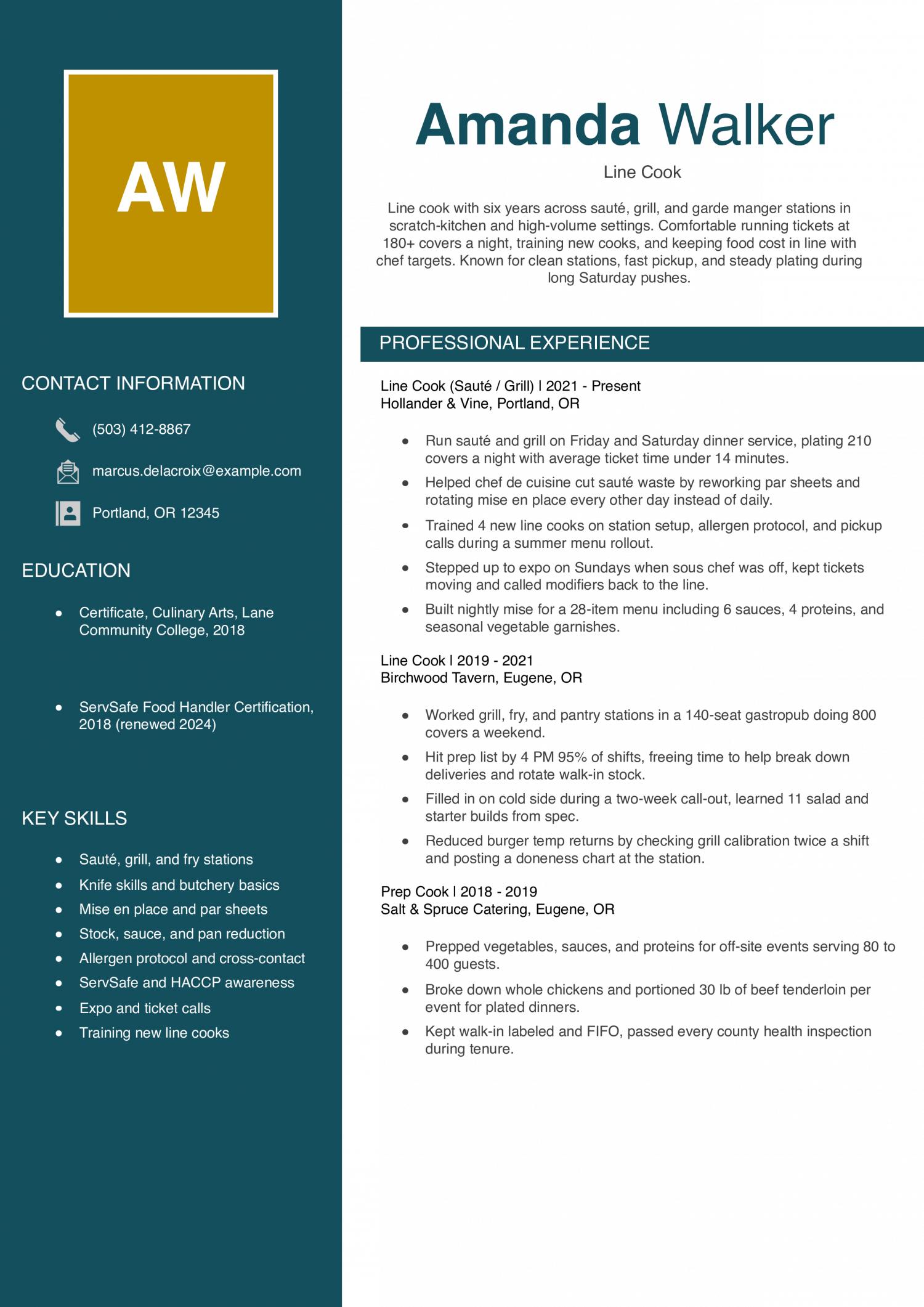
  • Grew from prep to grill in three jobs: The path from prep cook to lead grill makes the cook’s growth easy to follow at a glance.
  • Names the proteins, not just the station: Listing hanger steak, pork chop, and bone-in chicken proves real cooking, not just standing in front of fire.
  • Waste number speaks to chefs: Holding grill waste under 4% for 11 months is the kind of detail a chef de cuisine actually tracks.

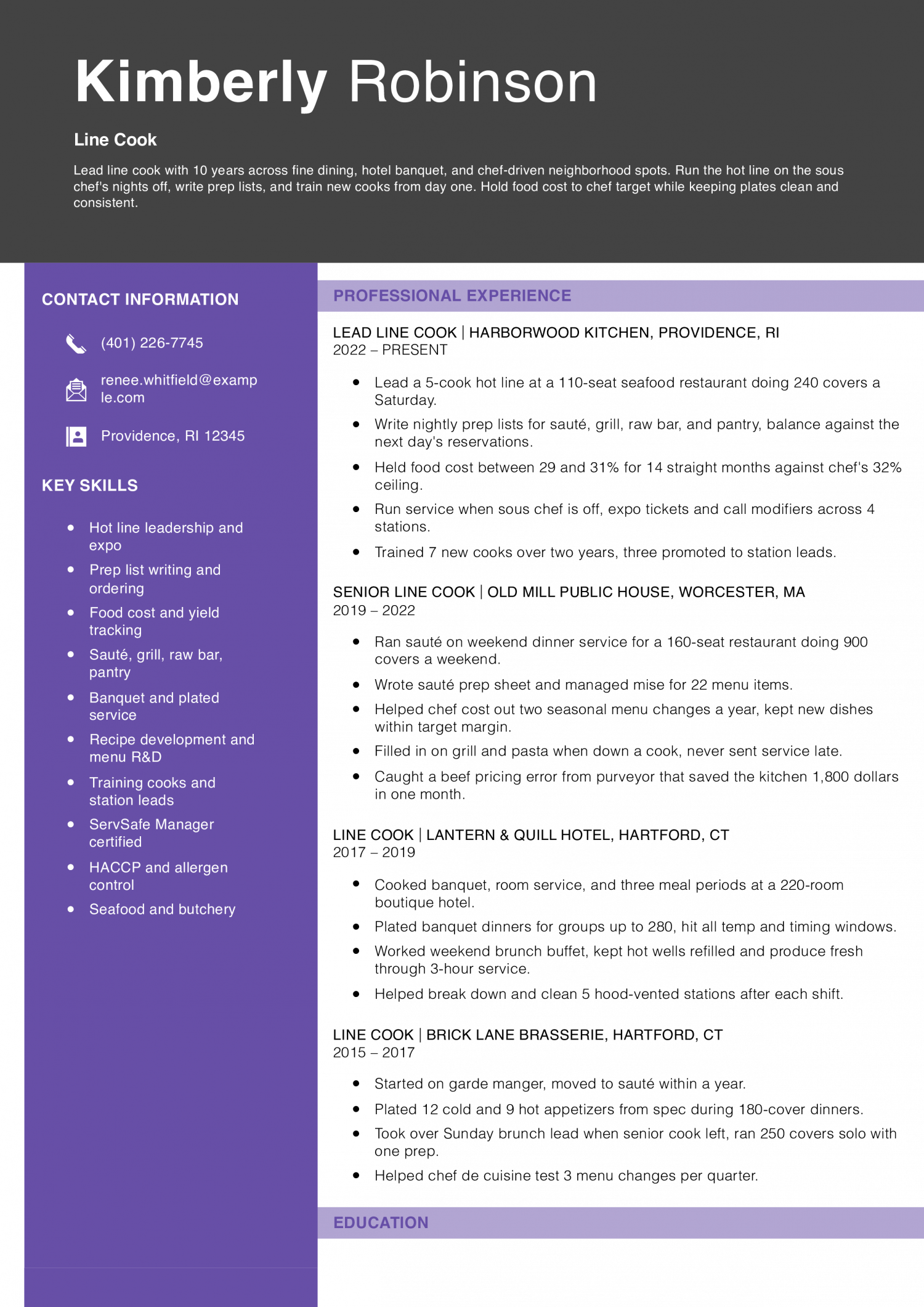
Lead Line Cook Example

Lead line cooks run the pass during service, train new hires on stations, and step in when the sous chef is off the floor. This resume needs to prove kitchen leadership, scheduling input, and measurable food cost or waste improvements.

Why this resume works

  • Food cost number a chef will respect: Holding food cost at 29 to 31% against a 32% ceiling is the metric a chef de cuisine asks about in interviews.
  • Caught a real money mistake: Spotting an 1,800 dollar purveyor error in one month shows this cook reads invoices, not just tickets.
  • Trained cooks who got promoted: Saying three of seven trainees became station leads is proof of teaching, not just a claim of being a team player.

How to Write a Line Cook Resume

01 Open with a profile that names your station scope

Your profile should state your years on the line, the kitchen type you’ve worked (fine dining, high-volume banquet, fast casual, hotel, country club), and the stations you run unassisted.

Name the covers per shift you handle and the cuisine style. A chef reading the top of page one wants to know in one pass whether you can hold sauté on a 250-cover Friday night or whether you’re still building speed on garde manger.

02 Quantify covers, tickets, and prep volume

Strong line cook bullets carry numbers. Name covers per shift, average tickets per hour on your station, and prep volume in pounds or pans.

Bullets without a number tend to read as duties, so swap vague claims for scale. Try covers held during peak service, ticket times you hit on the rail, and waste or cost reductions you contributed to under the sous chef’s targets.

03 Group bullets by station and prep

Sort your line cook work into three or four buckets so a chef can scan it fast. Group by stations run (grill, sauté, fry, broiler, garde manger), prep and butchery, food safety and HACCP, and team or training contributions.

Inside each group, lead with the heaviest scope. A bullet about running sauté solo on a Saturday service outranks a bullet about restocking lowboys, and the order on the page should reflect that.

04 Put food safety credentials on page one

ServSafe Food Handler or your state-equivalent card belongs in a credentials block near the top of page one, with the issuing body and expiration year. ServSafe Manager, allergen training, and any HACCP coursework go in the same block.

Executive chefs and sous chefs scan for these before they read bullets, because a card-current cook can start the next shift. List the credential name and year. Do not list card numbers on the resume itself.

05 Close with education and shift availability

Close with culinary education if you have it (CIA, Johnson and Wales, ICE, community college culinary programs, apprenticeships) and any externships at named restaurants. If you came up through the line without culinary school, list your highest education and lead the resume on stations instead.

Add a short availability line: nights, weekends, doubles, holidays. Executive chefs and sous chefs use that line to decide whether to call before they finish the stack.

Based on data from the line cook resumes our users build, the skills below are the ones that show up most on resumes that move to a trail shift. Chefs weigh hard skills like station coverage and ServSafe status first, then read soft skills as evidence behind the bullets. A claim of composure under pressure only lands if the bullet next to it names covers per shift.

Match the lists against the specific posting, and use your soft skills to back up what the station bullets already prove.

Soft Skills % of resumes with this skill
Teamwork 78%
Working under pressure 52%
Communication 45%
Attention to detail 38%
Time management 34%

And here are the top hard skills showing up most often.

Hard Skills % of resumes with this skill
Food safety and sanitation 70%
Knife skills 63%
Food preparation 42%
Station setup and line cooking 40%
Inventory management 28%

Based on data from thousands of line cooks’ resumes built on ResumeTemplates.com, May 2026.

Must Have on a Line Cook Resume

The items below are what separate a line cook resume from one that gets put back in the pile.

Food Handler Certifications

Food handler requirements vary by state and county, and chefs expect you to know which card applies where you work. List the credential, the issuing body, and the expiration year on page one.

  • ServSafe Food Handler (National Restaurant Association)
  • California Food Handler Card (ANSI-accredited provider)
  • Texas Food Handler Certificate (DSHS-accredited provider)
  • Illinois Food Handler Training (state-approved provider)
  • Washington Food Worker Card (state Department of Health)

POS Systems Familiarity

Modern kitchens run tickets through KDS screens tied to a POS, and chefs notice when you can name the system you’ve worked. List the platforms you’ve used in a short skills line near your hard skills.

  • Toast POS and Toast KDS
  • Square for Restaurants
  • Aloha POS (NCR)
  • Micros and Oracle Simphony
  • TouchBistro
  • Resy and OpenTable (for cover counts and ticket flow)

Shift Availability Belongs on the Resume

Chefs schedule around availability before they schedule around skill. A short availability line near the top of the resume tells them whether to call you before they finish the stack.

Sample Availability Line

Keep it to one line and be specific. Vague availability reads as limited availability.

  • Nights, weekends, and holidays
  • Open to doubles and split shifts
  • Available for brunch and dinner service
  • Reliable transportation for late closes
  • Open to banquet and event call-ins

Line Cooking Credentials That Get You the Job

Executive chefs and sous chefs read this list as a map of where your kitchen work is heading. The credentials below tell them which track you’ve invested in, whether food safety leadership, sanitation, or a specialty cuisine. List the issuing body and the year of completion for each item.

  • ServSafe Manager Certification: Signals you can run a station without sanitation oversight and positions you for shift lead or sous chef tracks.
  • HACCP Certification: Shows you understand critical control points, which matters in hotels, catering, and any operation with a corporate food safety audit.
  • ACF Certified Culinarian (CC): American Culinary Federation credential that backs up culinary school or apprenticeship time with a recognized professional mark.
  • Allergen Awareness Training: Many states now require it, and naming the course (such as ServSafe Allergens) tells chefs you can handle modifications cleanly.

Latest BLS Statistics for Line Cooks

Line cook is one of the larger occupations BLS tracks, which means the median pulls in a long tail of fast-casual and quick-service variants alongside steakhouses, hotels, and fine dining. The spread between the 10th and 90th percentile reflects that mix more than seniority alone.

To position above the median, lead the resume with the kitchen tier you’ve worked, the stations you run solo, and the covers per shift, not the years on the line.

$36,830 National median annual
$37,730 National mean annual
$28,010 Entry-tier floor (10th percentile)
$47,340 Top-decile ceiling (90th percentile)
1,452,130 Line Cooks in the U.S.
Where you stand

Entry tier

$28,010 to $36,830 At the entry tier, lead with your ServSafe card, the stations you've trained on, and willingness to work nights and weekends.

Mid band

$36,830 to $47,340 At the mid band, your resume needs to show two or three stations run solo, covers per shift, and clean HACCP execution.

Top decile

$47,340+ At the top decile, lead with the kitchen tier (fine dining, hotel, named chef), pass leadership, training scope, and food cost wins.

Top-paying states

# State Avg. Annual
1 Massachusetts $46,280
2 District of Columbia $45,230
3 Washington $44,980
4 Maine $44,870
5 Hawaii $44,710
6 Vermont $44,560
7 California $44,290
8 New York $39,890
9 Colorado $39,170
10 New Hampshire $39,050

Highest-employment states

# State Workers Median
1 California 160,270 $44,290
2 Florida 134,480 $36,300
3 Texas 125,880 $34,050
4 New York 62,430 $39,890
5 Illinois 61,630 $36,630
Source: U.S. Bureau of Labor Statistics, OEWS 2024 release (SOC 35-2014).
Written by professional resume writers and loved by hiring managers

Resume Templates offers HR approved resume templates to help you create a professional resume in minutes. Choose from several template options and even pre-populate a resume from your profile.

Frequently Asked Questions

Can I apply for a line cook job without prior experience?

Yes. Many kitchens hire line cooks straight from prep, dish, or culinary school externships.

Lead the resume with your ServSafe card, knife skills, and any stage or externship hours at named restaurants. Add a short availability line. Chefs hire on reliability and pace as much as on resume length.

How should I describe line cook work on my resume?

Name the stations you run (grill, sauté, fry, broiler, garde manger), the covers per shift, and the cuisine style of the kitchen.

Pair each bullet with a number where you have one, such as tickets per hour or prep volume. Group bullets by station so a chef can scan your scope in one read.

Should I list prep cook roles on a line cook resume?

Yes, but reframe them for the line. List prep volume in pounds or pans, the stations you supported during service, and any shifts you covered on the line.

If you stepped up to sauté or garde manger when a cook called out, name it. That is the bullet that tells a chef you're ready for a line role.

What format works best for a line cook resume?

A one-page reverse-chronological format works best. Chefs read fast and want the recent kitchens at the top.

Put your ServSafe and availability line near the top, then work history with bullets grouped by station, then a short education or culinary training block. Keep it to one page.

What's the best resume template for a line cook?

For a line cook, an ATS-friendly template is the safest pick, because it puts your certifications and experience where a hiring manager scans first. A basic template is a solid alternative. Whichever you choose, keep the formatting clean and easy to parse: clear section headings, a standard font, and no graphics a parser can choke on.

Rate this article

Line Cook Resume

Average Rating

4.1/5 stars with 145 reviews

You have given 0 Star(s)
4.1/5 stars with 145 reviews
Andrew Stoner

Executive Resume Writer and Career Coach

Andrew Stoner is an executive career coach and resume writer with 17 years of experience as a hiring manager and operations leader at two Fortune 500 Financial Services companies, and as the career services director at two major university business schools.