

Tip !

Production supervisors look for the specific machines, controls, and tolerances on the first page of a machine operator resume, because that list tells them whether the person can step onto the floor without a week of hand-holding.

Andrew Stoner , Executive Resume Writer and Career Coach

Why this resume works

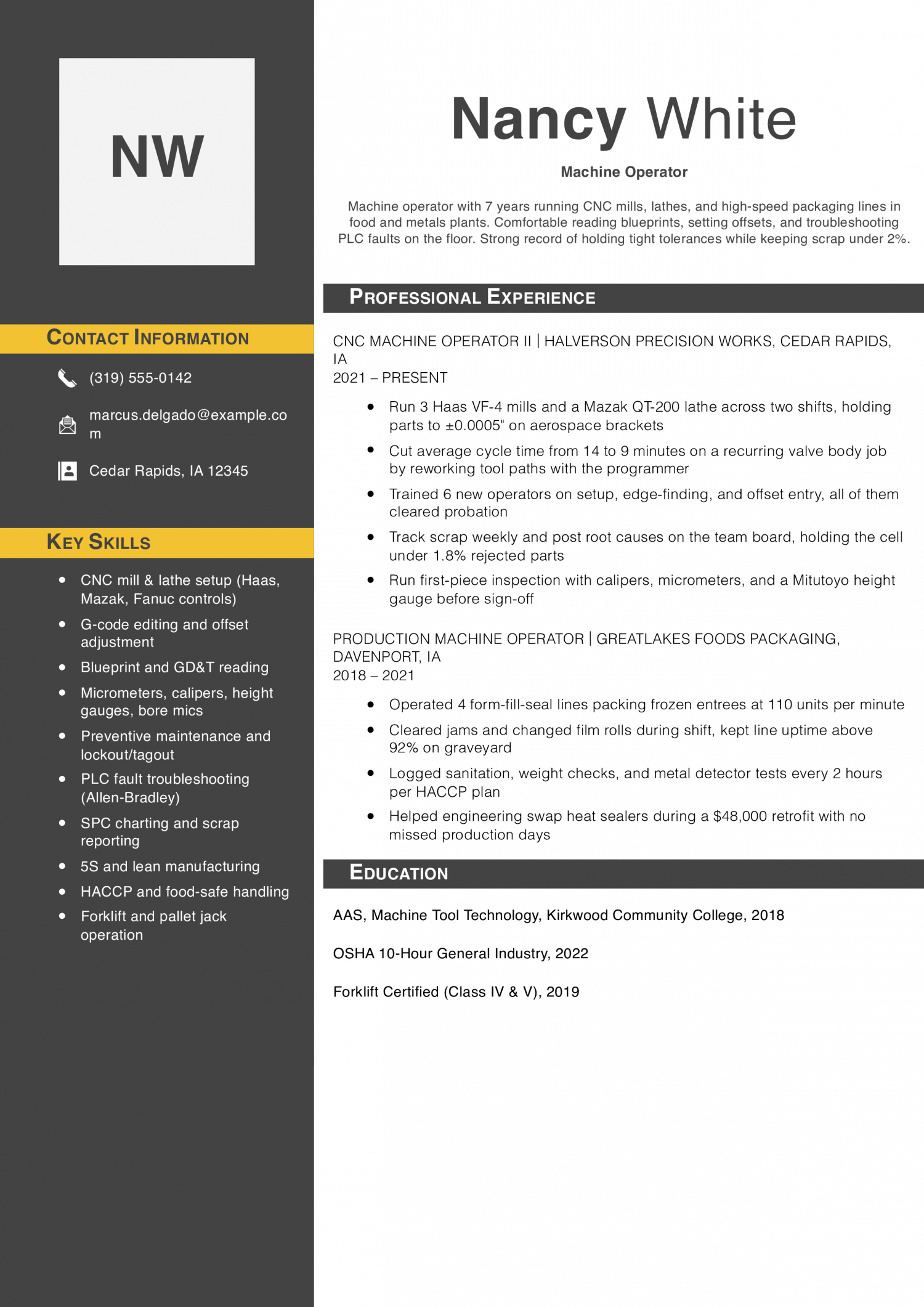
  • Real machines and real tolerances: Naming Haas, Mazak, and a ±0.0005″ spec shows the hiring manager this person has actually run the equipment.
  • Cycle time cut with a number: Dropping cycle time from 14 to 9 minutes ties effort to a result a production manager cares about.
  • Two industries on one resume: Metals and food packaging together signal someone who adapts to different lines and quality systems.

Entry Level Example

Entry-level operators are coming off a vocational program, a temp assignment, or a first production gig. The resume needs to prove safe machine handling, basic blueprint reading, and a clean attendance record across a full shift cycle.

Why this resume works

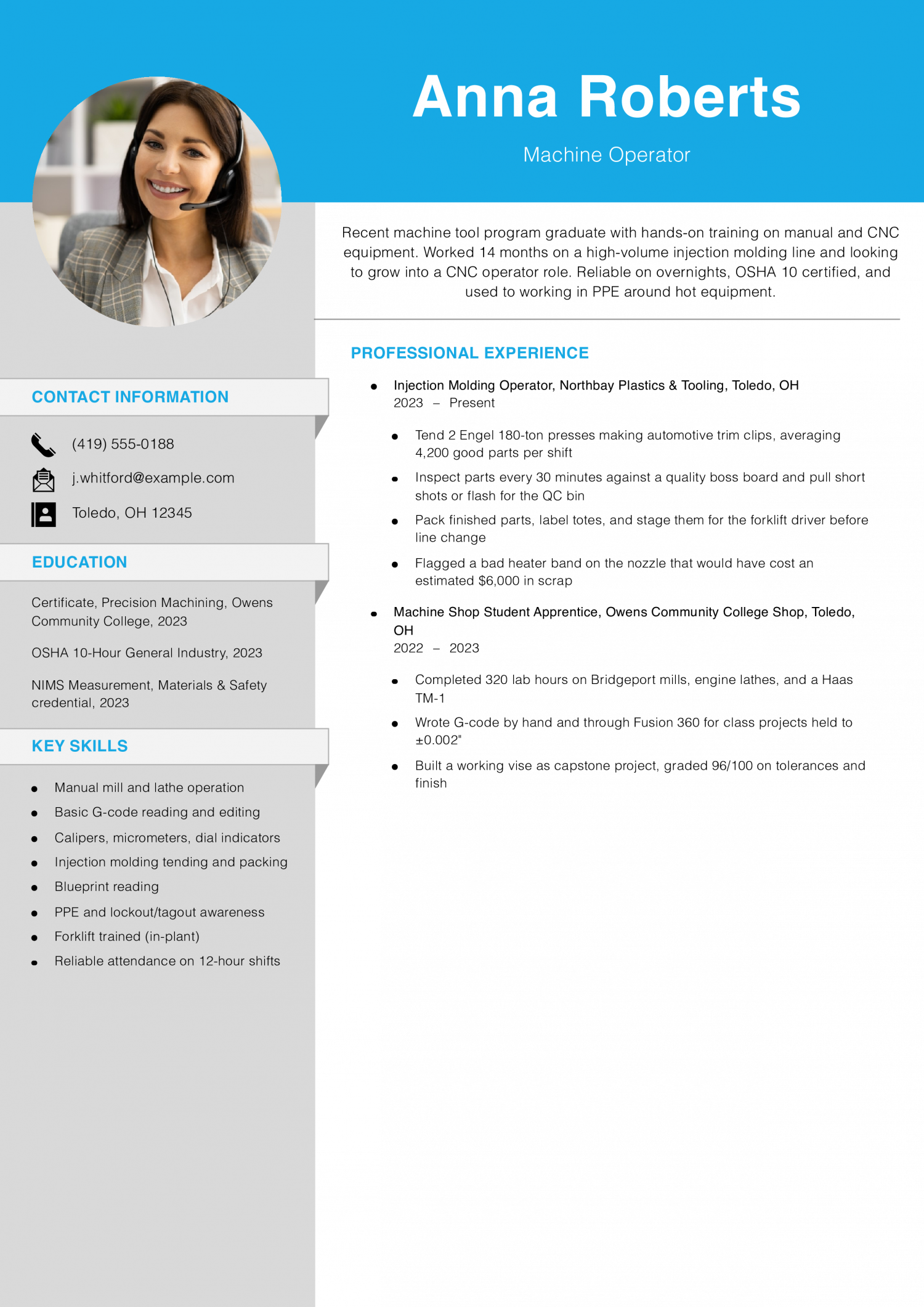
  • Catches a costly mistake: Spotting the bad heater band shows attention to detail that saves the plant real money, even at entry level.
  • School work that looks like real work: Lab hours, capstone vise, and a graded tolerance number tell the reader exactly what skills came out of the program.
  • Honest, current credentials: OSHA 10 and the NIMS credential are listed with years, so the hiring manager knows they are fresh.

Experienced Example

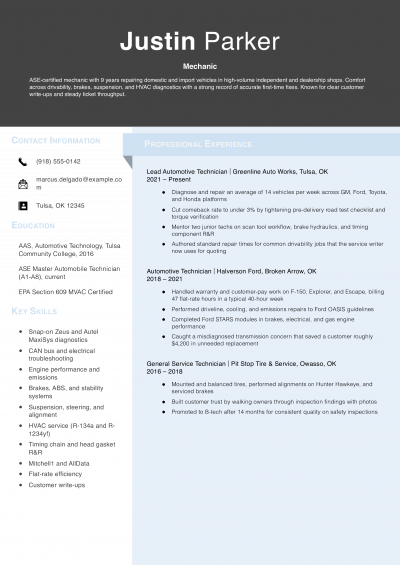
Experienced operators run one or two machine families with little supervision and own their changeovers. The resume needs to prove tolerance accuracy, scrap and uptime numbers, and quality checks like in-process gauging or first-piece inspection.

Why this resume works

  • Setup time cut with a method: Going from 95 to 62 minutes through tool pre-setting tells the reader both what changed and how.
  • Dollar savings tied to scrap: The $27,500 stock saving from a kaizen idea shows the operator thinks beyond just running parts.
  • Industries the buyer recognizes: Medical, automotive driveline, and stamping cover the most common job postings in this region.

Lead Example

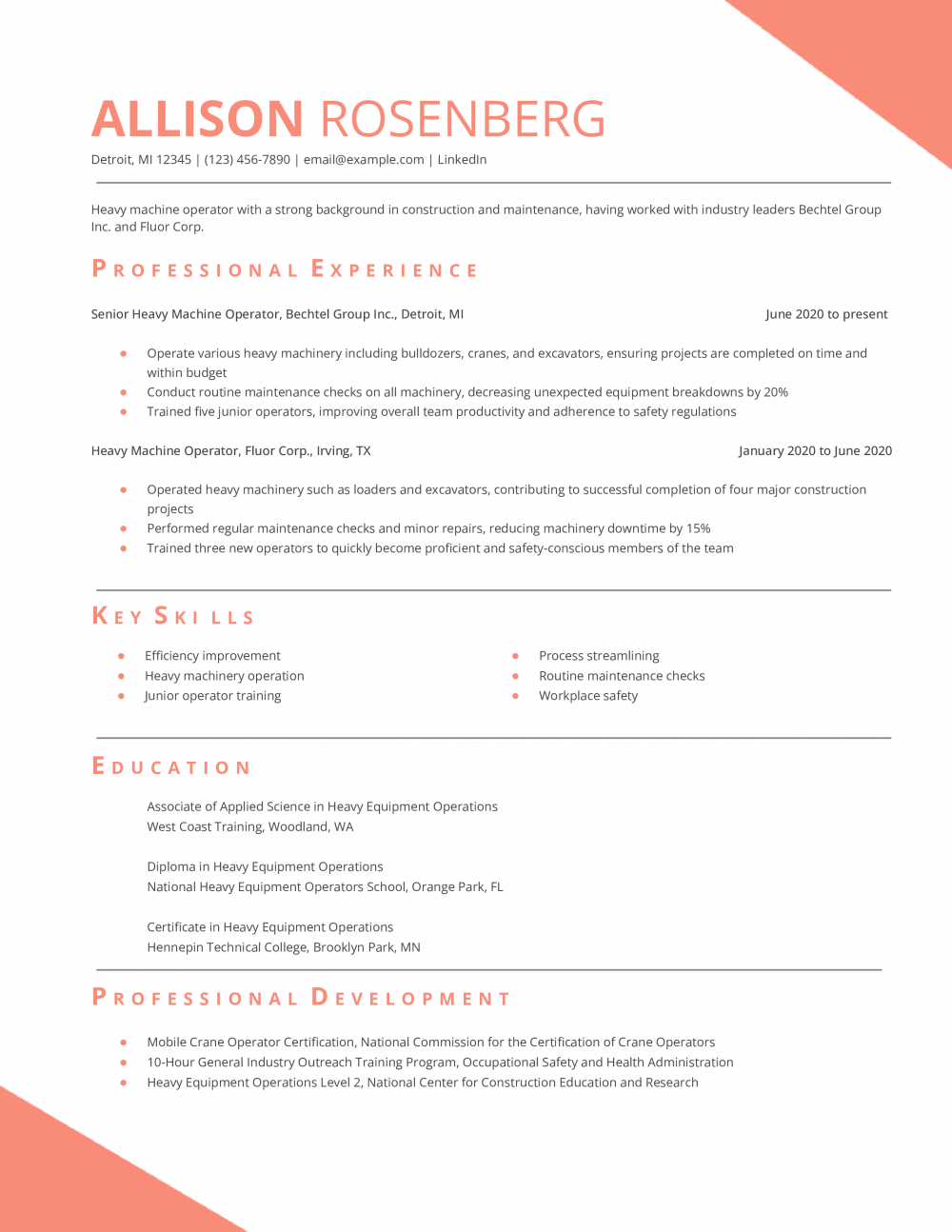
Lead operators set up jobs, train newer operators, and troubleshoot down machines without waiting on maintenance. The resume needs to prove cross-machine fluency, line-level throughput gains, and ownership of preventive maintenance schedules.

Why this resume works

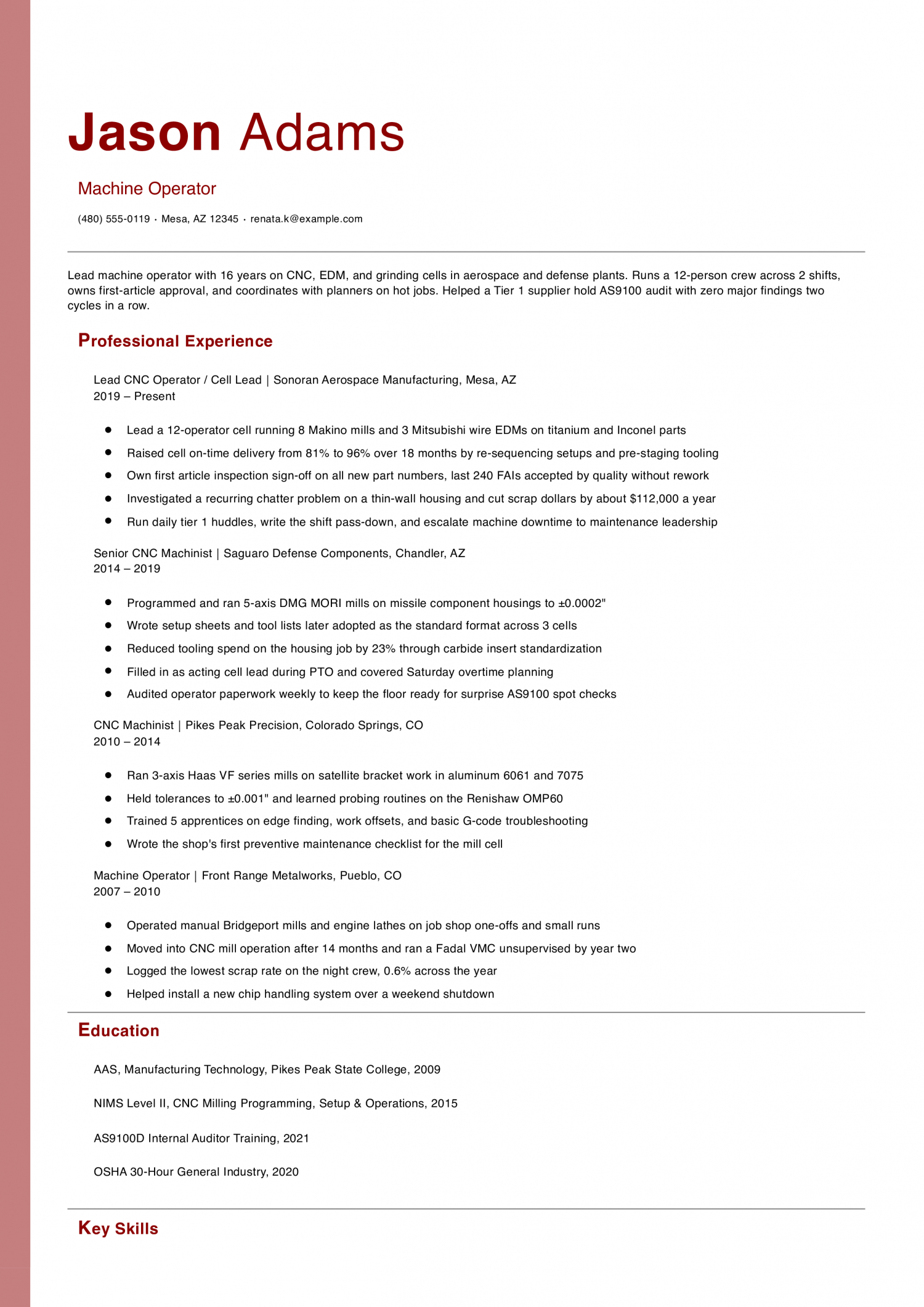
  • Big improvement with a clear method: Moving on-time delivery from 81% to 96% by re-sequencing setups shows leadership thinking, not just operator thinking.
  • Audit-ready record: Two clean AS9100 cycles and 240 accepted FAIs tell an aerospace buyer this lead can handle their paperwork.
  • Career arc that adds up: Manual mills to 5-axis aerospace lead reads like a real career, not a list of jobs.

How to Write a Machine Operator Resume

01 Open with a profile that names your machine scope

Your profile should state your years on the floor and the machine families you run. Name controls and brands: Fanuc, Haas, Mazak, Bridgeport, Cincinnati, or the specific press tonnage.

Add the industries you’ve worked in, such as automotive, aerospace, plastics, or food packaging. Close with the tolerances you hold and the shift pattern you keep.

A supervisor reading the top of page one should know within seconds whether you fit the line. Skip soft adjectives and lead with the equipment.

02 Quantify output, scrap, and uptime

Production work runs on numbers, so bullets without them tend to read as duties. Pull units per hour, parts per shift, scrap rate, and machine uptime from your last role.

Most strong resumes name two or three of these: cycle time held within tolerance, scrap reduced from one percent to half a percent, or uptime above 95 percent across a quarter.

If your plant tracked OEE or first-pass yield, use those numbers directly. Round to whole figures and tie each to the machine or line you ran.

03 Group your work by machine and process

Break your bullets into three or four buckets the reader can scan. Common groupings: machine setup and changeover, in-process operation, quality and inspection, and maintenance.

Under setup, name tool loads, offsets, and changeover times. Under operation, name the parts, materials, and tolerances you held.

Under quality, name your gauges and checks: calipers, micrometers, CMM, SPC charts, first-piece sign-off. Under maintenance, name the lubrication, tool changes, and PM tasks you owned.

04 Put tickets and safety training near the top

Production supervisors and plant managers need to see your forklift certification, OSHA 10 or 30, and any lockout/tagout training before they read your bullets. Put a credentials block under your profile on page one.

List each credential with the issuing body and the year. Include any NIMS stamps, MSSC CPT, or welding tickets you hold.

Add software and controls in the same block: Fanuc, Siemens, Mastercam, GibbsCAM, or any MES platform like Plex or SAP ME. This is what clears the first read.

05 Close with education and floor-ready extras

Under education, list your high school diploma, GED, or trade school program with the year. Name any apprenticeship hours or community college coursework in machining, welding, or industrial maintenance.

Add a short extras line for shift flexibility, second-language ability, or willingness to travel between plants. These details matter for multi-site employers and 24/7 operations.

Skip hobbies and generic interest lines. End the resume on something a foreman can use, not filler.

ATS filters catch more machine operator resumes than ever in 2026. The skills below come from our user-built machine operator resumes, so the list reflects what real operators put on the page. Production supervisors weigh hard skills first: machine families, controls, and gauges clear the first cut.

Soft skills like shift reliability and shop-floor communication decide whether the resume advances to a phone screen. Match the list against the posting you’re targeting, then use your bullets to back each soft skill with a concrete example from the line.

Soft Skills % of resumes with this skill
Attention to detail 70%
Reliability 69%
Communication 45%
Problem solving 35%
Teamwork 33%

And here are the top hard skills showing up most often.

Hard Skills % of resumes with this skill
Machine setup and operation 78%
Safety and OSHA compliance 66%
Quality control inspection 42%
Preventive maintenance 36%
Blueprint and gauge reading 25%

Based on data from thousands of machine operators’ resumes built on ResumeTemplates.com, May 2026.

Must Have on a Machine Operator Resume

Before a machine operator resume gets a closer read, hiring teams check for a short list of essentials.

OSHA Certifications

Safety tickets are the first thing a production supervisor checks. Put them in a credentials block on page one, with the issuing body and the year completed.

  • OSHA 10 General Industry, completed 2024
  • OSHA 30 General Industry, completed 2023
  • Lockout/Tagout (LOTO), annual refresher
  • Confined Space Entry training
  • Powered Industrial Truck (Forklift) certification, Class IV and V
  • Hazard Communication (HazCom) and SDS training
  • First Aid and CPR, American Red Cross

Tools of the Trade

Name the brands and controls, not just the machine category. “Haas VF-2 with Fanuc control” reads as real experience; “CNC mill” reads as a checkbox.

  • CNC mills and lathes: Haas, Mazak, Mori Seiki, Okuma
  • Controls: Fanuc, Siemens, Mitsubishi, Haas
  • CAM and programming: Mastercam, GibbsCAM, Fusion 360
  • Inspection tools: micrometers, calipers, height gauges, CMM
  • SPC and quality software: Minitab, InfinityQS
  • MES and ERP: Plex, SAP ME, Epicor
  • Press equipment: hydraulic and mechanical presses up to 400 ton
  • Material handling: sit-down, stand-up, and reach forklifts

Machine Operation Credentials That Get You the Job

Forklift certification and OSHA 10 keep you eligible for most production floors. The certifications below are what move a machine operator resume from the qualified-but-typical stack into a production supervisor’s shortlist. List the issuing body, the level, and the year earned.

  • NIMS Machining Level I or II: Signals verified skill in turning, milling, or grinding on CNC equipment and is recognized across most metalworking employers.
  • MSSC Certified Production Technician (CPT): Covers safety, quality, manufacturing processes, and maintenance awareness, which reads as cross-line fluency to multi-shift plants.
  • OSHA 30 General Industry: Goes beyond the entry-level OSHA 10 and signals you can lead safety conversations, which matters for lead and trainer roles.
  • Forklift and Powered Industrial Truck Certification: Required on most production floors that move raw stock or finished goods, so list the class of truck and the year trained.

Latest BLS Statistics for Machine Operators

Machine operator sits in a broad BLS occupation group, which means the median pulls in a long tail of light-duty tenders and packaging line jobs alongside skilled CNC work. The spread between the tenth and ninetieth percentile is wide, and most of that gap comes down to machine complexity, shift, and industry.

To position above the median, lead the resume with the controls and tolerances you hold, not the general label of machine operator.

$38,820 National median annual
$42,940 National mean annual
$30,370 Entry-tier floor (10th percentile)
$59,600 Top-decile ceiling (90th percentile)
277,060 Machine Operators in the U.S.
Where you stand

Entry tier

$30,370 to $38,820 At the entry tier, your resume needs to show OSHA 10, forklift certification, and the specific machines you ran during training or temp work.

Mid band

$38,820 to $59,600 At the mid band, lead with the CNC controls you run independently, tolerance ranges, and scrap or uptime numbers from your line.

Top decile

$59,600+ At the top decile, your resume needs to show setup ownership across machine families, NIMS or MSSC credentials, and operators you have trained.

Top-paying states

# State Avg. Annual
1 District of Columbia $107,100
2 Nebraska $52,810
3 Alaska $50,020
4 Colorado $47,650
5 North Dakota $47,080
6 Washington $46,700
7 Vermont $46,680
8 New Hampshire $46,460
9 Iowa $46,380
10 Minnesota $46,020

Highest-employment states

# State Workers Median
1 California 37,490 $39,430
2 Tennessee 24,870 $38,210
3 Georgia 23,780 $39,560
4 North Carolina 17,760 $37,200
5 Florida 13,360 $36,360
Source: U.S. Bureau of Labor Statistics, OEWS 2024 release (SOC 51-9199).
Written by professional resume writers and loved by hiring managers

Resume Templates offers HR approved resume templates to help you create a professional resume in minutes. Choose from several template options and even pre-populate a resume from your profile.

Frequently Asked Questions

What machine operator duties should I list on my resume?

Lead with the duties that match the job posting. Most production resumes group bullets into setup, operation, quality, and maintenance.

Name the machine and the part under each bullet. Generic lines like "operated machinery safely" get skimmed past.

Add the tolerance, cycle time, or scrap rate where you can. Numbers make the duty read as a result, not a job description.

How do I write a machine operator resume with no formal experience?

Pull from vocational school, temp assignments, and any production-adjacent work. Warehouse, assembly, or shipping roles count if you ran powered equipment or held a quality line.

Put your OSHA 10, forklift certification, and any NIMS coursework near the top. These tickets are what foremen scan for first.

In your profile, name the machines you trained on in school. Specifics like "Haas mill, manual lathe, basic GD&T" beat "hands-on shop experience."

Should I list every machine I've ever touched?

List the machines you can set up and run without supervision, plus the controls you know. A supervisor will assume you can operate anything on your resume on day one.

If you've only spot-trained on a machine, leave it off or note it as "familiar with" in a separate skills line.

Honesty here matters because most shops run a hands-on test or floor walk during the interview.

How long should a machine operator resume be?

One page for most operators with under 10 years of experience. Two pages only if you have lead, trainer, or multi-plant experience worth detailing.

Cut older jobs that don't show machine work. A 12-year-old retail role takes space from your last CNC bullet.

Keep the credentials block tight so page one still has room for two or three production bullets per role.

Which resume template works best for a machine operator?

For a machine operator, an ATS-friendly template is the safest pick, because it puts your certifications and experience where a hiring manager scans first. A basic template is a solid alternative. Whichever you choose, keep the formatting clean and easy to parse: clear section headings, a standard font, and no graphics a parser can choke on.

Rate this article

Machine Operator Resume

Average Rating

4.6/5 stars with 198 reviews

You have given 0 Star(s)
4.6/5 stars with 198 reviews
Andrew Stoner

Executive Resume Writer and Career Coach

Andrew Stoner is an executive career coach and resume writer with 17 years of experience as a hiring manager and operations leader at two Fortune 500 Financial Services companies, and as the career services director at two major university business schools.