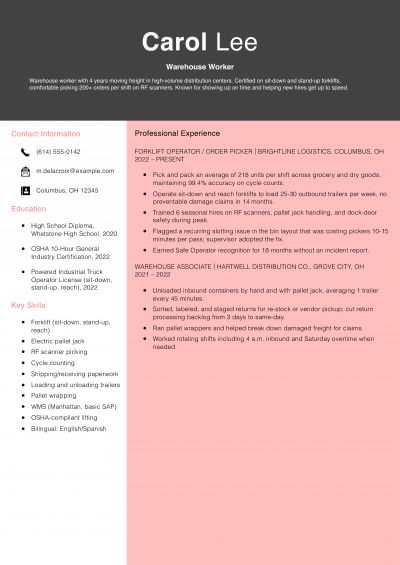
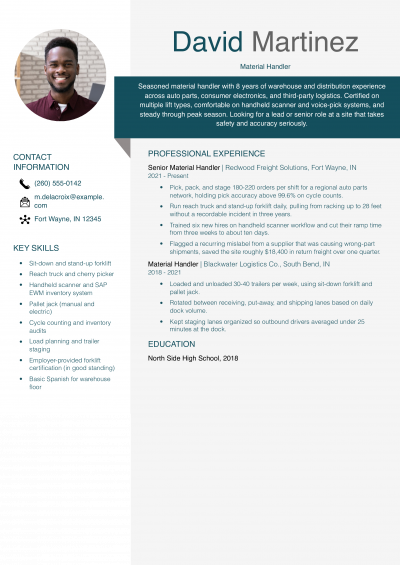
Warehouse Worker Resume Examples
Add a single line a shift lead cannot find on your OSHA card or forklift cert. That might be cold-storage experience or a hazmat endorsement. Other strong differentiators: SAP EWM or Manhattan WMS time on…
Every resume example is written and reviewed by our team of Certified Professional Resume Writers to ensure top-quality content and formatting.
Most package handler roles fill fast, often in a single round. Hub supervisors and warehouse operations managers screen for proof you can move volume safely. Your sort rate, load accuracy, and scan compliance numbers matter more than a long work history.
List your pieces per hour and your error rate from the last peak season. If you hold a Powered Industrial Truck (Forklift) Operator Certification, put it near the top. The examples below show how to build a package handler resume around the metrics that count. To compare layouts before you start, browse our resume templates.
Documented scan accuracy rates, forklift certification status and volume-per-hour metrics are what separate the Package Handler resumes that hub supervisors schedule for interviews from the rest.
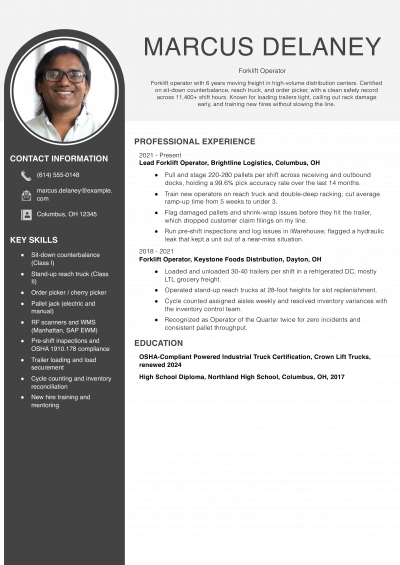
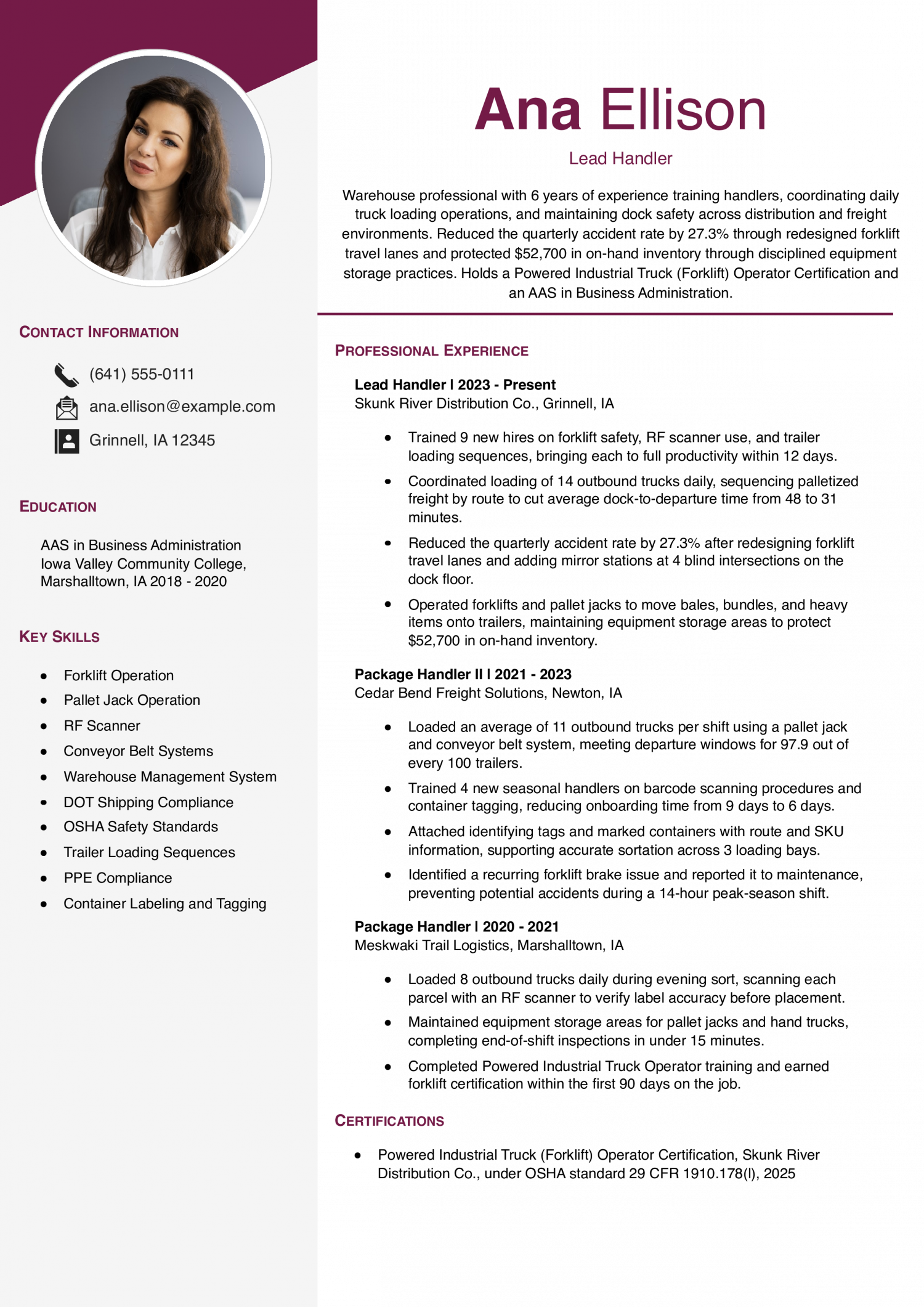
Pick this resume if you are a mid-level lead handler ready to show how dock floor leadership translates into safer, faster operations. Compare how each safety improvement names the physical change that caused the metric to move.
Redesigned forklift lanes and new mirror stations at blind intersections are physical fixes a dock manager can picture. Those changes explain the accident-rate drop far better than a bare percentage. Name the countermeasure behind any safety result you list.
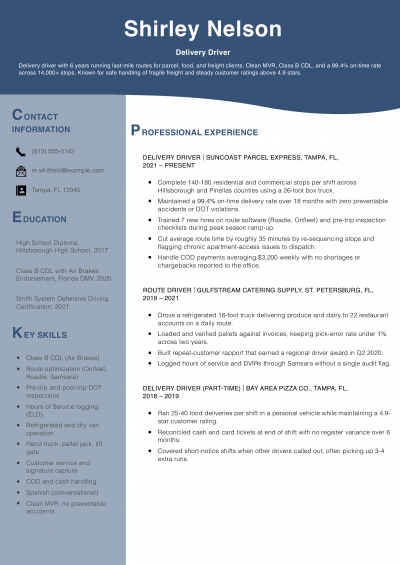
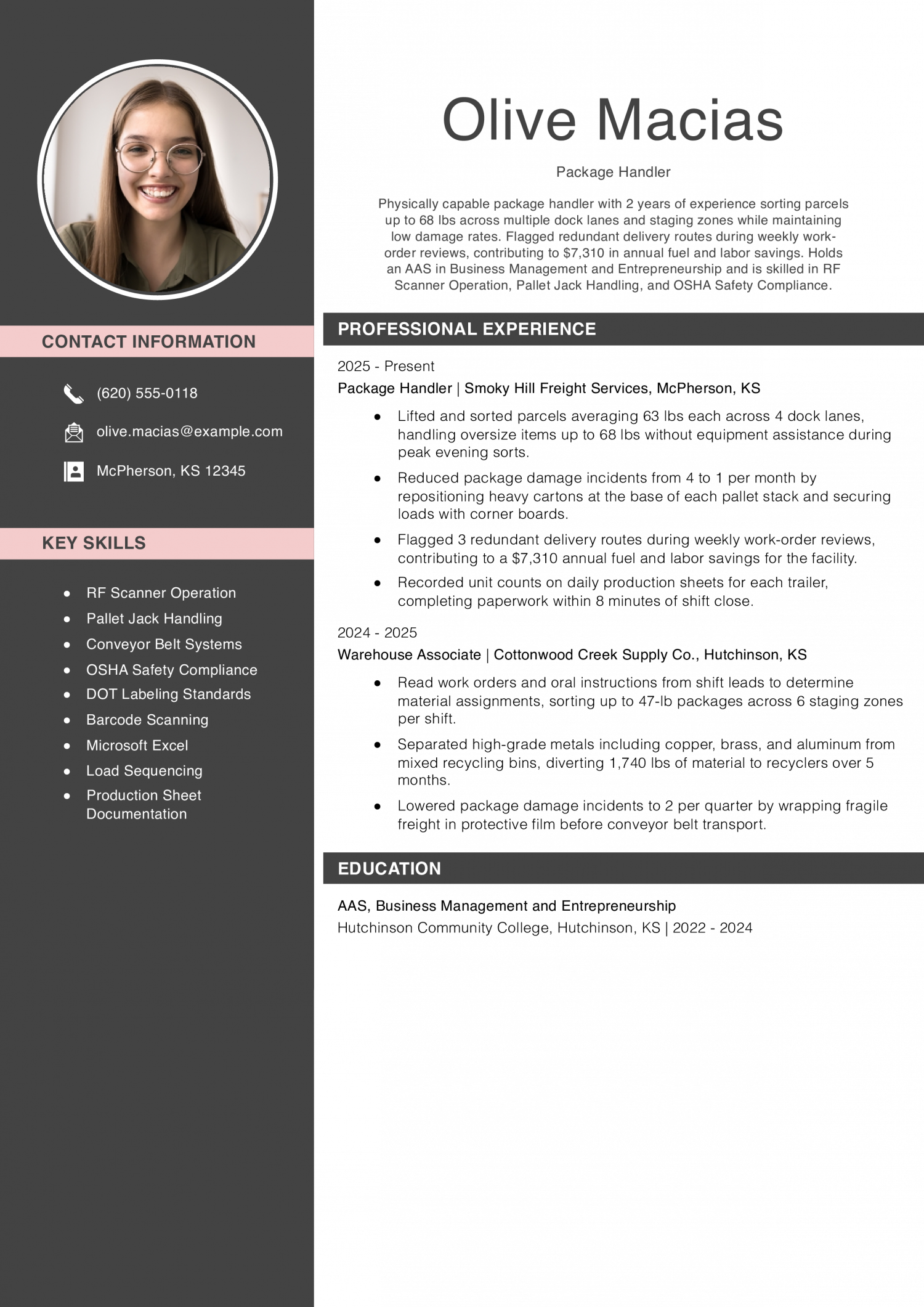
Start with this resume if you are an entry-level package handler building your first dock and warehouse experience. Emphasize how each improvement you made links a specific method to a measurable cost or damage reduction.
A set number of minutes for shift-close paperwork shows the next crew will not wait. A shift supervisor reading that time limit knows the handoff stays clean. Attach a time cap to any end-of-shift admin you handle so the turnaround is visible.
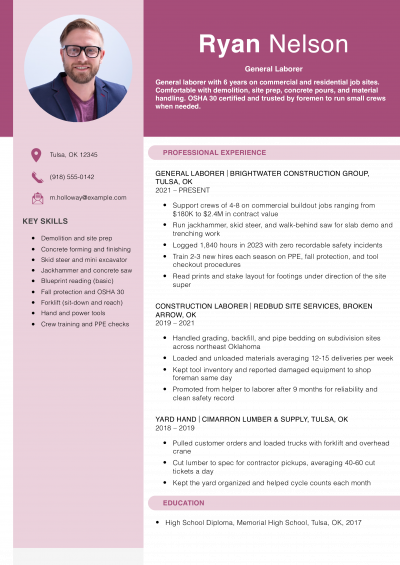
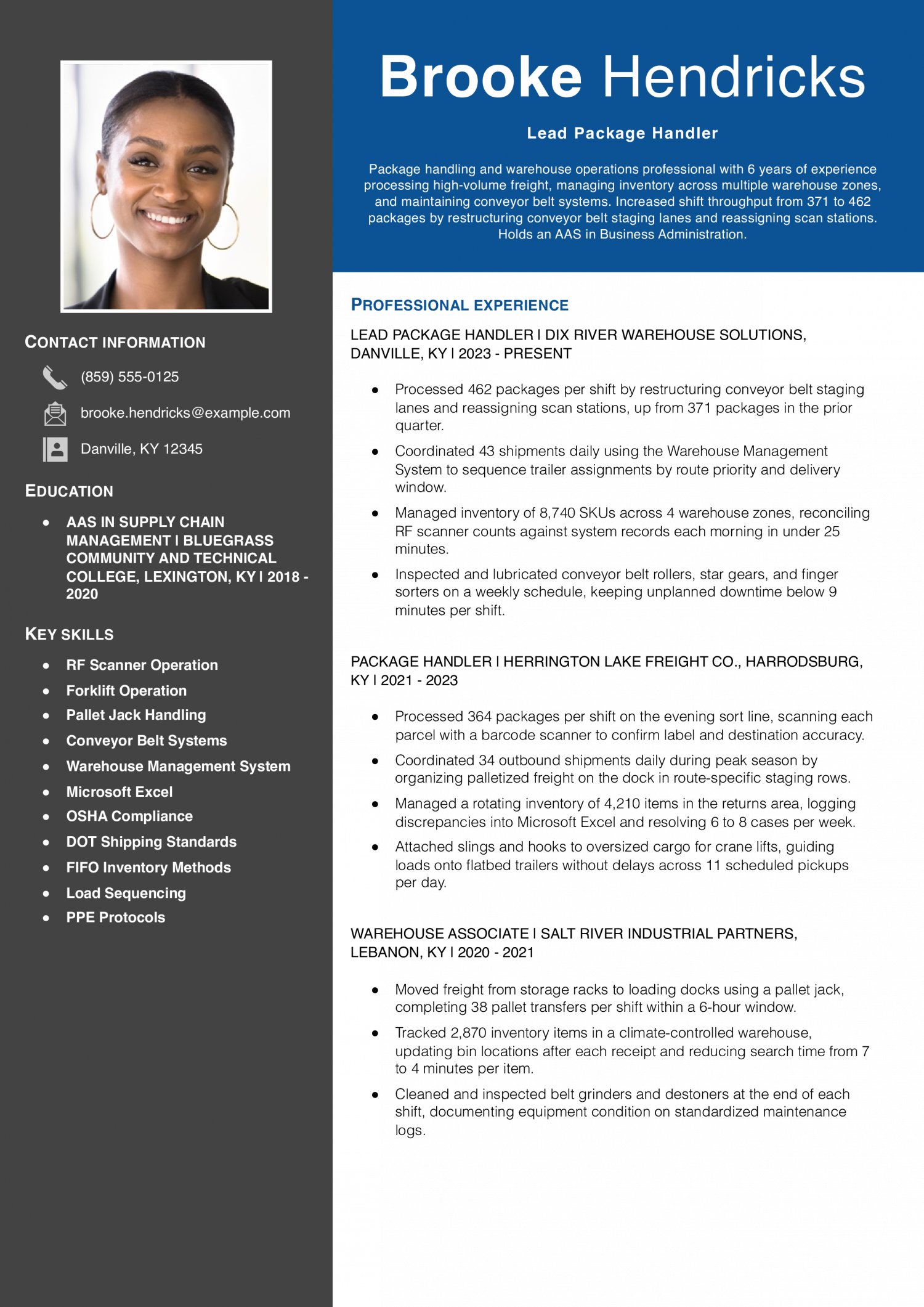
Try this layout if you are a mid-level package handler with lead experience across multiple warehouse environments. Fill each bullet with a specific before-and-after count so readers can measure your operational improvement.
Scanner counts were checked against system records each morning within a set time. Naming the tool, the comparison source, and the minutes it took shows the count is a real audit. Pair your own counting tool with a time limit and a comparison step.
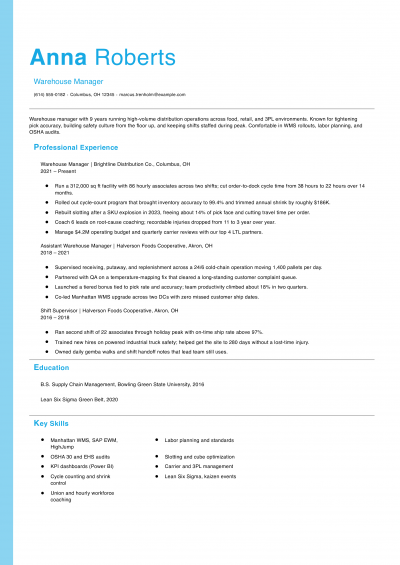
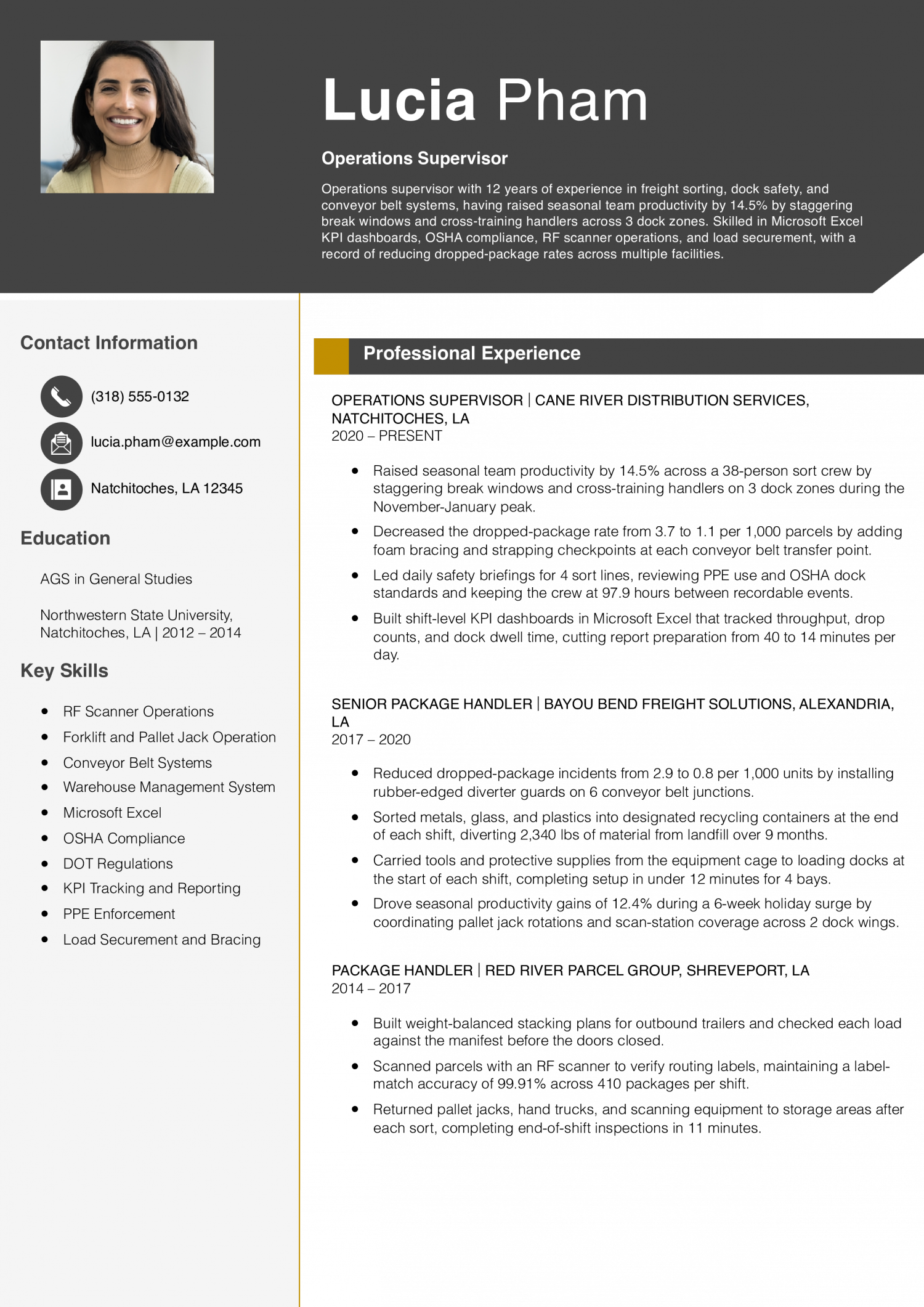
Lean on this resume if you are a senior-level operations supervisor ready to show a decade-plus record of warehouse leadership. Fold each productivity gain into the method behind it, the way this resume does with break windows and cross-training.
Break windows staggered by zone and cross-training across dock sections during peak season explain where the productivity gain came from. A distribution manager can see the plan, not a lucky stretch. Write the scheduling or staffing change behind any throughput improvement you claim.
Freight and warehouse material handler with 6 years of experience in load sequencing, RF scanner operation, and OSHA dock safety standards. Introduced a dual-scan verification step that reduced misload errors by 14.4% across 3 loading bays and recorded 1 workplace safety incident in 22 months on a crew of 9, contributing to a $5,480 reduction in annual workers’ compensation costs.
Lead your summary with a count. Hub supervisors and warehouse operations managers want to know your daily throughput. A line like “Package handler who scans and sorts 1,200 parcels per shift” tells them your pace right away.
Do not open with “hardworking team player” or a vague scope line. Name the pieces per hour or packages per shift you handled most recently. Add the carrier or hub size if you can.
A mid-size UPS hub and a FedEx Ground terminal run at different speeds. Stating the scale shows you grasp the pace your next facility requires. This single detail sets you apart from resumes that list only job titles and dates.
Most strong package handler resumes tie each bullet to a count. Start with packages scanned per hour or pieces loaded per trailer. Then note your mis-sort or damage rate.
A bullet like “Maintained a 99.6% scan accuracy rate across 800 parcels per shift” reads far stronger than “Scanned packages accurately.” A line with no count attached tends to read as a task, not an output. If your facility tracked load quality scores, include the percentage. You can also note the weight range you handled, such as parcels up to 70 pounds.
Hub supervisors and warehouse operations managers scan for these figures first. They reveal whether you can keep up during peak season surges.
Break your experience into areas that match warehouse workflow. The first group is inbound processing: unloading trailers, scanning barcodes, and sorting by zip code. The second is outbound loading, where you build walls inside trailers and stage pallets.
A third group covers safety and housekeeping. List tasks like clearing conveyor jams and reporting belt damage. If you operated pallet jacks or powered equipment, put that in a fourth group.
A fifth group can cover team coordination, such as training new hires or calling out irregular packages. Each group should have two to four bullet points so the section stays tight. This structure helps hub supervisors and warehouse operations managers see where you fit in their operation without reading a long block of text.
If you hold a Powered Industrial Truck (Forklift) Operator Certification, list it in a credentials block near the top of page one. Hub supervisors and warehouse operations managers need to see it early. The employer must certify that you completed the required training and evaluation. List the training and evaluation dates and the evaluator.
Note the employer that issued it and the year you earned it. Many facilities will re-certify you on site, but showing prior training signals lower onboarding time. Below the credential, list equipment you have used, such as sit-down forklifts and electric pallet jacks.
Also note any warehouse tools you know, like RF scanners or package tracking systems.
A high school diploma or GED is the typical minimum for package handler roles. List it at the bottom of your resume with the school name and year. If you have college coursework, include it even without a degree.
Add any safety training you completed, such as hazmat awareness or lockout-tagout procedures. CPR and first aid classes also belong here. Warehouse employers sometimes require a DOT physical, so note a current one if you have it.
Keep this section short, around three to five lines. Your work experience and throughput numbers carry more weight. This closing block rounds out the resume and confirms you meet the baseline requirements most facilities post.
Hub supervisors and warehouse operations managers scan hundreds of package handler resumes each month. They shortlist the ones that name clear skills and output numbers. Hard skills like load scanning and pallet building show you can keep freight moving on schedule.
Soft skills carry weight too. Hub supervisors and warehouse operations managers want proof you work well on a fast team. Reliability matters because missed shifts slow an entire sort line.
Stamina signals you can handle long hours on your feet. Compare each table to the posting you plan to target. Pull exact words from the job ad into your skills list.
Then back each soft skill with a bullet that shows it in action. A teamwork claim is stronger when tied to a measurable result. Use these tables as a starting checklist, not a final list.
| Soft Skills | AI-estimated % |
|---|---|
| Physical stamina | 77% |
| Team coordination | 62% |
| Time management | 49% |
| Attention to detail | 39% |
| Dependability under pressure | 32% |
And here are the top hard skills showing up most often.
| Hard Skills | AI-estimated % |
|---|---|
| Package sorting | 68% |
| Freight loading | 50% |
| Inventory receiving | 45% |
| Shipment scanning | 38% |
| Warehouse safety compliance | 26% |
Skill names and rankings come from an AI model grounded in U.S. Department of Labor occupation data for package handlers, not from a count of package handlers’ resumes built on ResumeTemplates.com.
Start with the safety training and credentials section.
Forklift work in a hub requires formal training. OSHA standard 29 CFR 1910.178(l) sets the rule. Your employer must ensure you are trained and evaluated, and certify you. A qualified outside trainer may conduct the training and evaluation.
Package volume peaks during nights and early mornings. Hub supervisors and warehouse operations managers staff around those windows. Stating your open shifts saves them a scheduling step.
Tip: State Your Shift Availability Early
Add a short line near the top of your resume. Name the exact shifts you can work, such as twilight or sunrise. Include weekend or holiday availability if it applies.
Hub supervisors and warehouse operations managers read this list as a map of where your work is heading. It tells them which tasks you can take on beyond the basic sort line. A forklift card, for example, signals you are ready to move freight with powered trucks.
That opens doors to load and unload roles that pay more per hour. Not every site asks for the same cards, so check each posting. List the name of each credential, the year you earned it, and the body that trained you.
The 90th-percentile earner in the broader laborers and material movers group out-earns the median by about 37 percent. That gap tells you the market pays more for volume handled and operational scope than for time on the job alone. National employment in this group is large, so competition for the higher bands is real.
These BLS figures cover all laborers and freight, stock, and material movers, hand. Package handlers are one part of that wider group. To stand out, lead your resume with daily package counts and the specific sorting systems you have operated.
| # | State | Median Annual |
|---|---|---|
| 1 | Minnesota | $46,280 |
| 2 | Washington | $46,190 |
| 3 | District of Columbia | $45,740 |
| 4 | North Dakota | $45,690 |
| 5 | Colorado | $45,370 |
| 6 | Massachusetts | $44,920 |
| 7 | Oregon | $44,750 |
| 8 | California | $44,710 |
| 9 | New York | $44,630 |
| 10 | Wisconsin | $44,610 |
| # | State | Workers | Median |
|---|---|---|---|
| 1 | California | 355,500 | $44,710 |
| 2 | Texas | 216,970 | $37,540 |
| 3 | Illinois | 195,390 | $40,550 |
| 4 | Florida | 164,400 | $38,160 |
| 5 | Georgia | 137,580 | $38,480 |
Resume Templates offers HR approved resume templates to help you create a professional resume in minutes. Choose from several template options and even pre-populate a resume from your profile.
Yes, submitting a resume gives you an advantage even when the application only asks for basic details. A resume lets you highlight your loading speed and any warehouse experience the online form cannot capture. Hub supervisors reviewing a stack of similar applications notice the person who attached one.
Lead each bullet with a verb and follow it with a number. Write something like "Sorted 1,200 parcels per shift with a 99.8% scan accuracy rate" instead of a vague duty list. Specific figures tell a warehouse operations manager what pace you can hold on the belt.
Focus on physical and operational skills that match the posting, such as pallet building and RF scanner use. Add soft skills like teamwork or time management only when you can tie them to a result. Two or three hard skills pulled straight from the job ad carry more weight than a long generic list.
One page is the standard length for most package handler applicants. Hub supervisors often review resumes between shifts, so a single concise page keeps your strongest points visible. A second page is reasonable only if you have ten or more years of logistics experience to show.
Yes, you can build a strong resume by drawing on transferable skills from retail, food service, or manual labor roles. Highlight tasks that involved lifting heavy items or meeting tight deadlines under pressure. A brief summary at the top can connect those tasks to the demands of a sorting hub.
Yes, seasonal and temporary stints show that you can ramp up during peak volume periods. List the employer, your dates, and the metrics you hit during that window. Warehouse operations managers value peak-season hires who proved they could keep pace under surge conditions.
Address the gap briefly in your summary or in a single line within your work history. If you did any physical work during that time, such as freelance moving or volunteer labor, list it with dates. Being upfront about the gap matters more than hiding it, because hub supervisors tend to ask about blank stretches.
An ATS-friendly template gives your safety training and sort-line experience their own sections. A basic template works for this role.
Package Handler Resume
4.9/5 stars with 240 reviews

Executive Resume Writer and Career Coach
Andrew Stoner is an executive career coach and resume writer with 17 years of experience as a hiring manager and operations leader at two Fortune 500 Financial Services companies, and as the career services director at two major university business schools.
© 2026 Resumetemplates.com All rights reserved.