Data Scientist Resume Examples and Templates for 2026

The first line of your summary should name a business metric you moved, not your years of modeling. Heads of data science read that line as your readiness to ship. Lead with the lift, the…
Every resume example is written and reviewed by our team of Certified Professional Resume Writers to ensure top-quality content and formatting.
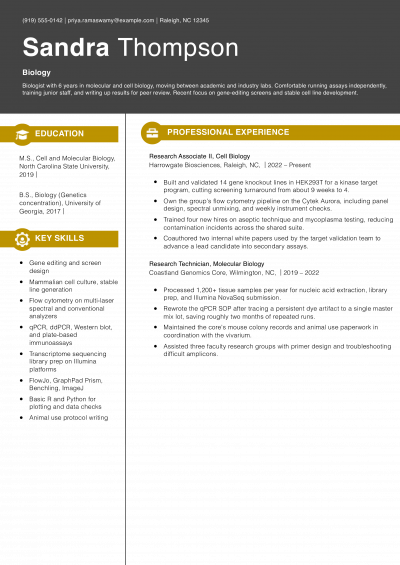
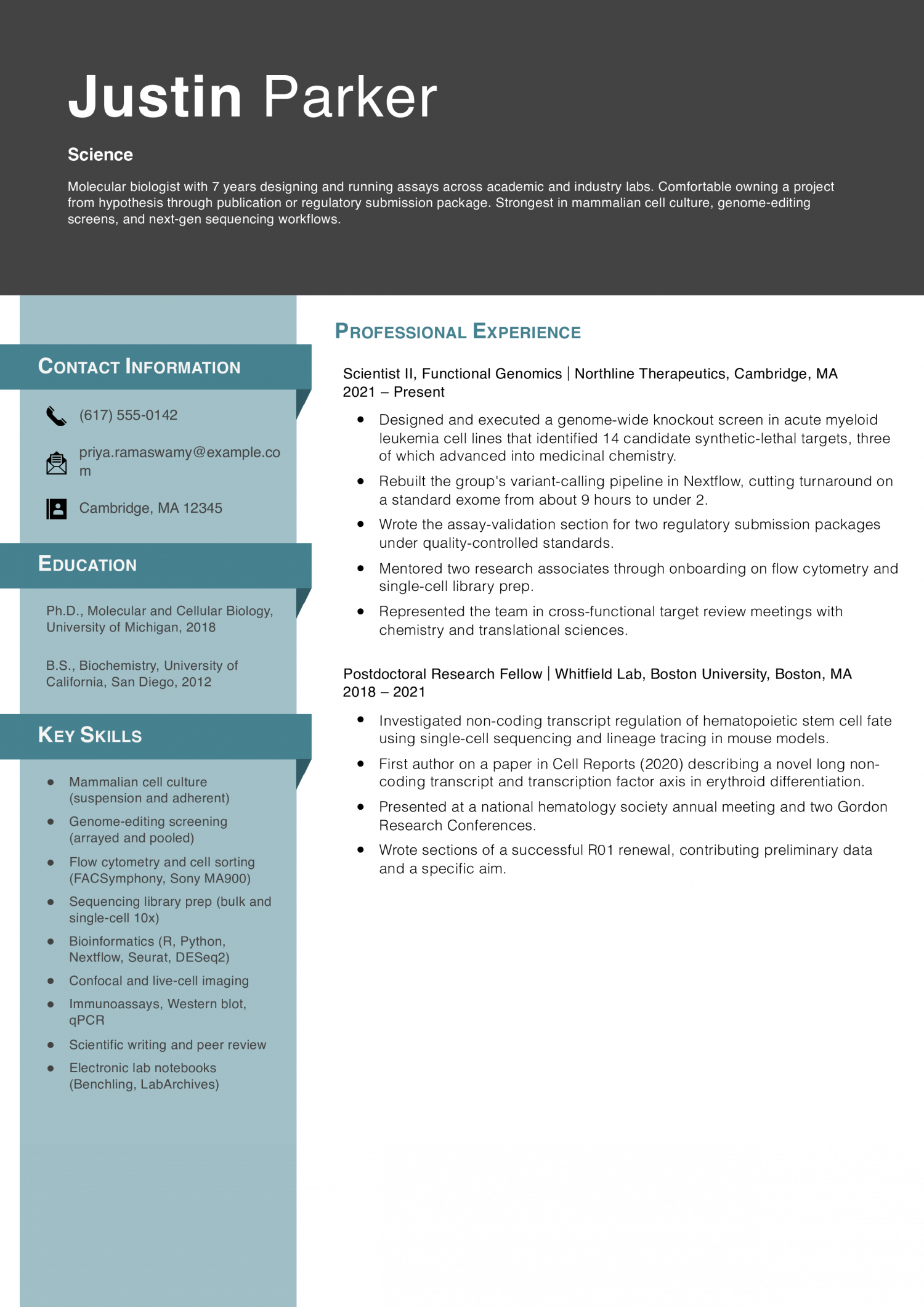
Science hiring turns on evidence you can run a project end to end, from hypothesis through published or reportable results. Your resume should show the methods you own, the instruments you run, and the systems where your data lives, whether that is Python, R, LabArchives, or GraphPad Prism.
Research directors and principal investigators read for reproducibility and ownership: grants you supported, papers you co-authored, and protocols you wrote or improved. Name the assays, the sample sizes, and the software, and tie each project to what it produced.
The examples below show how to frame bench work, field work, and computational work for different career stages and subfields.
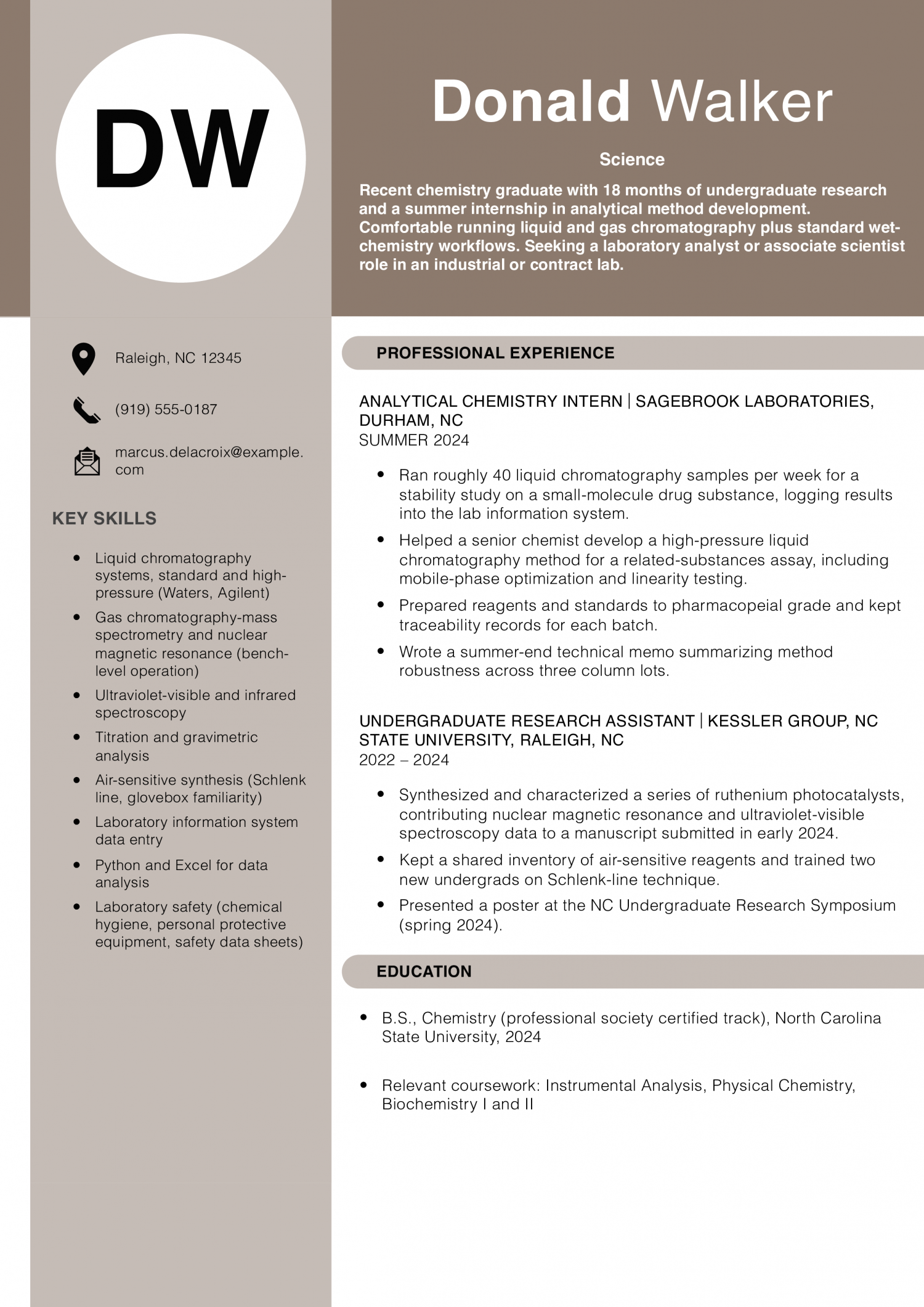
An entry level science resume belongs to a recent graduate or lab assistant with one or two research projects. It has to prove wet lab or field skills, coursework depth, and clean data handling under a supervising scientist.
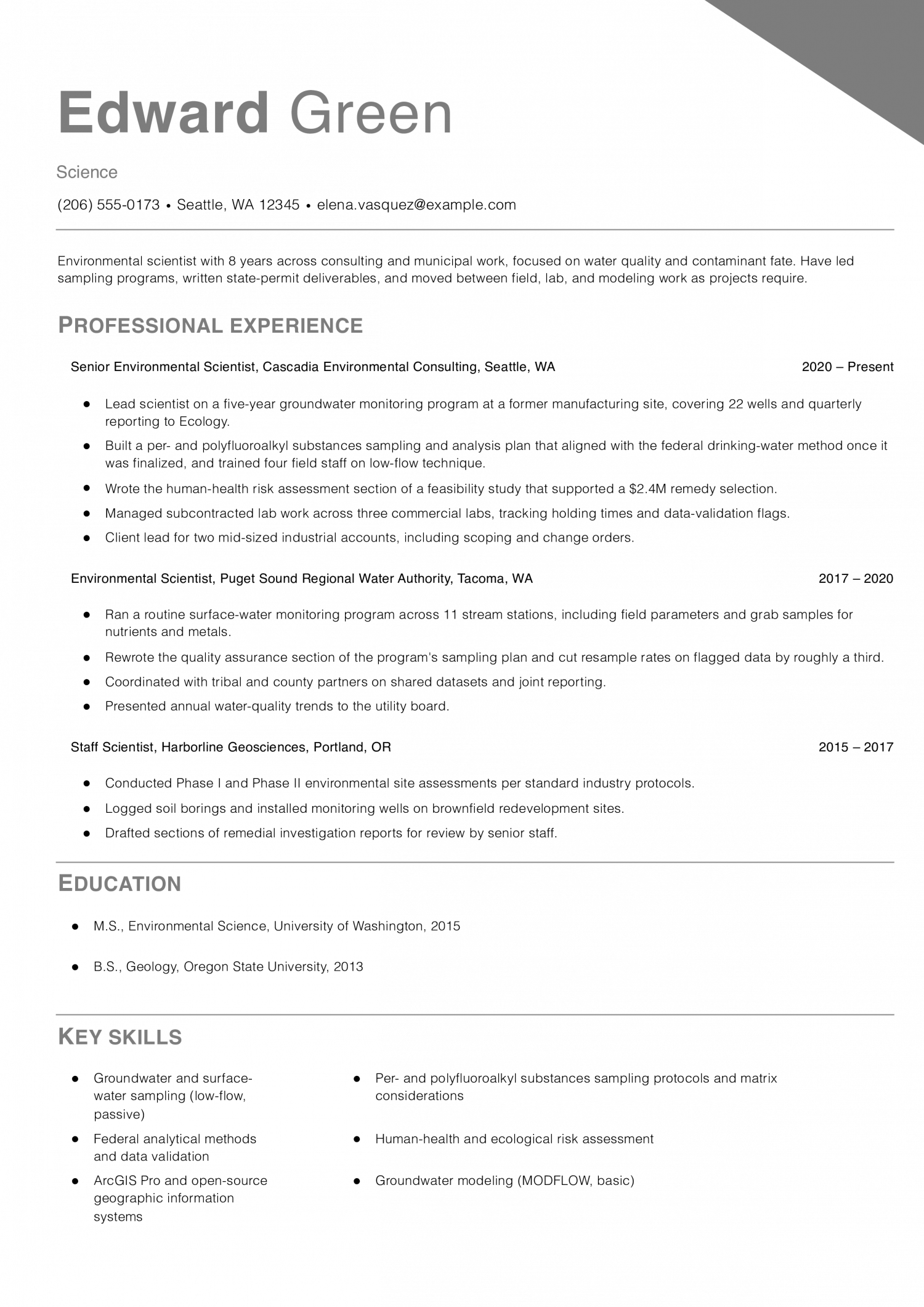
A mid career science resume covers four to eight years running experiments, drafting protocols, and mentoring junior staff. It has to prove ownership of a study line, published or presented results, and reliable collaboration with principal investigators.
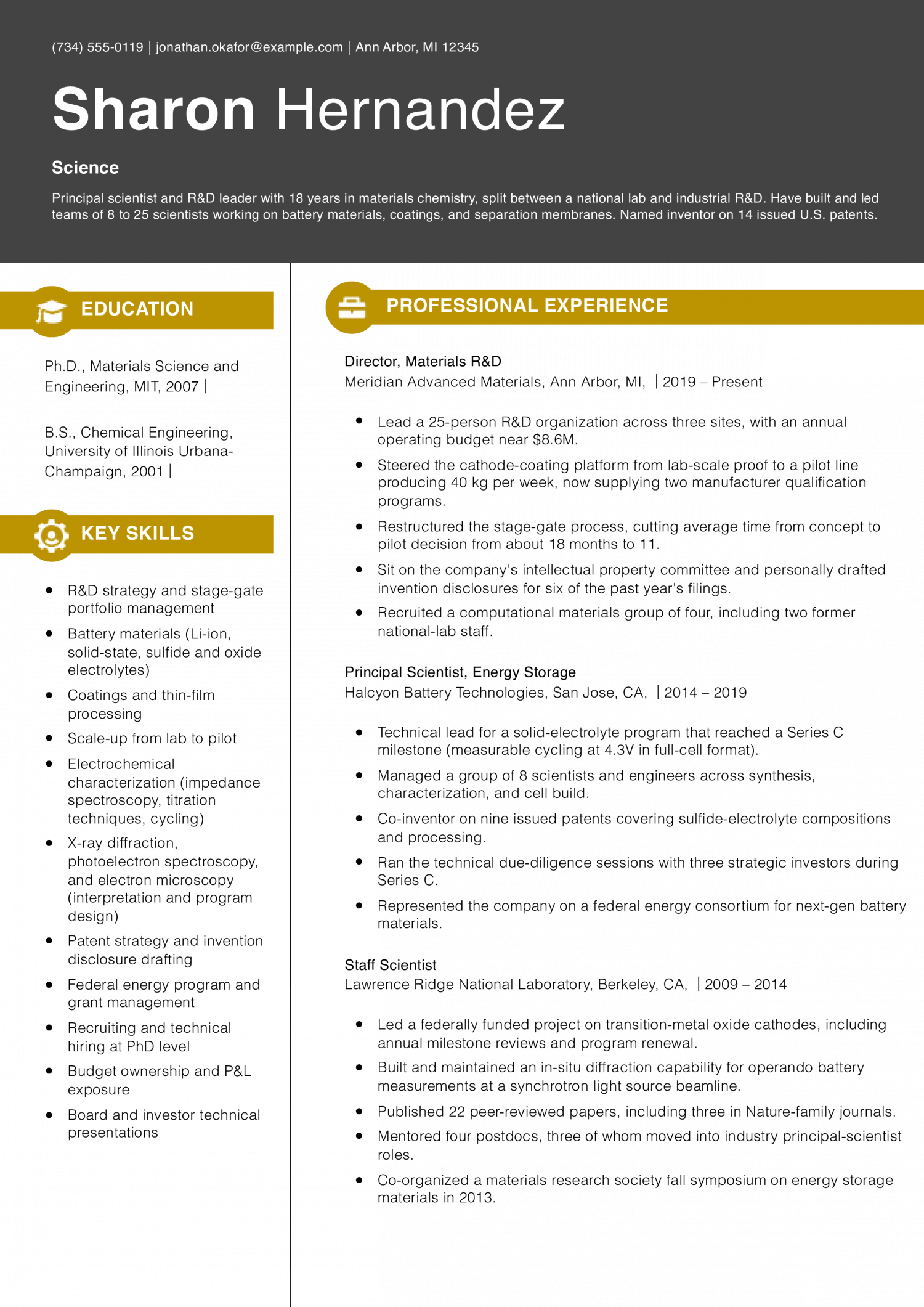
A senior science resume belongs to a staff scientist or team lead guiding several projects and budgets. It has to prove funded research, published work in peer reviewed venues, and hiring choices that shaped a productive lab.
Hana Lindqvist
Minneapolis, MN | (612) 555-0164 | [email protected] | linkedin.com/in/hana-lindqvist
Research scientist with 10 years in immunology and translational research, working across academic, biotech, and clinical settings. Comfortable owning an assay from development through validation, and equally comfortable presenting data to clinicians and to executives. Strongest in flow cytometry, cytokine multiplex assays, and clinical-sample workflows under regulated conditions.
Senior Scientist, Translational Immunology
Rivercrest Biosciences | Minneapolis, MN | 2022-Present
Scientist, Immunoassay Development
Aspen Diagnostics | St. Paul, MN | 2019-2022
Postdoctoral Fellow
Halberg Lab, University of Minnesota | Minneapolis, MN | 2016-2019
Graduate Research Assistant
Department of Microbiology and Immunology, Emory University | Atlanta, GA | 2011-2016
The first line of your summary should name a hard output, not your years at the bench. Lead with something a principal investigator can weigh in seconds. That means grant dollars you helped secure, first-author publications, patents filed, or assays you validated end to end.
Name the technique stack and the model system in the same breath. A protein biochemist opens with kinetic assays run and targets progressed. A field ecologist opens with sites sampled and datasets published.
Research directors read the top three lines to decide if your hands match their pipeline. Skip the phrase “passionate scientist.” Give them a number and a method, and let the rest of the resume prove it.
Science hiring rewards numbers, so push for them on every bullet you can. Most strong resumes name sample throughput, assay turnaround, error rates, or reagent cost saved per run. A bullet that says “ran Western blots” reads as a duty.
A bullet that says “ran 40 Westerns weekly at 98 percent pass rate” reads as capacity. Name the scale of your screens, the size of the cohort, or the number of compounds triaged. Cite publications by count and journal tier, and grants by dollar figure and your role on the award.
Recruiters scan for volume, precision, and independence first, so put those signals near the front of each line.
Cluster your bullets into three or four buckets a reviewer can scan. Common groupings are experimental design, wet lab or field execution, data analysis, and writing or presenting. Under design, name the hypotheses you framed and the controls you chose.
Under execution, name the platforms and the throughput. Under analysis, name the software, the statistical tests, and the pipelines you built. Under communication, name posters, talks, manuscripts, and grant sections you drafted.
This structure tells a research director where you sit on the bench-to-desk spectrum. It also lets a computational lead spot the coding work fast. Avoid a wall of technique names with no context.
Pair each method with the question it answered. If your work is mostly chemistry, see our chemist resume examples for ways to present that scope.
Your degree, field, and advisor belong in a page-one education block, right under the summary. PhD candidates should list expected defense date and dissertation title. Postdocs should name the lab and the funding mechanism.
Below that, put a short technical skills block grouped by category: wet lab methods, instruments, software, and languages such as R or Python. Research directors and principal investigators scan this block to match you against an open project before they read bullets. List any biosafety, animal handling, or radiation training the posting names, since those clear you for specific rooms.
Publications and posters go in their own section with full citations. Put preprints there too, marked as such, so reviewers can find your writing.
The bottom third of a science resume carries the work that rounds out your file. List peer-reviewed papers first, then preprints, then conference posters and talks. Use a consistent citation style and bold your name in the author list.
Add a short teaching section if you have led sections, mentored undergrads, or trained rotating students. Name the course, the level, and the number of students. Include service work such as journal review, committee seats, or outreach programs you ran.
Early-career scientists should keep this section tight and leave room for a strong methods list up top. Mid-career scientists can let it grow, since a longer publication record signals independence to a principal investigator reading for a staff scientist hire.
Set the two skill tables below next to the actual research posting and see where they overlap.
Hiring leads weigh hard skills first on the screen. They want to see the assay, the platform, or the model named. Soft skills like collaboration are read later, against your bullet evidence.
Pull the two or three hard skills the posting names most often. Mirror that language in your summary and in your bullets. Use the exact phrasing from the ad, not a synonym you prefer.
Parsers match strings, so a near miss can drop you. Treat the soft skills list as a prompt for bullet evidence. Do not paste the words in a block on their own.
Show collaboration by naming the cross-functional team and the shared output. Show mentoring by naming the junior scientist and what they learned.
| Soft Skills | AI-estimated % |
|---|---|
| Problem-solving | 79% |
| Communication | 69% |
| Teamwork and collaboration | 46% |
| Critical thinking | 40% |
| Time management | 33% |
And here are the top hard skills showing up most often.
| Hard Skills | AI-estimated % |
|---|---|
| Data analysis | 72% |
| Laboratory techniques | 66% |
| Statistical software | 45% |
| Experimental design | 36% |
| Scientific writing | 35% |
Skill names and rankings come from an AI model grounded in U.S. Department of Labor occupation data for scientists, not from a count of scientists’ resumes built on ResumeTemplates.com.
The items below are what a research director checks for before moving a science resume out of the reject stack.
Research directors and principal investigators scan for terms tied to your bench work. The words below map to real subfields of science. Group your resume around the ones you have actually done. A wet lab role reads nothing like a computational post. A senior scientist listing wants program depth and staff leadership. An industry move wants tech transfer and process language. Academic roles want grants, publications and mentoring cues. Pick the two or three rows that match your track. Leave the rest off so the file stays focused. Vary the terms by employer and posting each time.
| Niche | Keywords ATS scans for |
|---|---|
| Research scientist | hypothesis design, experimental protocols, data analysis |
| Industry R&D | process development, tech transfer, quality documentation |
| Senior scientist | program leadership, grant writing, staff mentoring |
| Lab operations | assay validation, instrument calibration, SOP authoring |
| Computational science | Python modeling, statistical analysis, data visualization |
Name the model, the task, and the check you ran on the output. Say who reviewed the code, the figure, or the draft before it left your hands.
Language models draft summaries of prior work, but you still verify citations against the source papers before writing.
Copilot-style tools speed up scripting for cleaning and plots, though statistical choices still sit with you and your PI.
Models suggest layouts and captions for panels, but journal figures need your hand on scale, color, and labels.
AI catches grammar and tightens phrasing in drafts, while methods sections and claims still need human review before submission.
ChatGPT or Claude: Draft outlines, summarize prior work, and edit prose, with citation checks against source PDFs.
GitHub Copilot: Write and refactor Python or R for analysis pipelines, with unit tests and code review.
Resume Templates offers HR approved resume templates to help you create a professional resume in minutes. Choose from several template options and even pre-populate a resume from your profile.
Spell it out on the first mention as Bachelor of Science, then name the field, the school, and the year.
The short form B.S. is fine on a second reference or in tight space. Research directors read the education line to confirm the field matches the lab, so keep the major clear.
Write Master of Science in full the first time, followed by the field, the institution, and the graduation year.
M.S. is the accepted short form once the degree has already appeared on the page. Put the thesis title and advisor under the degree line when the work maps to the posting.
Add a Research Projects section under education and give each project a title, the lab, and the dates.
Write two or three lines per project naming the question, the methods you ran, and the finding. Principal investigators read this section to see whether you can frame a hypothesis and drive it to a result.
Group your skills into techniques, instruments, and software so a reviewer can scan them in one pass.
Name the actual assays, platforms, and analysis packages you have run rather than broad categories. Skip anything you cannot defend in an interview, because a research director will ask.
One page works for early-career scientists through about five years of bench experience.
Two pages are standard once you have a publication list, patents, or a mix of academic and industry roles. A separate CV holding the full publication list can travel with a two-page resume for senior roles.
List coursework only when you are within about two years of graduation and the classes match the posting.
Name four to six advanced courses under the degree, not the introductory sequence every science major takes. Drop the coursework line once you have a full-time research role or a second degree on the page.
Name the gap plainly in the experience section with a short line covering caregiving, study, or a non-lab job.
Research directors care more about recent bench readiness than about a clean timeline. Add any volunteer lab hours, online courses in R or Python, or reading groups you kept up during the gap.
To present your research methods and publication record, use a professional template. You could go with an ATS-friendly template for a science resume.
Science Resume
4.8/5 stars with 211 reviews

Executive Resume Writer and Career Coach
Andrew Stoner is an executive career coach and resume writer with 17 years of experience as a hiring manager and operations leader at two Fortune 500 Financial Services companies, and as the career services director at two major university business schools.
© 2026 Resumetemplates.com All rights reserved.